
From Sawaipura to Viksit Bharat: Inside CSIR’s Science-Led Revolution in Rural India
The Council of Scientific and Industrial Research (CSIR) has launched its ambitious SMART Village Initiative in Sawaipura, Rajasthan, as a mission-mode project directly supporting the national vision of Viksit Bharat by 2047. This science-led rural transformation model moves beyond isolated solutions by deploying an integrated package of technologies from 14 CSIR labs, carefully selected after community need assessments. The initiative holistically addresses five interconnected pillars: climate-resilient housing and infrastructure, renewable energy and water security, diversified agriculture and livelihoods, waste-to-wealth systems, and digital AI tools for health and resource management. By partnering with an NGO for implementation and designing the model for replication across six geographically diverse pilot villages, CSIR aims to create a scalable blueprint for building self-reliant, sustainable, and resilient rural communities across India.
From Sawaipura to Viksit Bharat: Inside CSIR’s Science-Led Revolution in Rural India
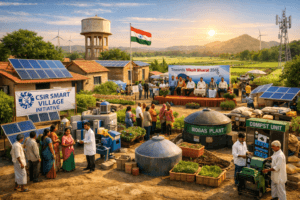
On December 20, 2025, the quiet village of Sawaipura in Rajasthan’s Pali district became the epicenter of a bold national experiment. As scientists from across India unpacked models of solar-powered water systems and cool roof tiles, villagers witnessed the first steps of a mission aiming to redefine rural life in India. The CSIR SMART Village Initiative, launched as a Mission Mode Project, represents more than a development program—it is India’s scientific community’s direct answer to building a developed nation by 2047.
The Launch: A Convergence of Science and Society
The inauguration ceremony brought together a unique assembly. Shri P. P. Chaudhary, Member of Parliament for Pali, and Dr. N. Kalaiselvi, Director General of CSIR, stood alongside local leaders, district officials, and scientists from over a dozen laboratories. This gathering symbolized the initiative’s core philosophy: a partnership between national scientific prowess and grassroots governance.
What sets this project apart is its genesis in listening. Before deploying any technology, scientists from 14 distinct CSIR laboratories fanned out across Sawaipura to conduct a comprehensive need assessment. They spoke with farmers, members of the Mahila Mandal, and panchayat officials to understand daily challenges, livelihood patterns, and local aspirations. This community-first diagnostic approach ensures that solutions are not imposed but co-created, addressing real problems like water scarcity, inadequate housing, and agricultural productivity.
The Five Pillars of Technological Transformation
The exhibition at the launch was a microcosm of the planned intervention, showcasing integrated technologies designed to work in synergy. These can be distilled into five key pillars:
| Technological Pillar | Key Solutions Showcased | Primary Objective |
| Housing & Infrastructure | Cool roof tech, low-cost housing systems, rural road materials | Enhance comfort, reduce energy use, and improve connectivity |
| Water & Energy Security | Solar-assisted systems, wastewater treatment, safe drinking water tech | Provide clean, reliable and sustainable water and power |
| Agriculture & Livelihood | Aromatic/medicinal crops, beekeeping, millet value-addition, smart machinery | Diversify income, increase farm productivity and profitability |
| Waste to Wealth | Solid waste management, biodegradable products, biogas, composting | Clean the environment and create new resources from waste |
| Digital & AI Enablement | Smart energy mgmt., health monitoring, milk quality analysis, groundwater tools | Bring precision, efficiency and data-driven decision making |
The integration across these pillars is critical. For instance, a solar-assisted system can power a water purification unit, providing clean drinking water. The organic waste from the village can then be converted into biogas for cooking, while the slurry becomes compost for fields growing medicinal plants. This circular model is the blueprint for creating a self-reliant ecosystem.
A Model with a National Blueprint
Sawaipura is the launchpad, but it is not the sole focus. The mission is designed as a replicable model, with six villages selected from geographically diverse regions including Ladakh, Assam, Gujarat, Madhya Pradesh, and Odisha. This deliberate diversity is strategic. Solutions perfected in the arid climate of Rajasthan will differ from those for Assam’s humid plains or Ladakh’s cold desert. The goal is to develop a portfolio of localized models that can be adapted across India’s varied rural landscape.
The initiative aligns with a broader push for science-led development under the Viksit Bharat 2047 vision. It complements other major CSIR partnerships, such as a recent MoU with the National Industrial Corridor Development Corporation (NICDC) to drive innovation in industrial corridors. This dual focus—nurturing self-reliant villages and high-tech industrial zones—reveals a holistic national strategy: strengthening India’s rural foundation while building its industrial future.
Beyond Technology: Partnerships and Community Agency
Technology alone is insufficient. The initiative’s success hinges on effective implementation and sustained community ownership. Recognizing this, CSIR signed an MoU with Bal Raksha Bharat, a well-established non-governmental organization, to act as the on-ground implementation partner. This partnership bridges the gap between laboratory innovation and field reality, ensuring continuous local engagement and support.
The approach mirrors successful global models like the Climate-Smart Villages (CSV) pioneered by CGIAR research programs. In CSV projects from Kenya to Bihar, the most sustainable outcomes arose from participatory processes where communities chose their preferred technologies. For example, in Kenya, this led to the rise of women-owned tree nurseries, boosting both ecology and income. Similarly, in Sawaipura, the active dialogue between villagers and scientists on launch day is a promising start for fostering this essential sense of agency.
Navigating the Road Ahead: Challenges and Expectations
The vision is compelling, but the path forward is paved with challenges familiar to rural development projects:
- Sustaining Engagement: Moving from a high-energy launch to the slow, hard work of daily implementation requires maintaining momentum.
- Inter-Institutional Coordination: Harmonizing the work of 14 different laboratories, an NGO partner, and multiple layers of government demands exceptional project management.
- Financial Sustainability: Ensuring the community can maintain and afford to operate these technologies long after the initial project support ends is crucial for true self-reliance.
The Nodal Coordinator, Dr. Kishor S. Kulkarni of CSIR-CBRI, and his team face the task of turning this ambitious blueprint into tangible change. Their success will be measured not by the technologies installed, but by their lasting impact on the quality of life, economic resilience, and environmental sustainability of Sawaipura.
Conclusion: A Laboratory for the Nation’s Future
The CSIR SMART Village Initiative marks a paradigm shift. It moves beyond traditional rural development by deploying a concerted, multi-disciplinary scientific arsenal to address interconnected village challenges. By treating Sawaipura as a living laboratory, CSIR is doing more than transforming one village—it is testing a scalable, science-powered framework for rural revitalization.
As Rajasthan’s sun beats down on Sawaipura’s new cool roofs and powers its solar pumps, this village begins its journey toward becoming a beacon. Its real product will be knowledge: a proven, adaptable model for building villages that are not just smart, but also resilient, prosperous, and fully equipped to contribute to a Viksit Bharat.
You must be logged in to post a comment.