
From Prison to Recovery: A Palestinian-American Teen’s Nine-Month Ordeal and Unanswered Questions
Mohammed Ibrahim, a 16-year-old Palestinian American from Florida, was released on Thanksgiving after being held for nine months in Israeli prisons without trial, following his arrest in a pre-dawn raid in the West Bank on accusations of throwing rocks—a charge he and his family deny.
During his detention, which included time at Megiddo and Ofer prisons, he reported severe abuse, including beatings, starvation, and coerced confession, and witnessed the death of a fellow teenage detainee; his release, secured after advocacy from his family, CAIR, and U.S. lawmakers, was overshadowed by the news that his cousin had been killed by Israeli settlers while Mohammed was imprisoned, highlighting broader concerns about the treatment of Palestinian minors in detention and the protection of dual citizens.
From Prison to Recovery: A Palestinian-American Teen’s Nine-Month Ordeal and Unanswered Questions
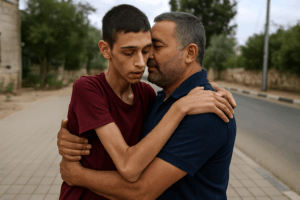
Mohammed Ibrahim’s first embrace with his father after more than nine months of detention was captured in a shaky cellphone video on a West Bank sidewalk. For his father, Zaher, the moment they had dreamed of felt surreal. “It was like from hell to heaven, that second,” he later described. As he hugged his son, a stark reality set in through touch: “You can feel his body, his back. He’s very, very skinny”.
This Thanksgiving reunion marked the end of a harrowing journey for the 16-year-old Palestinian-American from Florida, but the beginning of a long recovery—and a brewing confrontation over the treatment of minors in Israeli military detention.
The Night Everything Changed
Mohammed was just 15 years old and visiting family in the West Bank town of al-Mazra’a ash-Sharqiya when Israeli soldiers entered his home in the pre-dawn hours of February 16, 2025. According to his family, about two dozen armed soldiers conducted the raid, blindfolding and handcuffing the teenager before taking him away. The alleged offense: throwing stones at Israeli settlers’ vehicles—a charge both Mohammed and his family consistently denied.
The arrest occurred against the backdrop of heightened tensions in the West Bank. Since the start of the Israel-Hamas war in October 2023, the Israeli military has conducted regular arrest raids in the territory, detaining unprecedented numbers of Palestinians. While Israel states these operations aim to root out militancy, human rights groups note that civilians, including teenagers, have been caught in these sweeps.
A Timeline of Mohammed Ibrahim’s Detention and Release
timeline
title The Detention and Release of Mohammed Ibrahim
section 2025
February : 15-year-old Mohammed arrested<br>in pre-dawn raid in West Bank
Initial detention at<br>Megiddo Prison begins
March : Palestinian teen Walid Khalid dies<br>in custody at Ofer Prison
April : Family & advocates begin<br>public campaign for release
July : Mohammed’s cousin, Sayfollah Musallet,<br>killed by Israeli settlers
September : U.S. Embassy visits Mohammed,<br>reports concerning health decline
October : 27 U.S. lawmakers sign letter<br>urging pressure for release
November : Released on Thanksgiving<br>after 9.5 months in detention
Requires immediate<br>hospitalization upon release
“A Network of Torture Camps”: Conditions Behind Bars
Mohammed’s account of his detention, detailed in an affidavit provided by his lawyer and through family statements, paints a grim picture of the Israeli prison system. He described being beaten with rifle butts during his arrest and threatened by masked interrogators who he said coerced him into a false confession. “Out of sheer fear, I ultimately confessed,” the affidavit quotes him as saying.
The teenager was initially held at Megiddo Prison before being transferred to Ofer Prison, located north of Jerusalem. Both facilities have drawn criticism from human rights organizations. According to reports, conditions included:
- Meager food rations: Breakfast and lunch provided but no dinner, with no fresh fruit
- Inadequate medical care: Despite outbreaks of scabies and stomach viruses
- Overcrowding: Some prisoners slept on mattresses on the floor
Mohammed’s health deteriorated significantly during his detention. By August, his family reported he had lost about a quarter of his body weight and had been diagnosed with scabies. When U.S. Embassy officials visited him weeks before his release, they reported to his father that “he’s not doing good at all” and that they “feared for his life”.
Perhaps most traumatic was witnessing the death of a fellow detainee. Mohammed told his father he saw 17-year-old Walid Khalid—who had been arrested on similar stone-throwing accusations—collapse and die in their cell after being denied medical attention for scabies and a severe stomach virus.
The Push for Freedom
The campaign for Mohammed’s release gained momentum over the summer, drawing support from dozens of human rights and faith organizations. Notably, 27 Democratic members of Congress signed a letter in October urging Secretary of State Marco Rubio to pressure the Israeli government for the teen’s release.
The congressional letter highlighted their “grave concern regarding the detention without trial of Mohammed Zaher Ibrahim” and noted he was “a U.S. citizen from Florida who was reportedly blindfolded, handcuffed, and arrested”. This political pressure, combined with concerning reports about his declining health, appears to have been instrumental in securing his release.
The U.S. State Department welcomed the news of Mohammed’s release, stating that “the Trump Administration has no higher priority than the safety and security of US citizens”. However, Mohammed’s father expressed frustration with the timeline, suggesting that with greater pressure from the beginning, his son might have been released sooner.
A Family’s Dual Tragedy
Mohammed’s release was bittersweet. Shortly after being freed, he learned that his 20-year-old cousin, Sayfollah Musallet—also a Palestinian-American from Florida—had been beaten to death by Israeli settlers in July while Mohammed was in prison. The two had worked together at the family’s ice cream shop in Tampa.
The news was devastating. “He got the news. It was like—it was very hard. We had to stop the car. He couldn’t breathe,” Zaher Ibrahim recounted. The family had to put water on Mohammed’s face to help him recover from the shock.
This dual tragedy highlights the precarious situation facing Palestinian-Americans in the West Bank. As Zaher Ibrahim described: “You could be in your own house or a neighbor’s house in the village and you cannot be safe because you don’t know who’s going to come at night and attack your house or your family or your car”.
The Broader Context: Palestinian Child Detainees
Mohammed’s case is not isolated. According to the Israeli Prison Service, there are approximately 350 Palestinian child security detainees being held in Israeli jails. Human rights organizations and the United Nations have documented that many are held without charge and some have suffered abuse and torture.
The legal framework underpinning these detentions is complex. Israeli military courts in the West Bank operate under a different legal system than civilian courts in Israel proper. Stone-throwing is considered a serious offense under Israeli law, carrying sentences of up to 20 years.
Conditions Reported by Mohammed Ibrahim vs. Standard Prison Norms
| Condition Aspect | Mohammed’s Reported Experience | Standard International Norms for Juvenile Detention |
| Nutrition | Meager rations; breakfast and lunch only; no dinner or fresh fruit | Adequate, nutritious meals to support health and development |
| Medical Care | Denied treatment for scabies and stomach viruses; witnessed cellmate die after being denied care | Immediate access to medical treatment and regular health checks |
| Family Contact | No visits or phone calls with family for entire 9.5-month detention | Regular contact with family members recognized as essential right |
| Legal Process | Held without trial or formal charges for entire detention period | Prompt access to legal representation and timely judicial review |
| Interrogation | Threatened with further beatings to coerce confession | Prohibition of coercion, intimidation, or threats during questioning |
A Call for Accountability and Change
The Council on American-Islamic Relations (CAIR), which advocated for Mohammed throughout his detention, called his release “a turning point.” In a statement, CAIR-Florida asserted: “The U.S. cannot continue providing unchecked support to a government that tortures American children”.
Mohammed’s uncle, Zeyad Kadur, posed a poignant question that echoes beyond this single case: “I have to ask… if his name wasn’t Mohammed, if he wasn’t Palestinian-American, would he still be there?”
This case raises significant questions about consular protection for dual citizens and whether American citizenship provides equal protection regardless of ethnic or religious background. It also highlights the challenges facing Palestinian families divided between the United States and the West Bank, who must navigate different legal systems and power dynamics.
What Comes Next for Mohammed
For now, Mohammed’s family is focused on his recovery. He was taken directly to a hospital after his release for intravenous fluids and treatment. His immediate needs are physical—regaining the substantial weight he lost—and psychological, processing the trauma of his detention and the loss of his cousin.
Longer term, his father hopes to return with Mohammed to Florida, where the teenager can “catch up on studying, get his driver’s license, get his part-time job, start his life”. But the experience has undoubtedly altered the trajectory of this young life.
The broader implications of Mohammed’s case continue to unfold. Human rights organizations are calling for investigations into the treatment he reported, while advocates point to his experience as emblematic of systemic issues within Israel’s military detention system for Palestinian minors.
As Mohammed begins his recovery at home, his case remains a powerful reminder of the complex realities facing Palestinian-American families and the ongoing tensions in the West Bank—where the personal and political are inextricably intertwined, and where the simple act of visiting family can lead to a nightmare that lasts nearly a year.
You must be logged in to post a comment.