
From Pilgrim Trash to Forest Treasure: How Tamil Nadu’s Sacred Plastic Waste Became Office Furniture
A Tamil Nadu-based clean-tech startup, Recompose Recycling, has partnered with the state’s Forest Department to tackle the difficult problem of multi-layered plastic (MLP) waste generated by pilgrims on the sacred Vellingiri Hills. By collecting the discarded snack wrappers and packaging along the trekking route, the company processes this hard-to-recycle material into durable sheets and blocks, which are then fabricated into furniture like almirahs, tables, and sofas for use in local forest offices. This initiative creates a visible, closed-loop system where the waste from the hills is transformed into valuable, long-lasting assets for the very people who protect the landscape, demonstrating a practical model for managing pilgrimage waste that extends beyond Vellingiri to projects like building a village bus shelter from collected plastics.
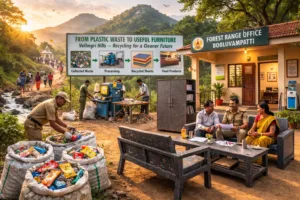
From Pilgrim Trash to Forest Treasure: How Tamil Nadu’s Sacred Plastic Waste Became Office Furniture
The mist hadn’t yet lifted from the Vellingiri Hills when S. Manickam began his morning patrol. For seventeen years, he’s walked these slopes as a forest guard, watching seasons change and pilgrims come and go. But this February morning felt different. He stopped outside the Booluvampatti Forest Range Office and ran his hand along the smooth surface of a brand-new almirah.
He knew exactly where that almirah came from.
“I collected some of this plastic myself,” he said, tapping the cupboard door. “Last year during the peak season, I must have filled at least forty bags from just my section of the trail. Now look at it. Sitting in our office, useful again.”
This is the story of how one of South India’s most sacred pilgrimage sites became an unlikely laboratory for solving one of recycling’s toughest challenges—and how the plastic waste carried up a mountain by devotees is now coming back down as furniture for the very people who protect that mountain.
The Mountain That Calls Thousands
The Vellingiri Hills rise sharply from the plains of Coimbatore district, their slopes wrapped in dense forest that gives way to rocky outcrops near the summit. Local communities call this range the ‘Kailash of the South,’ and for generations, pilgrims have undertaken the demanding trek as an act of devotion.
The journey is not for the faint-hearted. The trail winds through steep terrain, and even fit pilgrims need several hours to reach the top. Most begin before dawn, carrying what they’ll need for the day: food packets, water bottles, snacks to sustain energy, and offerings wrapped in whatever packaging is available.
By afternoon, the pilgrims begin their descent. By evening, forest staff and volunteers begin theirs—bent over the trail, collecting what the day’s devotion left behind.
“We never blamed the pilgrims,” Manickam said carefully. “They come with faith in their hearts. They’re thinking about the deity, not about waste management. But the plastic stays.”
For years, the accumulation felt inevitable. Each pilgrimage season brought more visitors, and each visitor brought more multi-layered plastic—the crinkly, silvery wrappers that hold chips, biscuits, and packaged snacks. Unlike water bottles or containers that could be sold to scrap dealers, these thin films had no market value. No one wanted to buy them. No one knew what to do with them.
The Problem Hidden in Plain Sight
Multi-layered plastic, or MLP, represents one of recycling’s most stubborn challenges. Unlike a simple plastic bottle made from a single material, MLP combines different polymers sandwiched together with aluminum or other barriers to preserve food and keep moisture out.
This engineering brilliance—the very thing that makes MLP perfect for preserving snacks—makes it nearly impossible to recycle through conventional means. The layers won’t separate. The materials won’t melt together properly. Most recycling facilities won’t touch the stuff.
India generates thousands of tons of MLP waste annually, and pilgrimage sites concentrate the problem. Devotees carry lightweight, single-serve packaging up the mountain because it’s practical. The waste comes down much harder to manage.
“The pilgrims aren’t doing anything wrong,” explained C. Prashanth of Recompose Recycling Private Limited, the Coimbatore-based clean-tech startup that eventually partnered with the forest department. “They’re using products that the entire system is designed to produce. The failure isn’t at the consumer level. It’s at the system level. We don’t have systems that know what to do with this material after its first use.”
Recompose Recycling built exactly that system—but not in a high-tech factory far from the problem. They built it at the source.
Closing the Loop on the Hillside
The partnership began simply enough. Forest officials had a growing mountain of MLP waste and no solution. Recompose Recycling had a technology for processing exactly this material and needed feedstock. The match made sense on paper, but the execution required reimagining how waste collection works at a pilgrimage site.
Rather than asking pilgrims to change their behavior—a notoriously difficult proposition—the partnership focused on what happened after pilgrims left. Forest staff already conducted clean-up operations. Now those operations became more systematic, with segregated collection of MLP materials.
The collected waste traveled down the mountain not to a landfill, but to Recompose’s facility where cleaning and processing began. The technology involved is proprietary, but the principle is straightforward: through mechanical and thermal processes, the mixed materials are transformed into a homogeneous substance that can be molded into new products.
What emerges from this process looks nothing like the crinkly wrappers that went in. It emerges as durable sheets, blocks, and planks—materials that can be fabricated into furniture, roofing, and infrastructure.
“We’re not making low-quality products that will fail quickly and become waste again,” Prashanth emphasized. “We’re making things that will last for decades. The plastic’s second life should be longer than its first.”
Furniture That Tells a Story
This February, when the forest department installed furniture made from Vellingiri Hills plastic at the Booluvampatti Forest Range Office, the gesture carried weight beyond mere functionality.
The almirah, the table, the three-seater sofa—these aren’t generic office furnishings. They’re physical evidence that circular systems can work, even for the most challenging materials. Every forest staff member who uses that furniture sees, daily, what happens when waste is treated as a resource rather than a problem.
For Manickam, the furniture represents something more personal. “When pilgrims ask me what happens to the plastic we collect, I can show them now. Not with words—with this almirah right here. They understand immediately. They see that their wrappers didn’t just disappear. They became something useful.”
This visibility matters enormously. Recycling systems often fail because the connection between individual action and systemic outcome remains invisible. You put a wrapper in a bin and never see it again. Trust that something good happened requires faith.
The Vellingiri Hills project eliminates that faith gap. The proof sits in a forest office, solid and usable, made from the very material pilgrims carried up the mountain.
Beyond Furniture: A Bus Shelter and a Model
The success at Vellingiri Hills didn’t remain isolated. As word spread, other local bodies took notice. The Kittampalayam village panchayat in Coimbatore district approached Recompose with a different challenge: a damaged bus shelter needed replacement, and the panchayat wanted to demonstrate what community-level waste management could achieve.
The numbers tell part of the story. Over nine months, the panchayat collected 1,908 kilograms of multi-layered plastic waste—the kind that normally has no recycling market. Residents learned source segregation. Organic waste was diverted to farms as compost. And the MLP portion went to Recompose for processing.
What emerged was a fully functional bus shelter, built from materials that would otherwise have languished in landfills or found their way into water bodies. Village Panchayat President V.M.C. Chandrasekar made sure the project included an educational component: residents could see, in real time, what their segregated waste was becoming.
“When people understand where their waste goes and what it becomes, segregation stops feeling like a burden and starts feeling like participation,” Chandrasekar noted after the shelter’s completion in November 2024.
The bus shelter now stands as everyday infrastructure, serving the same community that supplied the waste to build it. Commuters waiting for buses probably don’t think about the chips packets and biscuit wrappers that went into its construction. But the structure itself demonstrates something important: circular systems don’t have to be complicated to work. They just have to be complete.
The Landscape of Indian Plastic Innovation
Recompose Recycling isn’t alone in recognizing the potential locked in plastic waste. Across India, enterprises are finding ways to transform discarded materials into valuable products.
Hyderabad-based Banyan Nation has built a formal supply chain that converts discarded plastic into high-quality recycled granules for manufacturing, demonstrating that recycling can be both environmentally sound and economically viable. In Bengaluru, social enterprise PotHoleRaja uses plastic waste to repair potholes and build durable roads that resist water damage better than conventional materials.
These efforts share a common insight: the technology to recycle challenging materials already exists. The expertise to engineer durable products from waste exists. What’s often missing is the integration—the connection between waste generation points and processing facilities, between collection systems and end users.
The Vellingiri Hills project demonstrates what integration looks like at a pilgrimage site. The forest department provides collection infrastructure and storage. Recompose provides processing technology and product fabrication. And the finished products return to the forest department, closing the loop entirely within the same institutional partnership.
No long-distance transport of waste to faraway facilities. No complex logistics of selling recycled materials into distant markets. The waste stays local. The products serve local needs. The loop stays tight.
Faith and Waste: An Unlikely Convergence
There’s a certain poetry to what’s happening on Vellingiri Hills. Pilgrims ascend the mountain carrying offerings, and they leave traces of their devotion behind. Those traces, properly managed, return as furniture that serves the people who protect the mountain. The circle closes.
But poetry aside, the practical implications matter more. India’s pilgrimage sites draw enormous crowds—tens of millions of visitors annually to major destinations, with seasonal surges that overwhelm local infrastructure. Waste management at these sites has historically focused on collection and disposal, with recycling limited to materials that have clear market value.
The Vellingiri Hills model suggests a different approach. By treating MLP waste not as a problem but as a feedstock for local infrastructure, the partnership demonstrates that pilgrimage sites can become circular economy hubs rather than waste generation hotspots.
The key enablers aren’t complicated. They include:
- Segregated collection systems integrated with existing clean-up operations
- Processing technology capable of handling mixed materials
- Local end uses for recycled products that create visible feedback loops
- Institutional partnerships that align incentives across departments and private enterprises
None of these elements require breakthrough innovation. They require coordination, commitment, and the willingness to see waste differently.
What the Pilgrims See Now
This year, when pilgrims begin their pre-dawn ascent of Vellingiri Hills, they’ll still carry food packets and water bottles. They’ll still leave wrappers behind, intentionally or accidentally. Human behavior changes slowly, and pilgrimage traditions change slower still.
But something has shifted. Forest staff now have a story to tell when they collect waste—a story about almirahs and bus shelters, about plastic becoming furniture, about waste that doesn’t disappear but transforms.
Some pilgrims will hear that story and think differently about the wrappers in their bags. Others won’t. But the system no longer depends on individual behavior change. It depends on what happens after the pilgrims leave, on the collection and processing and fabrication that turns temporary packaging into permanent infrastructure.
“The mountain teaches us many things,” Manickam said, standing outside the forest office with the morning sun warming his face. “Patience. Devotion. Service. Maybe now it’s teaching us something about waste too. That nothing truly goes away. Everything becomes something else.”
He gestured toward the almirah behind him.
“Even this.”
The Road Ahead
The Vellingiri Hills project continues to evolve. Forest officials and Recompose Recycling are exploring additional products that could be fabricated from collected plastic—benches for trekking rest points, signboards for trails, markers for interpretation centers. Each new application creates additional demand for collected material, strengthening the economic case for continued segregation and processing.
The model has attracted attention from other pilgrimage sites facing similar challenges. If it scales, the approach could transform how India’s religious tourism destinations manage waste—not through high-tech solutions imported from elsewhere, but through local partnerships that connect collection to end use within the same geography.
For now, the furniture sits in a forest office, serving its purpose quietly. Forest staff file papers in the almirah. Visitors sit on the sofa during meetings. A table holds cups of tea during breaks from patrol.
None of them look particularly special. That’s the point. Recycled plastic, properly processed and fabricated, doesn’t announce its origins. It just works. It becomes ordinary infrastructure, doing ordinary jobs, day after day.
And somewhere on the slopes above, pilgrims continue their climb. The mist lifts. The trail awaits. And the plastic they carry will, in time, find its way back down—not as waste, but as something useful again.
You must be logged in to post a comment.