
From Pandemic to Powerhouse: How India’s BioE3 Policy Aims to Build a $300 Billion Biomanufacturing Hub
India’s BioE3 policy, launched in 2024, aims to build on the country’s demonstrated vaccine manufacturing prowess during the pandemic to establish a $300 billion bioeconomy by 2030 and position India as a global biomanufacturing hub.
The strategy focuses on fostering innovation in key sectors like biotherapeutics, sustainable agriculture, and bio-based materials through flagship initiatives such as creating a national network of biomanufacturing parks and biofoundries, strengthening public-private partnerships for de-risking R&D, and developing skilled talent. However, achieving this ambitious vision requires addressing significant implementation gaps, including streamlining a fragmented regulatory landscape, attracting more growth-stage risk capital for long-development-cycle biotech firms, bridging infrastructure and skill shortages beyond major metropolitan hubs, and strengthening intellectual property frameworks to build global trust and collaboration.
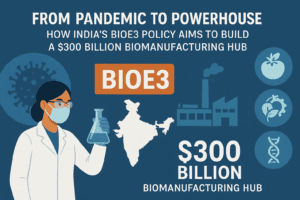
From Pandemic to Powerhouse: How India’s BioE3 Policy Aims to Build a $300 Billion Biomanufacturing Hub
Following its monumental role as the “pharmacy of the world” during the COVID-19 pandemic, India is strategically channeling that momentum into a long-term vision. The goal is to evolve from a vaccine supplier into a global innovation leader in biotechnology. At the heart of this ambition is the BioE3 policy—a comprehensive framework aiming to build a $300 billion bioeconomy by 2030 through sustainable, high-performance biomanufacturing. This initiative seeks to position India not just as a manufacturing hub, but as a co-developer and reliable global partner in cutting-edge biological solutions.
- Building on a Pandemic Foundation: India’s Biotech Coming of Age
India’s response to the COVID-19 crisis was a pivotal demonstration of its biotech capabilities. The country administered over 2.2 billion vaccine doses domestically and supplied vaccines to more than 100 nations through initiatives like Vaccine Maitri. This achievement was powered by a unique public-private partnership model, involving companies like the Serum Institute of India and Bharat Biotech, and supported by innovative government platforms like CoWIN for vaccine management.
The pandemic served as a catalyst, proving India’s capacity for large-scale, quality manufacturing and rapid innovation. It also revealed the strategic importance of resilient, geographically diversified biomanufacturing supply chains. Building on this demonstrated prowess, the government has moved to institutionalize these gains and set a more ambitious course for the future.
- The BioE3 Vision: Economy, Environment, and Employment
Officially launched in 2024, the Biotechnology for Economy, Environment and Employment (BioE3) policy is India’s first dedicated national biotechnology framework. Its name encapsulates its three-fold mission: to drive economic growth, promote environmental sustainability, and generate high-value employment.
The policy’s core objective is to transition from traditional, resource-intensive manufacturing to a regenerative, bio-based production model. It envisions a “green, clean, prosperous, and self-reliant” India, aligning with national goals like the Net Zero carbon emissions target and the ‘Lifestyle for Environment (LiFE)’ mission. To achieve this, BioE3 focuses on six strategic, high-impact sectors, as outlined below.
Table: The Six Strategic Sectors of India’s BioE3 Policy
| Thematic Sector | Primary Focus & Examples |
| Bio-based Chemicals & Enzymes | Developing sustainable alternatives to petrochemicals for industries. |
| Functional Foods & Smart Proteins | Creating nutrient-rich foods and alternative proteins for health and security. |
| Precision Biotherapeutics | Advancing targeted therapies like cell/gene therapies and mRNA vaccines. |
| Climate-Resilient Agriculture | Engineering drought-resistant crops and sustainable farming solutions. |
| Carbon Capture & Utilization | Using biological processes to capture and convert carbon into useful products. |
| Futuristic Marine & Space Research | Exploring biotechnology applications in extreme and new frontiers. |
- The Implementation Engine: Parks, Partnerships, and People
Transforming this vision into reality relies on creating a supportive ecosystem. The BioE3 strategy is being operationalized through several key mechanisms:
- Biomanufacturing Hubs and Biofoundries: A network of 21 advanced “bio-enabler” facilities has been launched across the country. These hubs, along with a national network of biofoundries, provide startups and small enterprises with shared, state-of-the-art infrastructure—such as GMP-certified labs and pilot-scale fermentation plants—that would otherwise be prohibitively expensive. This is critical for bridging the “valley of death” between lab-scale discovery and commercial production.
- Public-Private Partnerships (PPPs): Recognizing the high cost and risk of biotech innovation, BioE3 heavily promotes PPP models. Agencies like the Biotechnology Industry Research Assistance Council (BIRAC) run schemes such as the Biotechnology Ignition Grant (BIG) and the Biotechnology Industry Partnership Programme (BIPP), which provide funding, mentorship, and de-risked pathways for innovation. The World Bank-supported National Biopharma Mission is a prime example, having helped indigenous companies develop India’s first MRI scanner and biosimilar drugs.
- Talent and Youth Engagement: A skilled workforce is a major pillar of the policy. Beyond traditional skilling programs, the government has launched initiatives like the D.E.S.I.G.N. for BioE3 Challenge, which invites school students to propose biotech solutions to real-world problems. This aims to foster an innovative mindset from a young age and build a future pipeline of scientists and entrepreneurs.
- Navigating the Road Ahead: Critical Challenges and Gaps
Despite its strong foundation and ambitious plans, the successful implementation of BioE3 faces significant hurdles that stakeholders have identified:
- Infrastructure and Funding Asymmetry: While major cities have thriving bioclusters, there is a severe gap in pilot-scale and regulatory-grade infrastructure in Tier-2/3 cities and regions like Northeast India. Furthermore, although early-stage grant funding is available, there is a shortage of growth-stage risk capital for biotech ventures, which have long development cycles and high technical risk.
- Regulatory Complexity and IP Concerns: The biotech sector in India navigates a fragmented regulatory landscape involving multiple agencies, which can lead to delays and uncertainty. Concurrently, perceptions of a weak intellectual property (IP) regime can deter global partners from transferring cutting-edge technologies. Strengthening patent protection and enforcement is crucial for building trust and fostering collaboration.
- Supply Chain and Skill Dependencies: India’s biomanufacturing remains dependent on global supply chains for critical raw materials and equipment, creating vulnerability. There is also a pressing shortage of professionals skilled in niche areas like regulatory sciences, synthetic biology, and biomanufacturing process engineering, which threatens to stall innovation.
- Conclusion: A Strategic Crossroads for Global Biotech
India’s BioE3 policy represents a decisive and necessary step to capitalize on the country’s scientific talent and manufacturing strength. It moves beyond a generic growth target, framing biomanufacturing as a strategic lever for national resilience, environmental sustainability, and global leadership.
The promise is evident in early successes, from malaria vaccine production to pioneering biosimilars. However, the path to a $300 billion bioeconomy is not automatic. It requires sustained and coordinated action to address the gaps in infrastructure, regulation, financing, and skills.
If India can successfully implement this framework, it will achieve more than economic growth. It will position itself as an indispensable global partner in health security and green technology, offering scalable, affordable, and sustainable biological solutions for the world’s most pressing challenges. The journey from the pharmacy of the world to a global biomanufacturing and innovation hub is now firmly underway.
You must be logged in to post a comment.