
From Ocean Depths to Weather Forecasts: How India’s 2025 Earth Sciences Mission Delivered 50x Returns
In a landmark year for Indian science, the Ministry of Earth Sciences (MoES) demonstrated that high-end research delivers profound public benefit, achieving an unprecedented 50-fold economic return on investment in weather forecasting that supported nearly 11 million vulnerable families.
The ministry broke global records by successfully testing a deep-sea mining system at 5,270 meters and secured exclusive exploration rights to a strategic 10,000 sq km area in the Carlsberg Ridge for critical minerals. Simultaneously, it translated science into direct community impact by commissioning eco-friendly desalination plants for Lakshadweep, launching indigenous research vessels to protect India’s coastline, and augmenting supercomputing power to 21 Petaflops to fuel next-generation weather and climate services under Mission Mausam and IMD Vision 2047. Through these parallel paths of exploring oceanic extremes and safeguarding citizens, MoES cemented a model where ambitious discovery and tangible human progress advance together, building a more resilient and self-reliant India.
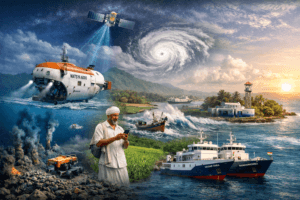
From Ocean Depths to Weather Forecasts: How India’s 2025 Earth Sciences Mission Delivered 50x Returns
In 2025, India’s Ministry of Earth Sciences (MoES) achieved something remarkable: it delivered a 50-fold economic return on the nation’s investment in weather science. For every ₹100 crore spent on advanced meteorology and supercomputing, the country reaped an estimated ₹5,000 crore in economic benefits, directly supporting nearly 11 million vulnerable families. This extraordinary figure underscores a year of profound transformation, where high-end scientific exploration was seamlessly fused with tangible, grassroots impact.
From setting a world record in deep-sea mining to securing freshwater for remote islands, the ministry’s work in 2025 wasn’t just about pushing frontiers—it was about bringing those frontiers home. This is the story of a landmark year that proved cutting-edge science can be a powerful, immediate force for national resilience and public good.
Quantifying Impact: The 50:1 Return on Weather Science
For the first time, a third-party audit put a number on the value of India’s investment in understanding the skies. The government’s expenditure of roughly ₹1,000 crore (about $120 million) on initiatives like the Monsoon Mission and high-performance computing infrastructure generated an astounding ₹50,000 crore (about $6 billion) in economic benefits.
This staggering return was not an abstract economic boost. It directly translated into security for small-scale farmers and fisherfolk, who form the backbone of India’s rural economy. By relying on precise daily weather forecasts, cyclone warnings, and ocean state alerts, these communities could make critical decisions to protect their crops, vessels, and livelihoods.
As Dr. M. Ravichandran, Secretary of the MoES, noted, “2025 was the year we proved that high-end science isn’t just for textbooks—it’s for the people”. This financial metric, therefore, is more than a ratio; it’s a measure of how science can insulate millions from climate vulnerability and economic loss.
Record-Breaking Depths: The Deep Ocean Mission Accelerates
India’s quest for resource security and technological sovereignty plunged to new depths in 2025, solidifying its place in an elite global group.
Engineering Triumphs in the Abyss
A crowning achievement was the successful trial of a deep-sea mining system at a depth of 5,270 meters (over 3.2 miles) in the Central Indian Ocean Basin. This was not just an Indian record but the deepest such test ever recorded globally, showcasing world-leading engineering.
This technological prowess is part of India’s broader Deep Ocean Mission, a ₹4,077 crore national project aimed at sustainably harnessing ocean resources. The mission’s flagship, the Samudrayaan project, saw its indigenous human submersible, MATSYA 6000, clear major hurdles. The vehicle, designed to carry three aquanauts to depths of 6,000 meters, successfully passed its integrated comfort, stability, and safety tests.
A Strategic Leap: Securing the Carlsberg Ridge
Beyond technology tests, India made a decisive strategic move by signing a landmark 15-year agreement with the International Seabed Authority (ISA). This grants India exclusive rights to explore a 10,000 sq km area in the Carlsberg Ridge, an underwater mountain chain in the Indian Ocean rich in polymetallic sulphides.
These sulphide deposits are nature’s underwater treasure towers, formed over millennia from mineral-rich fluids spewing from hydrothermal vents. They contain high concentrations of copper, zinc, gold, and silver—metals crucial for electronics, renewable energy, and modern industry.
This agreement is monumental for India’s blue economy and strategic mineral security. Experts believe that utilizing even a fraction of the polymetallic nodule resources in India’s other contract areas could meet the country’s energy requirements for a century. With this new contract, India now holds the largest area globally for exploring seabed sulphide minerals, a testament to its growing influence in ocean governance.
India’s Expanding Deep-Sea Footprint: A Strategic Overview
| Contract Area | Resource Type | Strategic Significance |
| Carlsberg Ridge (New in 2025) | Polymetallic Sulphides (PMS) | Rich in copper, zinc, gold; strengthens mineral security. |
| Central Indian Ocean Basin | Polymetallic Nodules (PMN) | Contains cobalt, nickel, manganese; potential to meet long-term energy needs. |
| Central & Southwest Indian Ridges | Polymetallic Sulphides (PMS) | Complements Carlsberg Ridge exploration; enhances India’s PMS portfolio. |
Science at the Shore: Protecting Coasts and Empowering Islands
While reaching into the deep, the MoES kept a sharp focus on India’s vast coastline and island communities, translating research into direct community benefits.
Water Security for Lakshadweep
Addressing the critical challenge of freshwater scarcity, the ministry commissioned three new eco-friendly desalination plants in the Lakshadweep islands. These plants utilize Low-Temperature Thermal Desalination (LTTD) technology, which uses the temperature difference between warm surface seawater and cold deep-sea water to produce fresh water. This method is particularly suited for islands and has minimal environmental impact compared to conventional techniques.
Homegrown Guardians of Ocean Health
In line with the ‘Make in India’ initiative, two new indigenously built research vessels—Sagar Tara and Sagar Anveshika—were launched. These vessels are now patrolling India’s 7,500-km coastline, monitoring ocean health, conducting fisheries surveys, and studying marine ecosystems. Their deployment reduces dependence on foreign vessels and boosts domestic shipbuilding expertise in specialized oceanography.
Vigilance Against Natural Hazards
The Indian Tsunami Early Warning Centre demonstrated relentless vigilance, monitoring 32 major earthquakes across the globe in 2025. This ensured real-time assessment and timely alerts for any potential tsunami threat to Indian shores, a critical service for the safety of millions in coastal communities.
Building for the Future: Infrastructure and Foresight
The year’s achievements were underpinned by significant investments in infrastructure and long-term vision-setting.
Supercomputing for a Climate-Resilient Future
To power the next generation of weather and climate services, the MoES augmented its high-performance computing (HPC) capacity to 21 Petaflops. This enhanced power supports Mission Mausam and the IMD Vision 2047, launched by the Prime Minister in January 2025. The goal is to generate some of the world’s highest-resolution weather and climate models, enabling more accurate predictions of cyclones, monsoon patterns, heatwaves, and urban flooding.
A Hub for Polar and Ocean Science
In May 2025, new state-of-the-art facilities—Polar Bhavan and Sagar Bhavan—were inaugurated at the National Centre for Polar and Ocean Research (NCPOR). Polar Bhavan houses advanced laboratories and forms the first phase of what will be South Asia’s first Polar and Ocean Museum, featuring a dynamic “Science on Sphere” Earth visualization system for education and outreach.
From Governance to Grassroots Platforms
The ministry also focused on creating tools for better governance and public service. This included the launch of:
- SAHAV: A technology platform for ocean governance, presented as a global model at the UN Ocean Conference.
- Urban Environment-Science to Society (UES25): An integrated digital platform providing weather, air quality, and urban flood information to city corporations and disaster managers.
The Road Ahead: Navigating Promise and Prudence
As India charges forward in deep-ocean exploration, it does so amidst a global scientific and environmental debate. The deep seabed is one of the planet’s last frontiers, hosting unique and often undiscovered ecosystems. A 2023 study in the Clarion-Clipperton Zone of the Pacific found that an estimated 88–92% of species there remain scientifically undescribed.
Internationally, over 900 scientists and 32 countries have called for a precautionary pause on deep-sea mining, citing risks of irreversible damage to fragile marine ecosystems. The International Seabed Authority is still finalizing regulations for commercial exploitation, placing India’s extensive technological trials and exploration in a context that demands the highest environmental safeguards.
Indian scientists and policymakers are acutely aware of this balance. The focus is on developing environmentally sensitive technology and conducting thorough baseline studies. As one scientist involved noted, the emphasis is on “designing systems that minimize environmental impact”. The long 15-year exploration period for the Carlsberg Ridge is designed precisely for this—to map resources and ecosystems in detail before any extraction decisions are made.
The year 2025 for India’s Ministry of Earth Sciences was a powerful demonstration of a dual-purpose mission: to explore the unknown for future security and to apply knowledge for immediate human benefit. From the record-shattering depths of the Indian Ocean to the weather-dependent fields of rural India, the ministry’s work created a tangible bridge between ambition and outcome.
The path forward, especially in the deep ocean, is complex and requires navigating technical wonders with ecological wisdom. However, the foundational principle established in 2025 is clear: India’s scientific endeavors are firmly anchored in the goal of building a more resilient, self-reliant, and secure future for its people. The voyage into the extremes continues, but it is a voyage that consistently brings its rewards back to shore.
You must be logged in to post a comment.