
From No. 10 to Goldman: Rishi Sunak’s Stark AI Warning to Small Business Owners
From No. 10 to Goldman: Rishi Sunak’s Stark AI Warning to Small Business Owners
Forget the global behemoths for a moment. The real battleground for the future of artificial intelligence isn’t Silicon Valley or Shenzhen—it’s the high street, the industrial estate, and the dairy farm. And according to one of the UK’s most prominent political figures turned financial advisers, the clock is ticking for those who hesitate.
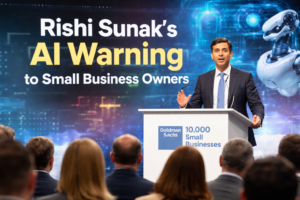
In a library in Birmingham, far from the marble floors of Downing Street or the trading floors of Wall Street, former Prime Minister Rishi Sunak delivered a message that every small business owner needs to hear: when it comes to AI, adoption is everything.
Speaking at Goldman Sachs’ “10,000 Small Businesses UK” summit, Sunak—now a senior adviser to the banking giant—painted a stark picture of a two-tier economy emerging in real-time. On one side, global tech titans are using AI to swallow markets whole. On the other, small and medium-sized enterprises (SMEs) face a choice: evolve with the machine, or risk being pushed out by it.
The New Portfolio Politician
Sunak’s presence at the podium marks a fascinating evolution in the post-political career. Since losing the 2024 general election, the Conservative MP for Richmond and Northallerton hasn’t retired to the backbenches. Instead, he has built a portfolio that reads like a blueprint for the AI economy: advisory roles at Goldman Sachs, Anthropic, and Microsoft.
To date, he has declared £1.1 million in earnings from Goldman alone—all of which he has donated to charity. But beyond the headlines of his paychecks lies a more interesting narrative: a former head of government now acting as a bridge between the cautious, regulated world of small business and the breakneck speed of frontier technology.
His message in Birmingham wasn’t theoretical. It was rooted in the mud and concrete of his own constituency.
“I see it in my own constituency up in North Yorkshire,” Sunak told the room of 300 business leaders. “I was recently talking to a dairy farmer who was using AI together with wearables, so he could spot things like mastitis in his cattle before it became an issue for his milk.”
This is the quiet revolution that often gets overlooked in the hype about generative AI and large language models. For the farmer in North Yorkshire, AI isn’t a chatbot or a image generator—it’s a diagnostic tool that saves livestock, protects milk yields, and ultimately keeps the business solvent.
The Adoption Chasm: Why Small Firms Can’t Afford to Wait
The central thesis of Sunak’s address—and indeed the entire Goldman Sachs summit—is what economists call the “adoption chasm.” Large corporations have the data science teams, the cloud computing credits, and the legal departments to roll out AI pilots overnight. Small businesses do not.
But that doesn’t mean they can afford to sit on the sidelines. In fact, the opposite is true.
A survey conducted in March of 400 graduates from Goldman’s 10KSB program found that a staggering 98 percent are already using AI in their businesses. That figure should serve as a wake-up call. If nearly every ambitious, growth-oriented small firm has already integrated AI into their operations, then the competitive landscape has already shifted.
Consider the alternative. A small marketing agency that refuses to use AI copywriting tools is competing against rivals who can produce first drafts in seconds. A logistics firm without AI route optimization is burning fuel and losing hours to a competitor who has automated the process. A care provider that doesn’t use AI to review care plans is spending administrative hours that could be spent on patient-facing work.
This isn’t about replacing human judgment. It’s about augmenting it.
The Care Home Conundrum: A Case Study in Responsible Adoption
Of course, the path to AI adoption is rarely a straight line. Phil Eckersley, founder of Bridgewater Home Care, knows this better than most. Eckersley is implementing AI to review care plans for his clients—a sensitive task that involves personal health data, regulatory compliance, and the fundamental trust between a care provider and vulnerable individuals.
“The nature of the business means personal data cannot be shared on the technology,” Eckersley explained. For him, adoption isn’t simply about plugging into the latest large language model. It’s about building bespoke systems that meet the firm’s own rigorous standards for privacy and quality.
This is a crucial insight that often gets lost in the hype. For small businesses, successful AI adoption isn’t about buying an off-the-shelf solution and hoping for the best. It’s about a thoughtful, iterative process:
- Auditing what data can and cannot be shared with third-party AI tools
- Building internal protocols that ensure compliance with regulations like GDPR
- Training staff not just to use the tools, but to understand their limitations
- Maintaining human oversight for any decision that affects client welfare
Eckersley’s approach is a model for the responsible small business owner. He isn’t rejecting AI—the competitive pressure is too strong for that. But he isn’t rushing in blindly, either. He’s building a system that works for his specific context, his specific clients, and his specific standards.
The £100 Million Foundation: Sunak’s Government Legacy
Sunak’s current evangelism for AI didn’t emerge from nowhere. As Prime Minister, he made the technology a signature issue, pledging more than £100 million to help regulators and universities tackle the challenges around AI. He also hosted the first global summit on AI safety at Bletchley Park—a symbolic choice, given that the site was also the home of World War Two codebreakers.
That legacy matters now because it created the regulatory and academic infrastructure that small businesses can lean on. The funding helped establish research programs into AI safety, data ethics, and workforce impacts. It signaled to the global tech community that the UK was open for AI business, but not at any cost.
For the small business owner sitting in Birmingham, that legacy translates into something tangible: a clearer path forward. The regulators have had time to think about data protection. The universities have had funding to study best practices. The legal frameworks, while still evolving, are further along than they would have been otherwise.
The Loneliness of the Small Business Owner
Perhaps the most overlooked element of the Goldman Sachs summit was not the technology, but the psychology. As Asahi Pompey, Goldman’s global head of corporate engagement, put it: “It can be a pretty lonely enterprise being a small business owner.”
Pompey noted that the 10KSB program, which has now guided about 2,500 small business leaders in partnership with Oxford University’s Said Business School, creates something more valuable than technical knowledge. It creates community.
“When you bring them all in the room together, this community becomes very close knit,” she said.
This is a profound observation. The AI revolution is not just a technological shift; it’s a psychological one. Business owners are being asked to trust algorithms with decisions they used to make themselves. They’re being asked to retrain staff, rework processes, and rethink assumptions that have guided them for years or even decades.
Doing that alone is daunting. Doing it in a room full of peers who are facing the same challenges is transformative.
Practical Steps for the AI-Ready Small Business
For the small business owner reading this and wondering where to start, the insights from Birmingham offer a practical roadmap:
- Identify the Repetitive TaskStart with something small, repetitive, and low-risk. The dairy farmer didn’t start by automating his entire operation. He started with a wearable sensor for his cattle. What is the equivalent in your business? Timesheet processing? Inventory tracking? First-draft copywriting? Find the task that eats hours but adds little strategic value.
- Audit Your DataBefore you adopt any AI tool, know what data you’re feeding into it. Eckersley at Bridgewater Home Care couldn’t share client health data. That didn’t stop him from adopting AI; it just meant he had to build a system that respected that constraint. Understand your own data boundaries before you start shopping for solutions.
- Start with Free or Low-Cost ToolsYou don’t need a six-figure IT budget to begin. Many AI tools offer free tiers or low-cost subscriptions. Use them. Experiment. See what works for your specific context. The goal is not to find the perfect solution on day one; it’s to start learning.
- Train Your TeamAI adoption fails when it’s imposed from the top without buy-in from the people who will actually use it. Involve your staff in the selection process. Train them thoroughly. Make it clear that the goal is to make their jobs easier and more meaningful, not to replace them.
- Join a Peer NetworkIf you’re feeling overwhelmed, you’re not alone. The 98 percent of 10KSB graduates using AI didn’t figure it all out by themselves. They learned from each other. Find a local business group, an industry association, or even an online forum. Share your wins and your failures. The community is the competitive advantage.
The Verdict: A New Industrial Revolution
Sunak’s appearance at the Birmingham summit, flanked by Goldman Sachs bankers and Oxford academics, signals something larger than one former politician’s portfolio career. It signals that AI has moved from the realm of speculative hype to the reality of industrial policy.
The small businesses that thrive in the coming decade will not necessarily be the ones with the most advanced algorithms or the biggest data centers. They will be the ones that figure out how to integrate AI into their existing workflows in a way that respects their values, protects their customers, and amplifies their human talent.
The dairy farmer in North Yorkshire figured it out. The care home owner in Bridgewater is figuring it out. The 2,500 graduates of the 10KSB program are figuring it out together.
The question for every other small business owner is simple: What are you waiting for?
The global behemoths aren’t waiting. The regulators aren’t waiting. The farmers and the care providers and the logistics firms aren’t waiting. And if the former Prime Minister has anything to say about it, neither should you.
The 10,000 Small Businesses UK program, run by Goldman Sachs in association with Oxford University’s Said Business School, continues to accept applications from UK-based small business owners seeking to scale their operations. The program is free to participants, funded entirely by the bank.
You must be logged in to post a comment.