
From National Pride to Global Powerhouse: How Dangote’s 1.4 Million BPD Gambit Reshapes Global Oil and Africa’s Destiny
Aliko Dangote has announced an audacious plan to double the capacity of his flagship Dangote Oil Refinery from its current 650,000 barrels per day to 1.4 million barrels per day, a move aimed at dethroning the Jamnagar refinery in India as the world’s largest.
This expansion, which follows a scheduled upgrade to 700,000 bpd by the end of 2025, represents a strategic gambit to achieve unparalleled economies of scale and leverage the facility’s existing infrastructure to transform Nigeria from a fuel-import-dependent nation into a global refining powerhouse.
If successful, this shift would not only secure energy independence for the region but also profoundly disrupt Atlantic Basin trade flows, challenge established refineries in Europe, and reposition Africa as a central player in the global energy value chain, despite facing significant hurdles in securing reliable crude oil supply and managing the immense operational complexity.
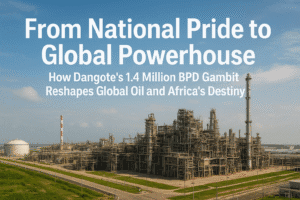
From National Pride to Global Powerhouse: How Dangote’s 1.4 Million BPD Gambit Reshapes Global Oil and Africa’s Destiny
For decades, the global refining map has been a story of established titans. The sprawling, complex facilities in Jamnagar, India, and the industrial heartlands of the US Gulf Coast have dictated the flow of gasoline, diesel, and aviation fuel that powers the world. But a seismic shift is underway, one emanating not from a traditional energy hub, but from the coast of Lagos, Nigeria. The Dangote Oil Refinery, once a symbol of national potential, is now openly aiming for global supremacy, with a plan so audacious it could redraw the geopolitical and economic lines of the entire industry.
Aliko Dangote’s recent declaration to double the refinery’s capacity from 650,000 to 1.4 million barrels per day (bpd) is more than just an expansion; it’s a statement of intent to dethrone India and seize the crown for the world’s largest refining complex. This isn’t a distant dream. The journey is already in motion, with an intermediate upgrade to 700,000 bpd slated by the end of 2025, a stepping stone that itself would propel it into the global top six.
But to understand the true magnitude of this ambition, we must look beyond the staggering numbers and into the profound implications for Africa, global trade, and the very nature of energy independence.
The Anatomy of an Ambition: More Than Just Size
The initial conception of the Dangote Refinery as a 650,000 bpd single-train facility was already a monumental engineering feat. A “single-train” design means the entire operation runs through one unified, integrated process unit, demanding unparalleled precision and reliability. Its success, evidenced by hitting 610,000 bpd output in August 2025, has proven the naysayers wrong and provided the confidence for this next giant leap.
The planned expansion to 1.4 million bpd is strategic on multiple levels:
- The Economics of Scale: In the brutally competitive refining business, size is a primary determinant of margin. A larger capacity allows Dangote to process cheaper, heavier crude varieties that smaller refineries cannot handle, optimizing crude procurement costs and maximizing the yield of high-value products like gasoline and jet fuel. This creates a significant cost advantage that can undercut competitors on the global stage.
- Infrastructure as a Moat: Dangote’s comment, “we have the infrastructure already here,” is a crucial insight. The refinery is integrated with a massive deep-sea port, a power plant, and pipelines. Expanding on this existing “energy ecosystem” is far more cost-effective than building from scratch elsewhere. This integrated infrastructure becomes a competitive moat, making it nearly impossible for new entrants to replicate its efficiency.
- Beyond the “World’s Largest” Title: Surpassing the 1.36 million bpd Jamnagar refinery is as much about geopolitics as it is about economics. It positions Nigeria, and by extension Africa, not as a passive source of raw crude, but as a dominant force in the global value chain. It shifts the continent from the periphery to the center of the energy conversation.
The Ripple Effect: Reshaping Continents and Markets
The success of this expansion will send shockwaves far beyond the fences of the Lekki Free Zone.
For Nigeria and Africa: The Dawn of a New Industrial Era
- The End of the “Resource Curse”? Nigeria, a nation that paradoxically imported nearly 100% of its refined fuel despite being a top crude oil producer, is on the cusp of a historic reversal. Dangote achieving its targets would not only end this humiliating dependency but would turn Nigeria into a net exporter of refined products. This saves billions in foreign exchange, stabilizes the local currency, and insulates the nation from volatile global fuel prices.
- A Catalyst for Allied Industries: A refinery of this scale is not an island. It will be the anchor tenant for a vast petrochemical ecosystem. Industries that rely on byproducts like polypropylene, polyethylene, and fertilizers will spring up around it, creating a manufacturing renaissance in West Africa. This is the real prize: moving up the value chain from commodity exporter to industrial producer.
- Re-Africanizing Energy Security: The refinery’s output has the potential to meet the fuel demands of West Africa and beyond. Neighboring countries that currently import fuel from Europe can source it from a more logistically sensible and economically stable region. This fosters regional integration and bolsters Africa’s collective energy security.
For the Global Market: A New Axis of Power
- Disrupting Atlantic Basin Trade Flows: European refineries, which have long supplied a significant portion of Africa’s gasoline and diesel, will face an existential threat. A self-sufficient West Africa, supplied by Dangote, removes a major market for these refineries, forcing them to find new buyers or face closure.
- Shifting the Geopolitical Center of Gravity: The global refining crown moving from India to Nigeria would be symbolic of a broader shift in economic power. It demonstrates that the ambition and capital to execute world-class industrial projects exist in Africa. It gives the continent a stronger seat at the table in global energy forums and negotiations.
- A New Benchmark for Competitiveness: Dangote’s scale and integrated model will set a new benchmark for refinery efficiency. Competitors in Asia, the Middle East, and the West will have to reassess their own operations to compete with the cost structure that Dangote will be able to achieve.
The Inevitable Hurdles: The Path is Not Without Peril
Despite the bullish outlook, the road to 1.4 million bpd is paved with significant challenges.
- The Crude Oil Conundrum: Can Nigeria’s aging oil fields and beleaguered by production challenges reliably supply a 1.4 million bpd refinery? While the refinery can source crude from elsewhere, a reliance on imports would expose it to currency and geopolitical risks, undermining its economic advantage. The success of the refinery is inextricably linked to the revival of Nigeria’s upstream oil sector.
- Operational Complexity: Managing a single-train refinery is complex; doubling its size multiplies that complexity exponentially. Maintaining consistent uptime, managing a vast workforce, and ensuring impeccable safety standards will be a Herculean task.
- Market Dynamics and Competition: The global push towards electrification and renewables poses a long-term threat to fossil fuel demand. While the need for refined products will remain for decades, Dangote is making a massive bet on the longevity of the oil age. Furthermore, established players will not cede market share lightly and may engage in price wars to protect their turf.
Conclusion: A Vision Beyond Refining
Aliko Dangote’s plan to build “the refinery again” is more than an infrastructure project; it is a declaration of African industrial sovereignty. It represents a bold bet that Africa can not only harness its own resources but can also become a primary architect of global market dynamics.
The journey from 610,000 bpd today to 1.4 million bpd tomorrow is a story we will all be watching. Its success would mark the culmination of one of the most ambitious industrial projects of the 21st century, proving that with audacious vision and relentless execution, the global economic order is not fixed, but forever malleable. The Dangote Refinery is no longer just a Nigerian story; it is a compelling new chapter in the story of global energy, and its next page promises to be its most dramatic yet.
You must be logged in to post a comment.