
From Moral Compass to Climate Guru: India’s Unlikely Journey to Normative Power
From Moral Compass to Climate Guru: India’s Unlikely Journey to Normative Power
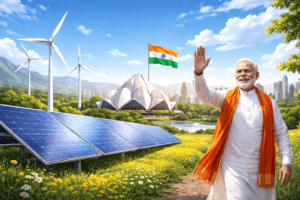
For decades, India’s quest for great power status was seen through a familiar prism: economic growth, military might, and strategic autonomy. Yet, as the world grapples with a polycrisis of climate change, geopolitical fragmentation, and eroding trust, a quieter, more profound transformation has taken root. India is no longer just seeking a seat at the high table; it is attempting to rewrite the menu, using an unexpected tool—normative climate leadership. This journey from a post-colonial moral voice to a pragmatic Vishwaguru (world teacher) reveals a sophisticated playbook for how a rising power can carve out global influence in the 21st century.
The Nehruvian Legacy: A Foundation Built on Idealism
India’s aspiration to shape global norms is not new. From its independence, under Jawaharlal Nehru, India positioned itself not as a traditional power, but as a normative power. It championed decolonization, disarmament, and non-alignment, weaving a foreign policy identity from the threads of anti-imperialism and ethical statecraft. This was a conscious strategy to secure influence disproportionate to its then-limited material strength. It sought a place in the “league of good nations,” advocating for a more just and equitable international order, epitomized by its push for a New International Economic Order (NIEO) in the 1970s.
However, this early idealism faced harsh realities. Domestic challenges, economic pressures, and regional conflicts forced India into a prolonged period of relative introversion. For much of the late 20th century, as scholar Subrata Mitra noted, India became a “status quo power,” often a passive recipient of norms set elsewhere. Its moral voice, while respected, lacked the material heft and consistent strategy to translate into tangible global agenda-setting.
The Pivot: Material Rise Meets Normative Ambition
The critical shift began in the last two decades. India’s explosive economic growth transformed it into an undeniable material power and, crucially, a veto player in global climate negotiations. The world could not solve climate change without India’s cooperation. Yet, Indian strategists understood that sheer size and emissions were not enough to confer the respected, leadership status it craved. As research by Basrur and de Estrada highlights, material weight alone would not fulfil India’s great power objective. The country needed a compelling story, a positive normative agenda it could own and export.
This is where Prime Minister Narendra Modi’s government, since 2014, executed a deliberate pivot. Climate change was identified as the perfect arena to relaunch India’s normative ambitions. Why?
- It Leveraged Indigenous Ideational Assets: Climate action provided a natural platform to invoke India’s ancient cultural and philosophical traditions—concepts of Prakriti (nature), harmony, and trusteeship over the Earth. Modi’s speeches at COP forums are laced with references to a 5,000-year-old culture of conservation. This frames climate action not as a Western-imposed burden, but as a return to inherently “Indian” values, giving the country a unique and authentic leadership voice.
- It Aligned with Domestic Imperatives: Severe climate vulnerabilities—from melting glaciers to erratic monsoons—made business-as-usual untenable for India’s own development. Leading on climate became synonymous with securing India’s future. Initiatives like the International Solar Alliance (ISA) and the Coalition for Disaster Resilient Infrastructure (CDRI) are pragmatic solutions to shared Global South problems, packaged as moral leadership.
- It Filled a Geopolitical Vacuum: With traditional powers often seen as historically responsible and insufficiently supportive, a space emerged for a credible advocate for the developing world. India’s narrative of “climate justice” and “common but differentiated responsibilities” resonates deeply across the Global South, positioning it as a synthesizer and bridge.
The Modi Doctrine: Pragmatic Norm Entrepreneurship
Modi’s approach is often labeled pragmatic, and rightly so. It represents a fusion of Hindu nationalist cultural confidence with a realist understanding of global politics. This is not the utopian idealism of early non-alignment. It is a hard-nosed norm entrepreneurship.
The cornerstone of this is the LiFE (Lifestyle for Environment) initiative. Launched at COP26, LiFE cleverly shifts the focus from purely state-level, legally-binding targets (where India faces pressure) to the domain of individual and cultural behavior. By advocating for mindful consumption and “pro-planet” living, India claims the high moral ground of collective action while deftly sidestepping debates over emission peaks. It’s a normative framework any nation or individual can adopt, potentially setting a new global standard for environmental citizenship.
This strategy reveals a key insight: India is not seeking to overturn the entire Western-led liberal international order. Instead, as scholars Adler-Nissen and Zarakol observe, it offers “qualified support” while carving out specific domains—like climate governance—where it can establish alternative normative leadership. It’s a tactic of selective contestation and supplementation, not wholesale revolution.
The Dragon and the Elephant: A Contrast in Pathways
India’s path starkly contrasts with China’s rise. While China projects power through the Belt and Road Initiative and institutional building, its normative offerings are often viewed with suspicion, seen as extensions of state-centric authoritarianism. India, despite its own democratic backsliding concerns, still leverages its democratic identity, pluralism, and softer cultural appeal. Its climate narrative is framed in the language of collective civilizational wisdom and equitable partnership, not transactional diplomacy. This distinction is crucial in the battle for influence in the Global South, where nations are wary of new dependencies.
The Road Ahead: Challenges to Authentic Leadership
For all its successes, India’s quest to be a genuine Vishwaguru faces significant hurdles:
- The Credibility Gap: Soaring domestic emissions, continued reliance on coal, and urban environmental crises can make international preaching seem hypocritical. Normative power requires perceived authenticity.
- From Veto to Vision: Moving beyond blocking unfavorable deals (veto power) to consistently brokering inclusive, actionable global consensus (agenda-setting) is the next test.
- Balancing Acts: Navigating the complex rivalry with China, while maintaining partnerships with the West and leadership of the Global South, requires diplomatic dexterity that is easily strained.
India’s story demonstrates that in today’s world, power is increasingly narrative-driven. By weaponizing its civilizational ethos and aligning it with a globally urgent issue like climate change, India has crafted a potent form of diplomatic leverage. It has moved from being a threat (in emission calculations) to an indispensable partner in crafting a just transition. Whether it becomes the full-fledged normative leader it aspires to be depends on its ability to marry its powerful ancient stories with consistent, credible modern action—proving that the true Vishwaguru leads not just by word, but by transformative example.
You must be logged in to post a comment.