
From Medals to Management: How the Bindra Report Aims to Fix India’s Broken Sports Administration System
The Task Force Report on Capacity Building of Sports Administrators, chaired by Abhinav Bindra, presents a transformative roadmap to overhaul India’s sports governance by addressing deep-seated systemic flaws including a lack of professional expertise, fragmented training, barriers for athletes transitioning into administration, and opaque governance in sports federations. Its core solution is a multi-level framework proposing the integration of sports governance into civil service training at LBSNAA, a performance monitoring system linking KPIs to career progression, and the establishment of an apex National Council for Sports Education & Capacity Building (NCSECB) to regulate and certify training, all aimed at creating a professional, accountable, and athlete-centric ecosystem. This report strategically complements existing initiatives like the proposed National Sports Governance Act and Khelo Bharat Niti, representing a crucial cultural shift to build sustainable administrative expertise—the essential “software” needed to effectively translate grassroots talent development and infrastructure investment into consistent international sporting success.
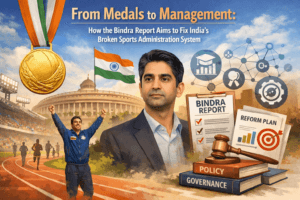
From Medals to Management: How the Bindra Report Aims to Fix India’s Broken Sports Administration System
For decades, India’s relationship with sports has been a paradox of passion and poor governance. We celebrate our champions with unbridled enthusiasm, yet the system that should nurture them often remains mired in bureaucracy, inconsistency, and a glaring lack of expertise. The recent submission of the Task Force Report on Capacity Building of Sports Administrators, chaired by Olympic gold medalist Abhinav Bindra, isn’t just another document—it’s a radical blueprint aiming to bridge this very chasm. It confronts an uncomfortable truth: to win consistently on the world stage, India must first win the off-field game of professional sports governance.
This report arrives at a critical juncture. With initiatives like Khelo India fostering grassroots talent and the country hosting mega-events like the 2036 Olympic bid, the infrastructure of Indian sports is evolving. However, the administrative superstructure—the engine room of strategy, funding, and athlete support—has been its weakest link. The Bindra Committee’s findings offer a surgical analysis of these systemic failures and propose a transformative, multi-level framework to build a future where sports administration is a profession of prestige, accountability, and impact.
Diagnosing the Core Illness: Where the System Falters
The report’s value lies in its unflinching diagnosis. It moves beyond superficial critiques to pinpoint four foundational gaps that have long crippled Indian sports administration.
- The Amateur Hour: A Crisis of ProfessionalismImagine a hospital run by engineers, or a tech firm led by artists. This is the absurdity plaguing many of our sports bodies. Key administrative roles are frequently occupied by generalist civil servants on deputation or contractual staff with no domain-specific knowledge. Their tenures are short, their learning curves steep, and their decisions, as the report notes, become “ad-hoc.” This lack of professional continuity disrupts long-term athlete development programs, strategic planning, and effective resource allocation. The administrator views the role as a temporary posting; the athlete suffers the consequences of transient policy.
- The Patchwork Training ParadigmExisting training programs for sports administrators are described as “sporadic and outdated.” There is no standardized, continuous professional development pathway. A one-off workshop cannot equip an administrator to handle the complexities of sports science, talent scouting, international federation regulations, modern marketing, or ethical governance. This fragmented approach results in administrators who manage reactively rather than lead proactively, unable to leverage global best practices.
- The Athlete’s Glass CeilingPerhaps the most poignant insight is the identification of “Athlete Transition Barriers.” Thousands of athletes dedicate their youth to the nation, yet upon retirement, their deep experiential knowledge is often lost to the system. There is no structured “Dual Career Pathway” to mentor and train former athletes for governance roles. This represents a colossal brain drain. Who better to understand an athlete’s needs than someone who has walked the path? The system, paradoxically, sidelines its most valuable potential assets.
- Governance in the Shadows: Concentration and OpacityMany National Sports Federations (NSFs) operate with a troubling lack of transparency and accountability. The report highlights the absence of clear role separation between the governing board and operational management, leading to over-centralized authority. This opacity can foster environments where decision-making is opaque, conflicts of interest arise, and the athlete’s welfare is not the unequivocal top priority.
The Prescription: Building a Professional Ecosystem
The committee’s recommendations are not piecemeal suggestions but an interconnected framework designed to instill professionalism from the grassroots to the peak.
- Sensitizing the Steel Frame: Civil Service IntegrationA masterstroke recommendation is the integration of sports governance modules into the training of IAS officers at the Lal Bahadur Shastri National Academy of Administration (LBSNAA). This aims to sensitize future policy-makers and district magistrates—the key implementers at the state and district levels—to the profound value of sports in public health, social cohesion, and national prestige. When the bureaucracy understands sport as a vital sector for development and not merely as recreation, policy support and resource allocation will follow.
- Linking Performance to ProgressThe proposedNational Performance Management and Monitoring System seeks to instil a culture of outcome-based accountability. By linking an administrator’s Key Performance Indicators (KPIs)—such as athlete development metrics, transparency audits, or infrastructure rollout—to their career progression (promotions, postings), the system incentivizes results. This moves administration from a passive, custodial role to an active, outcome-driven mission.
- Creating the Apex Brain Trust: The NCSECBThe cornerstone of the framework is the establishment of aNational Council for Sports Education & Capacity Building (NCSECB). This body would function as the regulatory, accrediting, and certifying authority for all sports administration training in India. Think of it as the “AICTE for Sports Management.” It would set curriculum standards, ensure quality control, and maintain a national registry of certified sports administrators, bringing much-needed uniformity and rigor to the field.
- The Operational Engine: National Training & Development CellThe NCSECB would be supported by a dynamicNational Training & Development Cell as its operational arm. This cell would be responsible for executing the vision: delivering the standardized curriculum, coordinating with academic institutions and NSFs, and monitoring outcomes. Crucially, the report emphasizes developing an India-specific curriculum—one that understands the unique challenges of our diverse sporting landscape, from wrestling akharas in Haryana to football fields in Kerala.
Connecting the Dots: A Symphony of Reforms
The Bindra Report does not exist in a vacuum. It is the logical next step in a series of reforming impulses. It dovetails perfectly with the proposed National Sports Governance Act, 2025, which envisages an independent National Sports Board, a National Sports Tribunal for dispute resolution, and a national election panel to ensure democratic NSF elections. Together, they target both capacity (the Bindra Report) and conduct (the Governance Act).
Similarly, this focus on professional administration is the necessary fuel for the ambitious Khelo Bharat Niti-2025 and the Khelo India Programme. The finest grassroots talent identification or world-class infrastructure will underperform if managed by an unprofessional, unstructured administration. The report provides the “software” to run the “hardware” of arenas and programs.
The Human Insight: Why This Truly Matters
Beyond the structural changes, this report signifies a profound cultural shift. It argues that respecting sport means respecting its governance. It recognizes athletes not as mere performers but as stakeholders and future leaders of the ecosystem. By creating a clear career pathway for administrators, it aims to attract the best and brightest minds—individuals who see sports management as a viable, respected, and impactful career, akin to roles in corporate strategy or public policy.
The ultimate value for a reader—be it a citizen, an aspiring athlete, or a future administrator—is the promise of a fairer, more efficient, and more sustainable sports ecosystem. It’s the promise that an athlete’s journey will be guided by expertise, not bureaucracy; that decisions will be made transparently in the interest of sport; and that India’s sporting prowess will be built on the solid foundation of professional governance, not left to the whims of passionate but potentially unqualified individuals.
The journey from the playing field to the podium is long and arduous. The Bindra Report provides the crucial map for the less visible, but equally critical, journey from ad-hoc management to professional administration. If implemented with sincerity, this could be the quiet revolution that finally allows Indian sports to consistently convert its billion dreams into golden realities.
You must be logged in to post a comment.