
From Map to Mindset: How Madhya Pradesh is Rewriting Its Economic Narrative on the Global Stage
Madhya Pradesh, under Chief Minister Dr. Mohan Yadav, is actively transforming its identity from a mere geographical entity into a global investment destination, as evidenced by its prominent participation at the World Economic Forum in Davos. Capitalizing on India’s growing international trade appeal, the state is leveraging its robust infrastructure, affordable renewable energy priced as low as ₹2.10 per unit, and its position among India’s states with the lowest unemployment rates to attract industries. With 2025 designated as Industry and Employment Year, the government is offering substantial capital subsidies—up to 60% for MSMEs—and planning integrated urban development, such as a master plan for Jabalpur, to create holistic ecosystems for business and living. Beyond economics, the state is enhancing its soft power through successful conservation projects like cheetah reintroduction and innovative tourism initiatives like subsidized helicopter services, collectively signaling a strategic shift from being defined by its map to being recognized for its actionable achievements and future-ready ambitions.
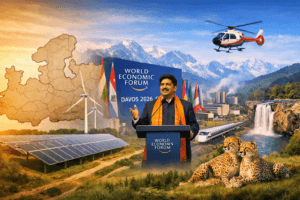
From Map to Mindset: How Madhya Pradesh is Rewriting Its Economic Narrative on the Global Stage
The identity of a place is often imprisoned by its cartography—reduced to borders, rivers, and cities on a page. But what happens when a state decides to break free and define itself not by its boundaries, but by its ambitions and achievements? This is the compelling story unfolding in the heart of India, where Madhya Pradesh, under the leadership of Chief Minister Dr. Mohan Yadav, is aggressively shifting the discourse from geographical location to economic destination. The recent felicitation of the CM in Jabalpur, following his return from the World Economic Forum in Davos, wasn’t merely a ceremonial welcome; it was a testament to a state confidently stepping onto the world’s premier economic stage and declaring its readiness for business.
The Davos Dividend: More Than Just a Photo-Op
The annual meeting in Davos is a dizzying symphony of global power, where narratives are crafted and investment flows are subtly directed. For years, the Indian story at Davos was predominantly scripted by a handful of metropolitan states and central government delegations. In 2026, a new subplot emerged with undeniable vigour: Madhya Pradesh. Dr. Yadav’s assertion that the Indian delegation, and within it Madhya Pradesh, commanded significant attention is more than political pride. It signals a maturation of India’s federal economic diplomacy. States are no longer passive backdrops but active protagonists, armed with their own data, policies, and pitches.
Madhya Pradesh’s standout proposition in the alpine town was its renewable energy leadership. Offering industrial power at a jaw-dropping ₹2.10 per unit is a powerful competitive advantage in an era where green energy is both an environmental imperative and a cost calculus. This isn’t just cheap power; it’s strategic positioning. By anchoring its appeal in sustainability, Madhya Pradesh is attracting a forward-looking breed of investor—those looking to future-proof their operations against both carbon tariffs and volatile fossil fuel prices. The state is effectively saying, “Your future factory here will be greener and cheaper to run.”
The Employment Conundrum: A Leading Statistic with Nuanced Layers
One of the most striking claims is Madhya Pradesh’s position among India’s top three states with the lowest unemployment rates. Given its vast population nearing 90 million, this is, on the surface, a monumental achievement. It suggests a bustling, inclusive economy where growth is translating into jobs. However, this statistic invites a deeper, more human inquiry. What is the quality of this employment? Is it predominantly in the vulnerable informal sector, or is it reflected in a rise in formal, salaried positions with social security?
This is where the state’s declaration of 2025 as “Industry and Employment Year” gains critical importance. The focus appears to be on bridging this potential gap. The announced subsidies—up to 30% capital subsidy for large industries and a substantial 60% for MSMEs—are calibrated tools. They aim to catalyze job-creating investments while specifically nurturing the small and medium enterprises that are often the most potent engines of localized, sustainable employment. The real insight for businesses and residents alike is that the state recognizes employment quantity alone is insufficient; the architecture for employment quality is being actively built.
Beyond Subsidies: Building the Ecosystem for “Ease of Living and Working”
Industrial policy often gets fixated on financial incentives. Madhya Pradesh’s narrative, however, hints at a more holistic understanding. The repeated emphasis on robust infrastructure—roads, power, water, and land banks—addresses the perennial pain points that can cripple even the most subsidized venture. An industry isn’t an island; it needs reliable logistics for its supply chain and a decent quality of life for its workforce.
The visionary mention of a comprehensive master plan for Jabalpur and its 50-kilometre satellite region is particularly insightful. It moves beyond the outdated model of isolated industrial parks. Instead, it envisions integrated economic zones where people can live, work, and thrive without enduring brutal commutes. This approach doesn’t just attract companies; it retains talent. It’s a recognition that for the modern professional, especially the youth whose strength the CM rightly highlights, a job is only one part of the equation. Urban liveability is the other.
The Soft Power of Cheetahs and the Logistics of Helicopters
In a masterstroke of symbolic governance, Dr. Yadav connected two seemingly disparate points: the expanding cheetah population and affordable helicopter tourism. This is not trivial. The cheetah reintroduction project is a global conservation landmark. Its success broadcasts a powerful message about the state’s environmental stewardship, administrative competence, and ability to manage complex, long-term projects. It builds a brand of reliability and ambition that resonates far beyond wildlife enthusiasts.
Conversely, the helicopter service at ₹3,500 for 45 minutes is a tangible, disruptive innovation in tourism and intra-state connectivity. It makes the state’s vast and often remote tourist attractions—from the marble rocks of Bhedaghat to the forests of Kanha—dramatically more accessible. This isn’t just a luxury service; it’s a strategic investment in democratizing high-value tourism and shrinking the state’s internal distances for business travel. It signals an agile, experimental approach to problem-solving.
The Road Ahead: From Promising Pitch to Enduring Progress
The energy emanating from the Mahakaushal Chamber of Commerce event is palpable. The state has a compelling story: green energy, low unemployment, aggressive subsidies, and big infrastructure dreams. The genuine human insight, however, lies in the challenges that remain the flip side of this optimism.
First, implementation is the true test. Land acquisition, environmental clearances, and bureaucratic red tape at the ground level can deflate the most attractive subsidy. The state’s credibility will hinge on creating a seamless, transparent “ease of doing business” experience that matches the grandeur of its Davos pitch.
Second, skilling the demographic dividend. A large youth population is an asset only if it is an employable one. Parallel to the push for industries must be a revolution in vocational training and education aligned with future market needs, particularly in the renewable and tech sectors the state is chasing.
Third, balanced regional development. While plans for Jabalpur are promising, ensuring that growth permeates beyond Indore and Bhopal to the state’s poorer regions will be crucial for equitable and politically sustainable progress.
In conclusion, Madhya Pradesh is undertaking a profound rebranding exercise. It is moving from being perceived as a large, central Indian state to positioning itself as a strategic, green, and investor-friendly powerhouse. Dr. Mohan Yadav’s post-Davos message underscores a pivotal shift in mindset: a state’s worth is not a static fact of its map, but a dynamic function of its achievements and its aspiration. The world, keen to engage with India, is now looking at Madhya Pradesh with renewed interest. The next chapter will be written not in conference halls abroad, but on the ground—in the success of its factories, the satisfaction of its workforce, and the sustained improvement in the lives of its nine crore citizens. The map has been drawn; now, the real work of building the future upon it begins.
You must be logged in to post a comment.