
From Lab to Land: Forging India’s Science-First Blueprint for Viksit Bharat
The National Science Day 2026 celebrations in New Delhi pivoted from mere observance to strategic action, as science leaders led by Principal Scientific Adviser Prof. Ajay K. Sood outlined a definitive blueprint for integrating research with policy to achieve the Viksit Bharat vision. Emphasizing a mission-mode approach over traditional lab-to-land translation, the discussions showcased indigenous breakthroughs like the “Drishti” visibility system and Direct-to-Mobile broadcasting, while calling for a paradigm shift in how India tackles critical sectors such as aerospace, defence, and strategic materials. The collective resolve was clear: by fostering deep science-policy convergence, empowering women in research, and democratizing knowledge through local languages, India is actively engineering its transformation into a developed nation through deliberate, inclusive, and technologically sovereign innovation.
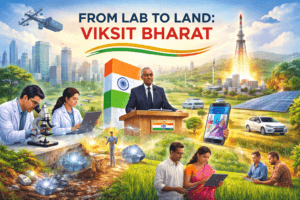
From Lab to Land: Forging India’s Science-First Blueprint for Viksit Bharat
New Delhi, March 4, 2026: In the rarefied air of Vigyan Bhawan, where India’s scientific and policy elite often converge, the conversation has historically oscillated between celebrating discoveries and lamenting the “valley of death”—the chasm that separates a groundbreaking research paper from a product in the hands of a citizen. But at the National Science Day Celebration 2026, the tone was distinctly different. The mandate was clear: the era of siloed excellence is over. The future belongs to a deliberate, integrated march from the laboratory to the land, from the drawing board to the defence line, and from the research journal to the farmer’s field.
Chaired by the Principal Scientific Adviser (PSA) to the Government of India, Prof. Ajay K. Sood, the event was not merely a ceremonial observance of a historic discovery (the Raman Effect). It was a high-stakes strategic workshop on how to weaponize India’s scientific intellect to build a developed nation, or as it is famously envisioned, Viksit Bharat.
The gathering was a powerful testament to a new paradigm: science is no longer a spectator in the narrative of national progress; it is the protagonist. The focal theme, “Women in Science Catalysing Viksit Bharat,” and the subsequent deep-dive into the “Science Policy Interface” underscored a holistic approach—one where inclusivity and strategy are two sides of the same coin.
The Imperative of Convergence: More Than Just a Buzzword
Prof. Sood’s inaugural address set a definitive course, moving beyond the rhetoric of ‘linkages’ to the reality of ‘convergence.’ He articulated a vision where the nation’s scientific trajectory is inextricably linked with its policy compass. “Science–policy convergence is essential to realise the vision of Viksit Bharat,” he asserted, framing the interface not as a bureaucratic hurdle but as the primary engine for translational success.
This convergence, as Prof. Sood detailed, is not a passive alignment. It is an active, coordinated assault on national challenges. He pinpointed critical sectors—aerospace, defence, critical metals, advanced materials, and digital communication—as the new theatres of national strength. These are not areas where India can afford to be a mere follower. They demand what he called “coordinated institutional mechanisms and sustained research investment.”
The underlying message was profound: In a world of geopolitical flux and technological nationalism, a nation’s true sovereignty is defined by its indigenous technological capacity. Prof. Sood emphasized that research, innovation, and policy frameworks must function in “synergy.” This means that when a scientist in Bengaluru develops a new material for a battery, a policymaker in Delhi is simultaneously crafting the incentives, regulations, and industrial partnerships to ensure that material powers an Indian electric vehicle, rather than gathering dust in a lab.
In a move that signals a maturation of the scientific ecosystem, Prof. Sood also championed the cause of communicating science in Indian languages. This is not just about outreach; it is about democratizing innovation. By breaking the linguistic barrier, we invite millions of minds into the scientific discourse, fostering a culture where science is a national passion, not an elite pursuit.
The Trinity of Transformation: Strategic Technologies Take Center Stage
The three National Science Day Lectures were not academic exercises; they were blueprints for self-reliance, presented by the very architects of India’s technological strides.
- Direct to Mobile (D2M): The Next Digital LeapfrogShri Shashi S. Vempati, former CEO of Prasar Bharati, painted a picture of a hyper-connected India with his lecture on “Direct to Mobile Broadcasting.” He traced Doordarshan’s journey from analog to digital, and now to a future where broadcasting bypasses the internet. The D2M technology, being developed in collaboration with IIT Kanpur and a nimble startup partner, aims to stream video content directly to smartphones without consuming data.
The human insight here is profound. For a country where data affordability remains a challenge for millions, D2M is not just a technological marvel; it is a great equalizer. Imagine a student in a remote village accessing high-quality educational content, or a farmer receiving real-time market prices and weather alerts, all without a data plan. This is the essence of inclusive innovation—leveraging cutting-edge tech to solve fundamental problems of access and equity. It’s a classic “leapfrog” moment, similar to how India skipped landlines and embraced mobile phones.
- Critical Metals and Materials: A Mission-Mode MindsetDr. K. Balasubramanian, Director of the Non-Ferrous Technology Development Centre (NFTDC), delivered a sobering and ambitious roadmap for “Critical Metals and Materials.” He acknowledged India’s historical dependence on imports for minerals crucial to space, defence, and clean energy. However, his lecture was not one of despair but of strategic opportunity.
Dr. Balasubramanian highlighted India’s latent strengths: world-class process engineering, a burgeoning IT sector, and a proven ability to scale up rapidly. He argued that the traditional model of linear development—from lab-scale success to pilot plant to full-scale production—is too slow for a nation with Viksit Bharat ambitions. He called for a “mission-mode, systems-based approach.”
This is a critical shift in thinking. It means treating the challenge of critical minerals with the same urgency and integrated planning as the Chandrayaan or Mangalyaan missions. It requires parallel processing: securing raw material sources (through domestic mining or strategic international partnerships) while simultaneously building the “rapid plant-scale capability” he mentioned. The insight here is that in a world competing for these resources, speed and strategic integration are as valuable as the raw material itself.
- Aerospace and Defence: Made in India, Making India ProudDr. Shubha V. Iyenger, a recently conferred Padma Shri awardee and former Distinguished Scientist at CSIR-National Aerospace Laboratories (CSIR-NAL), brought the theme of self-reliance to life with her lecture on indigenous aerospace technologies. Her spotlight on “Drishti,” India’s first indigenous runway visibility measuring system, was a masterclass in identifying a critical need and filling it with homegrown excellence.
“Drishti” is more than an instrument; it is a symbol. Before its development, India was dependent on expensive foreign systems to ensure flight safety in foggy conditions. Dr. Iyenger’s work demonstrated that Indian scientists could not only match global standards but also tailor solutions to India’s unique climatic and operational conditions. Her story, as a woman leader in the male-dominated field of aerospace, also served as a powerful, unspoken testament to the event’s focal theme. It proved that when women are empowered in science, they don’t just participate; they lead and build national assets.
Building the Bridge: The Science-Policy Interface in Action
The panel discussion on “Science Policy Interface for Catalysing Viksit Bharat” moved from the ‘what’ of innovation to the ‘how’ of implementation. Prof. Abhay Karandikar, Secretary of the Department of Science and Technology (DST), laid out the architectural principles of this bridge. He emphasized that India’s policy architecture must be dual-pronged: supporting “frontier research” (the pursuit of knowledge for its own sake) while aggressively fostering “translational innovation” (turning that knowledge into solutions).
Prof. Karandikar’s commitment to empowering researchers, with a special focus on women, is a crucial policy insight. An inclusive research ecosystem is not just a matter of social justice; it is a matter of national competitiveness. By tapping into the full spectrum of India’s talent, we inherently increase the volume and diversity of ideas, leading to more robust and creative solutions. His vision of policy instruments that “accelerate innovation cycles while ensuring equitable access” is the delicate balance a developing nation must strike—moving fast without leaving anyone behind.
Adding another layer of depth, Prof. Shekhar C. Mande, President of the Indian National Science Academy (INSA), stressed the need for “sustained dialogue” between scientists and policymakers. He championed the cause of “evidence-based policymaking,” a concept that sounds obvious but is often difficult to practice. It requires a cultural shift where policymakers are trained to seek out scientific advice, and scientists are equipped to communicate complex ideas in a policy-relevant format. Strengthening the “institutional interfaces” between academia and government, as he suggested, means creating formal, reliable channels for this dialogue to flow continuously, not just during crises.
The Road Ahead: A Collective Resolve
The National Science Day event at Vigyan Bhawan concluded with a resolve that felt more like a beginning. The discussions transcended the event itself, laying down a clear, actionable framework for the years leading up to 2047.
The vision of Viksit Bharat, as articulated by these science leaders, is not a destination that will be reached by chance. It will be built, brick by painstaking brick, through the convergence of visionary policy and tenacious scientific inquiry. It will be forged in the collaboration between a professor at IIT Kanpur, a startup founder, and a public broadcaster like Prasar Bharati. It will be realized in the mission-mode extraction of a critical metal that powers a self-reliant defence sector. It will be visible every time a pilot lands safely using an indigenous “Drishti” system.
The message from New Delhi was unequivocal: India’s journey to becoming a developed nation is, at its core, a scientific mission. By dismantling the walls between labs and policies, between discovery and delivery, and by ensuring that half of its scientific workforce—its women—are fully empowered, India is not just preparing for the future. It is actively, deliberately, and scientifically building it.
You must be logged in to post a comment.