
From Khan Younis to Statehood: The Elusive Quest for Palestine
Despite over 80% of UN member states recognizing Palestine as a sovereign state, a fully independent Palestinian state remains unrealized due to a fundamental gap between diplomatic recognition and on-the-ground sovereignty. The historical trajectory since the 1947 UN Partition Plan has seen growing international support, including a significant wave of recognitions from Western nations in 2024-2025. However, core obstacles persist: Palestine lacks exclusive control over its territory and borders, suffers from internal political fragmentation between the West Bank and Gaza, and faces explicit opposition from the current Israeli government, which maintains security control.
Furthermore, the United States’ position as a permanent UN Security Council member with veto power has consistently blocked full UN membership. Consequently, as tragically illustrated by the recent killings in Khan Younis, international recognition has not translated into the tangible sovereignty needed to provide safety and self-determination for the Palestinian people, leaving them in a state of diplomatic limbo and ongoing conflict.
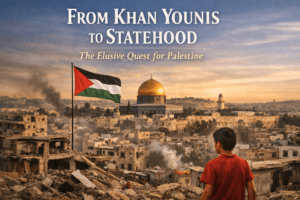
From Khan Younis to Statehood: The Elusive Quest for Palestine
The tragic deaths in Khan Younis, including a 15-year-old boy and a fisherman, represent more than isolated incidents—they are symptoms of a 78-year-old political failure to establish sovereignty for the Palestinian people.
The recent killing of three Palestinians in Khan Younis—a 15-year-old boy, a fisherman, and another man—serves as another tragic reminder of the ongoing conflict in Gaza. Despite over 80% of UN member states recognizing Palestine as a sovereign state, the Palestinian people continue to live under occupation, blockade, or partial control without true sovereignty. This article explores the complex historical, political, and diplomatic journey that has brought us to this moment, examining why formal international recognition has not translated into tangible statehood for Palestinians.
Historical Context: The Long Road from Partition to Recognition
The quest for Palestinian statehood has its roots in decisions made long before most people alive today were born. The timeline below highlights pivotal moments in this enduring struggle:
| Year | Event | Significance for Palestinian Statehood |
| 1947 | UN Resolution 181 (Partition Plan) | First international proposal for separate Jewish and Arab states; accepted by Jewish leaders but rejected by Arab states and Palestinians. |
| 1948 | Establishment of Israel; First Arab-Israeli War | Israel declares independence; Arab states intervene; Palestinian displacement (Nakba) begins. |
| 1967 | Six-Day War | Israel occupies West Bank, Gaza Strip, East Jerusalem, Sinai Peninsula, and Golan Heights. |
| 1974 | PLO recognized as Palestinian representative at UN | International recognition of Palestinian political identity begins. |
| 1988 | Palestinian Declaration of Independence | PLO declares State of Palestine; initially recognized by 78 countries. |
| 1993 | Oslo Accords | Creates Palestinian Authority as interim self-government; establishes framework for negotiations. |
| 2012 | Palestine becomes UN non-member observer state | Enhanced international status but not full UN membership. |
| 2024-2025 | New wave of Western recognitions | Ireland, Norway, Spain (2024); France, UK, Canada, Australia, others (2025) recognize Palestine. |
The historical trajectory reveals a central tension: international recognition has steadily grown while ground realities have increasingly complicated the establishment of a viable, contiguous state.
The 2025 Diplomatic Shift: Symbolism Versus Substance
September 2025 marked a potentially transformative moment when traditionally cautious Western powers changed their positions. In a coordinated diplomatic push led by France and Saudi Arabia, the United Kingdom, Canada, Australia, Portugal, Belgium, and several other European nations formally recognized the State of Palestine.
French President Emmanuel Macron framed this not as an anti-Israel move but as “a way of affirming that the Palestinian people is not a people too many”. The countries joining this recognition wave generally conditioned their decision on Palestinian commitments that Hamas would have no role in future governance, all hostages would be released, and Israel’s right to exist would be reaffirmed.
However, even with these recognitions, Palestine remains in a diplomatic limbo. It is recognized by 157 of 193 UN members but lacks full UN membership due to expected U.S. veto power in the Security Council. As Daniel Levy of the U.S./Middle East Project notes, “We are in a situation today where, increasingly, two states seems to be the stuff of fantasy given the realities on the ground”.
The Core Obstacles to Realizing Statehood
- The Sovereignty-Control Paradox
Despite widespread recognition, Palestine lacks what international law considers the essential attributes of statehood: exclusive control over territory, a monopoly on legitimate force, and the ability to conduct foreign policy independently. Israel maintains security control over significant portions of the West Bank through military administration and settlements, while Gaza has been under blockade since 2007.
Jon Alterman of the Center for Strategic and International Studies observes, “Palestine doesn’t have a lot of the characteristics that a state needs to have. It doesn’t have sovereignty. It doesn’t really control its own borders”.
- Palestinian Political Fragmentation
The division between Hamas-controlled Gaza and the Palestinian Authority-administered West Bank presents what Palestinian researcher Yousef Munayyer calls a “huge obstacle” to statehood. This split dates back to 2007 when Hamas violently seized control of Gaza from the Palestinian Authority, resulting in separate governing entities that have not held elections since.
The current leadership faces credibility challenges—Mahmoud Abbas, now 89, has been characterized as “weak, corrupt” and prone to deflecting “blame for his failure unto Israel”. Meanwhile, more popular figures like Marwan Barghouti remain imprisoned in Israel, creating a leadership vacuum.
- Israeli Policy Shifts
Israeli positions have fluctuated but hardened significantly in recent years. While Prime Minister Ehud Olmert made a substantial peace offer in 2008, current Prime Minister Benjamin Netanyahu has vehemently opposed Palestinian sovereignty. In 2023, he stated Israel would maintain “overriding security responsibility” in any future arrangement. More recently, amid the Gaza war, he vowed a Palestinian state “will not be established”.
The Israeli parliament formalized this opposition in July 2024, passing a resolution rejecting Palestinian statehood with 68 votes in favor. This legislative action reflects what analysts describe as “the most right-wing government in Israel’s history”.
- The American Veto and Geopolitics
The United States remains the decisive external actor. As a permanent Security Council member with veto power, it has consistently blocked Palestine’s full UN membership. While President Biden rejoined UNESCO in 2023 after a Palestinian membership controversy, the U.S. withdrew again after President Trump’s return to power in 2025.
This pattern creates what some diplomats call “diplomatic Groundhog Day“—cycles of violence followed by temporary ceasefires without addressing underlying sovereignty issues.
The Human Dimension: Statehood as More Than Diplomacy
Behind the political debates are real human consequences. The fisherman killed in Khan Younis represents communities denied access to their traditional livelihoods by naval blockades. The 15-year-old boy symbolizes a younger generation growing up knowing only occupation, blockade, or conflict.
Palestinians face what the Cairo Review describes as “settler-colonialism, apartheid, and genocide” in Gaza, with recognition alone doing little to address these realities. Even with increased diplomatic status, Palestinians lack the fundamental protections that statehood should provide.
Potential Pathways Forward
Despite the obstacles, several scenarios could alter the current trajectory:
- The “Premature State” Model: International law scholar James Crawford proposed the concept of a “premature state” that gains recognition before establishing all Montevideo Convention criteria, potentially applying to Palestine.
- International Protective Measures: Some advocates suggest that recognition should trigger concrete policies—sanctions, arms embargoes, and support for international legal mechanisms—rather than remaining symbolic.
- Regional Integration: Historical proposals for Jordanian or Egyptian administration of Palestinian territories resurface periodically, though neither Amman nor Cairo appears eager to assume responsibility for “rowdy and violent Palestinian militias”.
- Grassroots Palestinian Unity: Ultimately, as Hussain Abdul-Hussain argues, “Israel cannot build a Palestinian state for them. Only Palestinians can”. This would require reconciliation between Palestinian factions and development of effective governance structures.
Conclusion: Between Recognition and Reality
The tragic events in Khan Younis remind us that diplomatic recognition alone cannot stop bullets or provide sovereignty. The Palestinian quest for statehood stands at a crossroads: historically unprecedented international recognition on one hand, increasingly entrenched occupation and fragmentation on the other.
The fundamental dilemma remains: how to transform symbolic recognition into substantive sovereignty when key actors oppose it, when the territory is divided, and when the international community lacks consensus on enforcement mechanisms. Until this gap between diplomatic recognition and ground realities closes, incidents like those in Khan Younis will continue occurring in what is simultaneously recognized as the State of Palestine by most of the world, yet remains under another state’s effective control.
The path forward likely requires what French President Macron described at the UN: “tangible, timebound, and irreversible steps” rather than mere declarations. Whether the international community can muster the political will to implement such steps remains the unanswered question at the heart of both the Khan Younis tragedy and the broader Palestinian struggle for self-determination.
You must be logged in to post a comment.