
From Himalayan Streams to Telangana Tanks: How a High-Tech Farm is Rewriting India’s Aquaculture Map
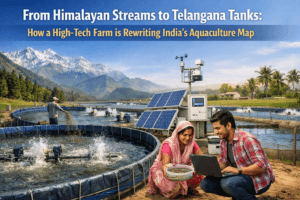
From Himalayan Streams to Telangana Tanks: How a High-Tech Farm is Rewriting India’s Aquaculture Map
In a quiet corner of Ranga Reddy district, Telangana, where the air typically hums with dry heat, a quiet revolution is taking place inside a series of precisely engineered tanks. On January 5, 2026, Union Minister Shri Rajiv Ranjan Singh inaugurated a facility that challenges a fundamental law of nature: that certain fish belong only to certain climates. The inauguration of the Smart Green Aquaculture Farm and Research Institute, with its state-of-the-art Recirculatory Aquaculture System (RAS), isn’t just another farm launch; it’s a宣言 that India’s aquaculture future will be engineered, not just harvested.
For decades, the delicate, high-value rainbow trout was a prisoner of geography in India. Its need for cold, oxygen-rich, flowing water confined it to the Himalayan states—Uttarakhand, Himachal Pradesh, Jammu & Kashmir. It was a niche product, a delicacy for tourists in hill stations, its supply limited by the very streams it called home. The idea of farming it commercially in tropical Hyderabad was considered, at best, a fantastical and expensive experiment.
Smart Green Aquaculture Limited has turned that notion on its head. Their achievement is a masterclass in applied environmental engineering. The core of this breakthrough is the Recirculatory Aquaculture System (RAS), a “closed-loop” technology that is as much about microbiology and robotics as it is about fish.
The Engine Room: More Than Just Water in a Loop
To call an RAS a “water recycling system” is to call a smartphone a “telephone.” It is a life-support system of staggering complexity. Here’s what happens behind the scenes:
- Physical Filtration: Solid waste is removed within minutes, keeping the water crystal clear.
- Biological Filtration: This is the heart. Billions of beneficial bacteria, housed in massive biofilters, perform a miraculous alchemy. They convert toxic ammonia (from fish waste) into nitrites and then into harmless nitrates. This process, known as the nitrogen cycle, is what allows the same water to be reused over 95-99%.
- Water Sterilisation: UV and ozone systems relentlessly patrol for pathogens, ensuring disease cannot gain a foothold in the pristine environment.
- Precision Oxygenation and Cooling: Computer-controlled oxygen injectors maintain dissolved oxygen at optimal levels, while chillers work round-the-clock to keep the water at a steady, chilly temperature trout thrive in—a perpetual artificial winter in the middle of Telangana.
- Digital Nervous System: Sensors monitor every conceivable parameter—pH, temperature, oxygen, salinity—feeding data to a central control system that makes micro-adjustments in real time. The fish are living in a algorithmically managed habitat.
This technological symphony allows for an astonishing 10-20 times higher stocking density than traditional ponds, on a fraction of the land and using less than 5% of the water a conventional farm would need. The implications for water-scarce regions are profound.
Beyond the Fish: Ripple Effects of a Breakthrough
The value of this farm extends far beyond its capacity to produce gourmet trout.
- A Living Classroom for a New Generation:The facility doubles as a Research Institute. In a country where aquaculture is often associated with traditional knowledge, this farm is training a new cadre of “blue-tech” professionals. Youth are gaining hands-on experience in robotics, hydro-chemistry, genetics, and system management. This isn’t just fish farming; it’s building human capital for theFourth Blue Revolution, where tech-savvy graduates see fisheries as a high-skill, high-growth career.
- Decentralising Prosperity, De-risking Supply:Currently, India’s cold-water fisheries are clustered in specific regions. By proving the climate-agnostic model, RAS technology opens the door for high-value aquaculture to be set up near major urban consumption centres—Mumbai, Bangalore, Delhi—drastically reducing transport costs, carbon footprint, and delivering a fresher product. It also insulates production from the climate vulnerabilities of river-based systems.
- A Template for Species Diversification:If rainbow trout can be farmed in Hyderabad, what’s next? Atlantic salmon? Sturgeon for caviar? The success establishes a playbook for domesticating other high-value, temperature-sensitive species. This reduces import dependence and creates new export opportunities. India’s aquaculture story, long dominated by shrimp and carp, is getting a luxurious new chapter.
The National Blueprint: Government Vision Meets Private Innovation
This private-sector milestone dovetails perfectly with the Government of India’s strategic push. The Rs. 38,572 crore investment in the sector since 2015, under schemes like the Pradhan Mantri Matsya Sampada Yojana (PMMSY), is creating the fertile ground for such innovations. The government’s focus is multi-pronged:
- Developing Cold-Water Clusters in Himalayan states (as notified for J&K, Ladakh, Uttarakhand, Himachal) for traditional, resource-based farming.
- Promoting Technology Adoption like RAS for climate-resilient, intensive production anywhere.
- Boosting Seed Production, with trout seed production now at 14 lakh annually.
- Linking Livelihoods, like the Uttarakhand-ITBP MoU to supply trout under the Vibrant Villages Programme.
The Smart Green Aquaculture farm is a vivid manifestation of this policy direction. It shows what happens when national ambition (to transform fisheries into a tech-driven growth engine) meets private investment and engineering prowess.
The Challenges on the Horizon
The path forward is not without hurdles. RAS facilities are capital-intensive, with high upfront costs for equipment and significant energy demands for running pumps, chillers, and filters. The economic viability hinges on achieving premium prices for the output and scaling up efficiently. Furthermore, the sector needs a steady stream of trained technicians to maintain these complex biological factories. The farm’s role as a training institute is therefore not an add-on, but a critical component of its own sustainability and for the sector at large.
A Watershed Moment, Indeed
As the Union Minister cut the ribbon, he wasn’t just inaugurating a fish farm. He was opening a window to a new paradigm for Indian agriculture. This facility in Kandukur is a powerful symbol of a nation moving from being a prisoner of its geography to an architect of its own biosphere.
It proves that with intelligence, investment, and innovation, we can create the exact conditions for prosperity to thrive—anywhere. The water in those tanks is more than just a medium for raising trout; it’s a mirror reflecting a future where India doesn’t just adapt to its environment, but thoughtfully, sustainably engineers it for food security, economic growth, and technological leadership. The message is clear: in the new blue economy, the climate is not a constraint, but a variable to be managed.
You must be logged in to post a comment.