
From Ground Up: How India’s 2025 Startups Built Hope by Solving Local Problems
In 2025, a wave of Indian startups redefined innovation by tackling hyper-local environmental and social problems with deeply personal, grassroots solutions. Moving beyond Silicon Valley models, founders drew from direct experience—like childhood beach cleanups or memories of daily wage laborers—to build ventures that turn ocean plastic into furniture, create drinking water from air, and digitize informal labor markets.
These companies successfully intertwine environmental healing, community upliftment, and sustainable economics, proving that addressing urgent, visible challenges can build viable businesses. Supported by growing cleantech investment and consumer demand for ethics, this trend marks a significant shift toward an entrepreneurship model where profit and profound purpose are fundamentally linked, building a more hopeful and inclusive future from the ground up.
From Ground Up: How India’s 2025 Startups Built Hope by Solving Local Problems
In 2025, a powerful narrative emerged from India’s innovation landscape. The most compelling stories of entrepreneurship no longer originated solely in the glass-walled boardrooms of Bengaluru or Gurugram. Instead, they were born on littered beaches, in crowded urban slums, and in remote village schools. This year, a new wave of startups demonstrated that the most sustainable and impactful businesses are those that solve the pressing, visible problems right outside the founder’s own window.
This shift represents more than a trend; it’s a fundamental rethinking of innovation. Backed by a surge in cleantech funding, which grew 43% to $2.6 billion in India, these founders are building ventures that measure success not just in valuation, but in kilograms of waste diverted, millions of litres of clean water produced, and thousands of livelihoods dignified.
The Heart of the Matter: Startups with a Personal Mission
What sets these companies apart is the profound personal connection each founder has to the problem they’re solving. Their ventures are extensions of their life stories, which fuels a resilience that goes beyond typical entrepreneurship.
- Transforming Personal Grief into Environmental Healing: For Siddharth A K of Carbon & Whale, cleaning beaches was a childhood ritual with his mother. After losing her, it became a source of grounding. The futility of seeing litter return the day after a cleanup pushed him to find a permanent solution. He sold personal belongings to fund research, ultimately co-founding a startup that turns plastic waste into durable furniture and tiles. This personal mission has helped divert 10,000 kg of plastic from Kerala’s coastline.
- Channeling Personal Loss into Affordable Healthcare: Rajvinder Kaur’s venture, Incredible Devices, was born from a painful question after her husband died from a cardiac arrest: why is timely heart care unaffordable for so many? She co-developed a system to safely reprocess expensive cardiac catheters, slashing their cost by up to 99% and making life-saving procedures accessible.
- Digitizing the Labour Chowk from Memory: Chandrashekhar Mandal’s “Digital Labour Chowk” was inspired by a rainy-day memory. Watching daily wage workers scramble for shelter, he recalled his relatives in Bihar doing the same. He quit his finance job to build what he calls a “LinkedIn for blue-collar workers,” now used by over one lakh workers to find jobs with dignity and choice.
Beyond Profit: A Triad of Impact
These startups are archetypes of a sustainable business model that balances three core pillars from inception:
| Startup | Core Solution | Environmental/Social Impact | Economic Model & Scale |
| Carbon & Whale | Furniture from ocean plastic | Diverted 10,000+ kg of waste; cleaner beaches | Revenue from product sales; projected ₹5 crore by 2025 |
| Akvo Atmospheric Water | Water-from-air generators | 100M+ litres produced, zero groundwater used | B2B/BOOT models; 2,000+ units in 15 countries |
| AGRATE | Sustainable farming tools & inputs | Supported 10,000+ farmers with better practices | ₹2.5 crore turnover; partnerships with major corps |
| Digital Labour Chowk | App for daily wage workers | Dignity & choice for 1 lakh+ blue-collar workers | Free for workers; revenue from employer side |
- Environmental Ingenuity
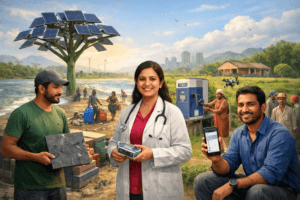
The environmental solutions are strikingly pragmatic. Faced with India’s land scarcity, Shani Pandya asked why solar power needed acres. His answer was the “solar tree,” which fits 45 panels on a single pole, reducing land use from 2,200 sq ft to just 2 sq ft. Similarly, Rupankar Bhattacharjee and Aniket Dhar saw Assam’s water hyacinth—a weed choking wetlands—not as a nuisance, but as raw material for beautiful, tree-free paper.
- Deep Social Integration
The social impact is woven into the business fabric. These startups often create virtuous cycles where solving an environmental problem also uplifts communities. The brothers behind Scrapdeal didn’t just build a recycling app; they formalized and dignified the work of the kabadiwala (scrap dealer), offering transparent weighing and instant digital payments.
- Sustainable Economic Models
Economically, they prove that impactful businesses can be viable. Many are bootstrapped or frugally funded, focusing on unit economics from the start. Scrapdeal, started with student pocket money, is now a Rs 2 crore operation. Akvo has achieved global scale with over 2,000 installations without relying on heavy external investment, choosing sustainable growth instead.
The Bigger Picture: India’s Maturing Innovation Ecosystem
The rise of these grassroots startups is not occurring in a vacuum. It is fueled by a powerful convergence of factors that define India’s 2025 innovation ecosystem.
- Regulatory and Policy Support: Government initiatives like Startup India and sector-specific Production-Linked Incentive (PLI) schemes have moved sustainability from a voluntary ideal to a integrated part of national policy, reducing market-entry friction for new ventures.
- A Powerful Market Shift: With over 700 million internet users, Indian consumers—especially younger demographics—are increasingly demanding transparent and ethical products. Startups like iD Fresh Food have successfully built direct-to-consumer brands that meet this demand.
- The Capital Is Flowing: The dramatic 43% year-on-year increase in cleantech funding to $2.6 billion shows that impact-focused capital is now mainstream. Investors are competing to back businesses that solve hard problems, creating a “founder’s market” for genuine innovators.
Furthermore, a parallel, government-backed revolution is brewing in deep tech. The launch of the $1.25 billion IndiaAI Mission marks a strategic push for sovereignty in artificial intelligence. This initiative addresses a historic gap in R&D spending and aims to build foundational AI models that work for India’s linguistic diversity, applying AI to critical sectors like agriculture, healthcare, and education. This national-level ambition in technology provides a broader infrastructure within which grassroots startups can eventually thrive and scale.
Navigating the Inevitable Challenges
Despite the optimism, the path for these startups is fraught with hurdles that test their founder-led resilience.
- The Scale Challenge: As noted by observers of India’s water management startup scene, achieving global scale is a significant hurdle. The market is sensitive and often requires navigating complex bureaucracy and old policies that can act as barriers to entry.
- The Resource Gap: The struggle for resources is starkly evident in the AI sector. Indian AI founders have watched with a mix of inspiration and dismay as global peers with larger funding outpace them. Abhishek Upperwal of Soket AI Labs reflected that with better funding two years ago, his team could have built what others have just released.
- Proving Long-Term Viability: The ultimate test is transitioning from a passionate project to a enduring business. This requires moving beyond community support to robust, scalable unit economics that can withstand market pressures and outlive the founder’s initial drive.
Key Takeaways for the Next Generation of Founders
The stories of 2025 offer clear lessons for anyone looking to build a business that matters:
- Start with What You Know: The most powerful solutions are born from intimate, personal understanding of a problem. Look to your own experiences, community, and environment for the problem worth solving.
- Build a Multi-Sided Value Proposition: Integrate environmental, social, and economic value from day one. This “triple bottom line” approach is what makes a business resilient and attractive to modern consumers and investors.
- Leverage the Ecosystem: Utilize the unprecedented availability of policy support, consumer demand for ethics, and impact-focused capital. These macro-trends are tailwinds for sustainable business.
- Prepare for the Long Haul: Solving deep-rooted problems requires patience and prudence. As one ecosystem builder noted, success requires “understanding the perception and sentiment of the last mile”.
The narrative of Indian innovation in 2025 is being rewritten. It is a story where profit and purpose are not trade-offs but prerequisites for each other. From the solar tree that fits in a courtyard to the mobile lab that brings drones to village children, these startups are building a tangible, hopeful future. They prove that the most advanced technology is sometimes not the most complex one, but the one applied with the most heart, to the problems that matter most.
You must be logged in to post a comment.