
From Grief to Green: How One Woman’s Leadership Transformed a Village into India’s Climate Vanguard
Yogeshwari Chaudhary, a widowed schoolteacher turned sarpanch, transformed Maharashtra’s struggling Dawwa village into a national model for sustainable development by harnessing community participation and state schemes. After her election in 2023, she revived degraded farmland and reversed youth migration by introducing solar-powered irrigation, diversifying crops through farmer field schools, and empowering 38 women’s self-help groups as economic engines. Her leadership drove the planting of over 116,000 trees, instituted rigorous waste management, and brought solar energy to public spaces, culminating in the village winning India’s inaugural Climate Action Special Panchayat Award in 2025. Dawwa’s journey from hardship to a Rs. 1.61-crore award-winning community demonstrates that effective climate action is rooted in inclusive governance, gender empowerment, and turning collective hope into tangible ecological and economic revival.
From Grief to Green: How One Woman’s Leadership Transformed a Village into India’s Climate Vanguard
In the heart of Maharashtra’s Gondia district, a quiet revolution is taking root. Dawwa village, once a picture of agricultural struggle and outward migration, now stands as a living blueprint for rural India’s sustainable future. The catalyst for this change was not a sweeping government mandate or a hefty corporate grant, but the resolve of a single woman: Yogeshwari Chatrugan Chaudhary, a widowed schoolteacher who turned personal tragedy into a collective triumph. Her journey, and that of her village, reveals a powerful truth: transformative climate action is less about technology alone and more about governance, empathy, and unwavering community spirit.
The Unlikely Architect of Change
Yogeshwari’s story begins not in the panchayat office, but in profound loss. After her husband’s sudden passing in 2017, she was left as a single mother, grappling with grief and an uncertain future. Rather than retreating, she chose to look outward at her struggling community. Dawwa was caught in a debilitating cycle—degraded soil, failing monsoons, and a steady exodus of its youth seeking work in distant cities. The village’s decline was a mirror to challenges faced by thousands of rural Indian communities.
Armed with an education and a deep connection to her home, but with no political pedigree, Yogeshwari made a daring decision: she would run for sarpanch. In December 2023, backed by community trust, she won decisively, becoming Dawwa’s first woman village head. Her mandate was clear, not from a party manifesto, but from the shared despair and hope of her neighbors. She didn’t just inherit a administrative role; she embraced a mission to rebuild from the ground up.
Building a Foundation on Participation, Not Decree
What distinguishes Yogeshwari’s leadership is her foundational approach. She began with samvaad (dialogue), not aadesh (order). Recognizing that a village of 796 households held the keys to its own revival, she instituted a model of participatory governance that is often praised but rarely practiced so effectively.
She formed focused committees—on water, biodiversity, sanitation, and disaster management—ensuring every household had a representative voice. This was crucial. As development expert Kishore Bansode notes, the projects that followed succeeded because they were owned by the community, not just delivered to it. This structure also served as Yogeshwari’s anchor, guiding her through the complex maze of panchayat administration with mentorship from former sarpanch Shri Bahekar.
Her strategic masterstroke was seamlessly dovetailing Dawwa’s ambitions with broader state initiatives like Maharashtra’s Majhi Vasundhara 4.0 campaign. This provided a framework, credibility, and eventually, critical funding. It’s a lesson in grassroots governance: local vision must be astutely paired with larger schemes to achieve scale and sustainability.
The Pillars of Transformation: Smarter Ecology and Empowered Economics
Dawwa’s metamorphosis rests on two intertwined pillars: ecological restoration and economic empowerment, each fuelling the other.
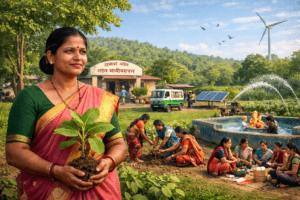
- The Green Reclamation:The most visible sign of change is Dawwa’s new canopy. Over116,000 trees—a mix of teak, fruit orchards, and native species—now stand where barren land once lay. This wasn’t a top-down plantation drive. It involved village nurseries, seed-ball scattering campaigns, and the conversion of private farmland. Yogeshwari led by example, dedicating five of her own eight acres to teak. This greening serves multiple purposes: it restores soil health, improves micro-climates, provides future timber income, and literally roots the community’s commitment to their land.
Complementing this was a rigorous waste management system. Segregation, composting, and a fleet of electric vehicles for collection transformed waste from a nuisance into a resource. Bans on plastic and firecrackers further reduced the village’s environmental burden.
- Energy and Agricultural Revival:Perhaps the most impactful intervention was in energy and irrigation. Yogeshwari, through relentless follow-up, leveraged state subsidies like theMagel Tyala Saur Krushi Pump Yojana to bring solar-powered irrigation to farmers. For smallholders, a 95% subsidy on solar pumps was a game-changer, liberating them from erratic grid power and costly diesel.
This clean energy access catalyzed an agricultural revolution. Yogeshwari promoted diversification—encouraging farmers to move beyond paddy to orchards, vegetables, and livestock. She established Shetishalas (Farmers’ Field Schools) where practical, hands-on training in sustainable techniques took place on demonstration plots. The result? Increased yields, improved incomes, and a dramatic drop in the necessity for migration. As former migrant worker Digambar Lanjewar proudly states, he is now a full-time farmer in his home village.
- The Engine of Women’s Empowerment:Central to this economic shift were the38 Women’s Self-Help Groups (SHGs) formed under Yogeshwari’s guidance. These became the financial and entrepreneurial backbone of Dawwa. Women moved from being farm helpers to farm managers, handling accounts, making decisions, and running micro-enterprises. This financial autonomy transformed gender dynamics and ensured that development was inclusive. “We are no longer just helpers,” shares SHG leader Mamta Katre, encapsulating a silent social revolution.
The Crucible of Leadership: Navigating Conflict
True leadership was tested not during success, but during resistance. When Yogeshwari constructed an immersion tank to prevent festival idols from polluting local water bodies, she faced significant backlash, even to the point of police being called. This conflict between tradition and ecological necessity is a flashpoint in many Indian villages.
Yogeshwari stood firm, framing the issue not as disrespect to faith but as duty to the Panchabhutas (the five elemental forces: earth, water, fire, air, and space). “My duty isn’t confined to roads or drains,” she asserted. Her perseverance paid off. Two years later, the same tank is used collectively by the village—a powerful testament to how patient, principled leadership can shift cultural norms toward sustainability.
Recognition and a Replicable Model
Dawwa’s efforts culminated in historic national recognition: becoming the first Indian village to win the Climate Action Special Panchayat Award (CASPA) in 2025, along with a Rs. 1 crore prize. Combined with other state awards, the village garnered accolades worth Rs. 1.61 crore—a financial injection that will fuel future projects.
A key factor in this win was transparency. Yogeshwari meticulously documented every project, using smartphone geotagging and the Bhuvan app for GPS verification. This created an irrefutable digital trail of work done, a model for accountability that other panchayats can emulate.
The Human Insight: What Dawwa Teaches Us
Dawwa’s story is more than a checklist of environmental achievements. It offers profound insights for rural development:
- Leadership is About Empathy, Not Authority: Yogeshwari’s credibility stemmed from shared struggle, not imposed power. Her personal story of resilience made her mission relatable and urgent.
- Climate Action is Local Governance: The most effective climate solutions—water harvesting, afforestation, waste management—are executed at the village level. Empowering local, accountable leadership is therefore a critical climate strategy.
- Inclusion is Non-Negotiable: By placing women’s SHGs at the core of economic change, Dawwa ensured benefits were widespread and sustainable. Development cannot be lasting if it excludes half the population.
- Technology is an Enabler, Not a Savior: Solar pumps and mini-grids were vital, but they worked because they were embedded in a framework of farmer training, community ownership, and maintained through diligent bureaucratic engagement.
Standing under the shade of young teak trees she helped plant, Yogeshwari Chatrugan Chaudhary reflects, “We planted hope along with these saplings.” Today, Dawwa is a thriving testament to that hope. It proves that the fight against climate change and rural distress can be won not in distant conference halls, but in the fields, homes, and panchayat meetings of India’s villages, provided there is a leader who listens and a community that dreams together. The seeds sown in Dawwa are now beginning to forest a new future for rural India.
You must be logged in to post a comment.