
From Grassroots to GDP: How India’s Small Sustainable Choices Are Building a $1 Trillion Green Economy
From Grassroots to GDP: How India’s Small Sustainable Choices Are Building a $1 Trillion Green Economy
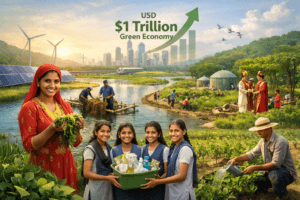
- The macro shift: Individual stories of sustainability in India are no longer isolated acts of conscience but the foundational pillars of a massive economic transformation. From teen activists to village leaders, these efforts collectively feed into a green economy projected to be worth USD 1.1 trillion by 2047.
- The seaweed revolution: At the intersection of environmental action and economic opportunity lies India’s burgeoning seaweed industry. What begins as a plastic-alternative startup in Pune can tap into a domestic market growing at 7.79% annually, aiming to reach USD 625.9 million by 2034.
- The job engine: This green transition is fundamentally about livelihoods. Beyond restoring ponds and planting trees, these activities are part of value chains capable of creating 48 million full-time jobs within the next two decades, offering a new development pathway for rural and urban India alike.
The Seed and the System: How Micro-Stories Feed a Macro Economy
The story of four teen girls in Ghaziabad launching a startup to fight plastic waste is more than a heartwarming tale of youth activism. It is a microcosm of India’s broader shift toward a circular economy, where waste is reimagined as resource and problems spark entrepreneurial solutions. Similarly, when a Bhopal couple chooses a wedding that diverts 45 kg of plastic and empowers 50 local women, they are not just hosting a party. They are participating in and validating a consumer-led revolution toward mindful consumption. This growing demand for sustainable goods and experiences is the very force driving markets for plant-based foods, eco-friendly cosmetics, and plastic alternatives—sectors where seaweed is emerging as a star player.
These individual choices gain monumental significance when viewed through the lens of national strategy. A landmark report by the Council on Energy, Environment and Water (CEEW) titled Building a Green Economy for Viksit Bharat maps this precise convergence. It reveals that the collective outcome of these dispersed actions—the village plantations, the water revivals, the sustainable celebrations—could unlock a market value of Rs 97.7 lakh crore (USD 1.1 trillion) by 2047. This isn’t a separate “green sector” but a fundamental reimagining of mainstream industries—from agriculture and packaging to energy and tourism—where sustainability is the core of competitiveness and job creation.
Case in Point: The Seaweed Story from Coast to Cupboard
Perhaps no example better illustrates this link between local action and national economic opportunity than India’s seaweed narrative. For coastal communities, cultivating seaweed has long been a small-scale activity. Today, it is being recognized as a cornerstone of India’s Blue Economy strategy, with the potential to transform livelihoods along the nation’s 8,118-km coastline.
The following table outlines the primary segments and applications driving India’s seaweed market growth:
| Market Segment | Key Applications | Primary Drivers & Examples |
| Food & Beverages | Snacks, seasonings, hydrocolloids (agar, carrageenan), functional foods | Rising health consciousness, plant-based diet trends, popularity of Asian cuisines. |
| Agriculture & Animal Feed | Bio-fertilizers, biostimulants, feed additives | Shift toward organic farming, need for sustainable livestock and aquaculture feed. |
| Cosmetics & Pharmaceuticals | Skincare serums, face masks, shampoos, medicinal extracts | Demand for natural, bioactive ingredients with anti-aging and anti-inflammatory properties. |
| Industrial & Packaging | Bioplastics, biodegradable films, bio-packaging, biofuels (R&D) | Innovation to replace single-use plastics and fossil-fuel-based materials. |
From Pollution Solution to Economic Engine
The journey of Neha Jain and her startup Zerocircle perfectly encapsulates this evolution. Disturbed by plastic pollution, she looked to the sea for an answer. Her company now creates home-compostable, edible packaging films from seaweed, offering a viable alternative for everything from shopping bags to tea bags. This innovation, which won the Tom Ford Plastic Innovation Prize, solves an environmental problem while creating a new value-added product from a marine resource.
This individual enterprise plugs directly into a vast economic pipeline. The CEEW report identifies seaweed cultivation for bioplastics as a green value chain with the potential to generate 900,900 jobs by 2047. Furthermore, companies like Sea6 Energy are industrializing the process, developing mechanized, large-scale farming and partnering with giants like Hindustan Petroleum Corporation Ltd (HPCL) to explore seaweed-based biofuels. This progression—from a founder’s idea to scalable industry to high-value research partnerships—shows how a sustainability challenge can be systematically transformed into an economic opportunity.
The Green Growth Multiplier: Water, Forests, and Sustainable Livelihoods
The ripple effects of green initiatives extend far beyond their immediate scope. Consider the couple who, with 400 villagers, revived 11 dead water bodies in drought-prone Anantapur. This isn’t just water conservation; it’s climatic buffer creation and livelihood restoration. Healthy water bodies recharge groundwater, support agriculture, and revive local biodiversity. This aligns with national opportunities in wetland management and mangrove restoration, which the CEEW report estimates could have a market value of Rs 7,500 crore, creating sustainable livelihoods through ecotourism and fisheries support.
Similarly, when a sarpanch like Pratibha Shinde mobilizes her village to plant 1,16,000 trees and adopt solar power, she is building natural infrastructure. This combats soil degradation, provides food and fodder, and creates a cooler microclimate. On a national scale, this mirrors the immense opportunity in chemical-free and natural farming. The shift to organic agriculture is projected to contribute a market value of Rs 8.04 lakh crore by 2047, improving soil health, on-farm biodiversity, and farmer incomes.
The table below highlights the scale of economic potential within specific green value chains identified in national research:
| Green Value Chain | Projected Market Value by 2047 | Key Economic & Social Impact |
| Chemical-Free Agriculture | Rs 8.04 Lakh Crore | Market for 2,197 lakh MT of produce; improves soil health and farmer resilience. |
| Sustainable Packaging | Part of broader bio-economy | Could create ~549,600 jobs; utilizes agro-waste to reduce stubble burning and plastic pollution. |
| Seaweed Cultivation for Bioplastics | Part of broader blue economy | Could create ~900,900 jobs; boosts coastal livelihoods and provides plastic alternatives. |
| Wetland & Mangrove Management | Rs 7,500 Crore | Supports biodiversity, fisheries, and eco-tourism; protects coastlines. |
Navigating the Path Forward: Challenges and Essential Enablers
For this green growth narrative to fully materialize, certain persistent challenges must be addressed. As noted in market analyses, limited consumer awareness and acceptance of new products like seaweed-based foods remains a barrier. The supply chain for emerging bio-resources is also fragile, facing issues like seasonal dependence, post-harvest losses, and a lack of processing infrastructure. Streamlining regulatory frameworks and ensuring clear food safety and quality certifications are also critical to building market confidence.
Overcoming these hurdles requires a three-pronged approach:
- Continued Policy Catalysis: Government initiatives like the Pradhan Mantri Matsya Sampada Yojana (PMMSY), which has allocated Rs 640 crore for seaweed cultivation, are vital. Policy must continue to provide financial support, foster public-private partnerships, and build research and development infrastructure like seed banks and hatcheries.
- Innovation and Entrepreneurship: The spirit shown by the teen girls of Pahal, Neha Jain of Zerocircle, and countless others must be scaled. This requires green capital and support systems like accelerators (exemplified by Zerocircle’s induction into the Marico Innovation Foundation’s Scale-Up program) to help innovations reach commercial viability and market.
- Building a Supportive Ecosystem: As Abhishek Jain of CEEW states, unlocking potential requires “green entrepreneurs, green innovation, and green capital to come together“. This ecosystem includes skilled workers—evident in the demand for Research Assistants in seaweed labs—informed consumers, and collaborative networks between communities, industry, and academia.
The Bigger Picture: A Redefined Development Pathway
The ultimate insight from weaving together these local stories and national data is that India is prototyping a new development paradigm. This model doesn’t view environmental care as a trade-off for economic growth but as its very engine. It’s a vision where:
- A plastic-free wedding directly supports women artisans and stimulates demand for sustainable goods.
- A revived village pond enhances climate resilience and agricultural productivity.
- A seaweed farm simultaneously provides a farmer’s income, a raw material for biodegradable packaging, and a natural carbon sink.
As Amitabh Kant, former CEO of NITI Aayog, asserted, India has the chance to “pole-vault into a green economy,” much as it leveraged digital infrastructure for technological leapfrogging. The grassroots stories of sustainability are the first powerful strides in that jump. They prove that the values of conservation and community are not just ethically sound but are the bedrock of a market-positive, job-intensive, and low-carbon future for India. The task ahead is to connect these countless dots of hope and effort into an unstoppable wave of green growth.
You must be logged in to post a comment.