
From Gaza to Tehran: The Dangerous Export of Israel’s Extermination Rhetoric
The recent escalation between Israel and Iran represents a dangerous fusion of ancient religious rhetoric with modern military conflict, as Israeli leaders invoke biblical narratives like the story of Amalek—a scriptural mandate for total annihilation—and frame the war through the lens of the Purim holiday, casting Iran as a modern-day Persia led by a villain like Haman who must be destroyed. This rhetorical strategy mirrors the language used during the Gaza genocide, effectively transferring a genocidal playbook to a much wider regional theater, with devastating human consequences already evident in mounting civilian casualties, including the targeting of an Iranian school that killed 168 people. When both sides frame the conflict through apocalyptic theology—Israeli messianism viewing itself as executing divine will against Iranian “prophetic Islamist delusions”—compromise becomes impossible, transforming a geopolitical struggle into a holy war with no logical endpoint other than total victory.
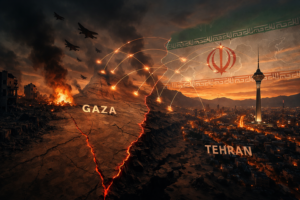
From Gaza to Tehran: The Dangerous Export of Israel’s Extermination Rhetoric
The recent escalation between Israel and Iran marks a significant and dangerous turning point in Middle Eastern geopolitics. While the immediate triggers involve missile strikes and military operations, a deeper, more volatile layer has been added to the conflict: the language of holy war. By invoking ancient theological concepts, Israeli leaders are framing the confrontation not merely as a political or territorial dispute, but as an existential, divinely mandated struggle. This shift mirrors rhetoric previously employed during the operations in Gaza, suggesting the adoption of a familiar, and highly controversial, playbook .
This analysis explores how biblical narratives, particularly the story of Amalek and the festival of Purim, are being used to shape the conflict with Iran. It examines the implications of this rhetorical strategy and considers the ideological dimensions on both sides, drawing on recent statements, historical context, and on-the-ground reporting.
The Ghost of Amalek: From Gaza to Tehran
On March 2, 2026, Israeli Prime Minister Benjamin Netanyahu stood in the city of Beit Shemesh, at the site of a deadly Iranian missile strike that had killed nine Israelis . In his address to the media, he delivered a message that resonated far beyond the immediate political context. “In this week’s Torah portion, we read ‘Remember what Amalek did to you,'” Netanyahu stated. “We remember and we act” .
This reference to Amalek is loaded with profound and violent significance. In Jewish scripture, the Amalekites are depicted as the archetypal enemy of the Israelites, who attacked the weak and weary from behind during the Exodus from Egypt . The divine command is not just to remember this act of aggression, but to utterly destroy them: “kill both man and woman, child and infant” (I Samuel 15:3) .
For critics and international observers, the invocation of Amalek moves beyond metaphorical language of good versus evil and enters the realm of incitement. This is not the first time this rhetoric has been used in recent conflicts. During the early stages of the Gaza war in October 2023, Netanyahu told Israeli soldiers, “You must remember what Amalek has done to you… and we do remember” . The phrase “wipe out the memory of Amalek” became a dog whistle within Israel’s far-right, widely interpreted as a call for the extermination of the Palestinian people in Gaza .
Now, by applying this same theological framework to Iran, analysts argue that the Israeli government is transferring the genocidal logic that defined the Gaza campaign to a new, far more expansive theater . The implication is stark: if Hamas was Amalek, and now Iran is being cast in the same role, then the perceived biblical mandate for total eradication could be seen to apply to the Iranian regime and, by extension, those associated with it.
The Purim Parallel: Slaying a Modern Haman
The timing of the recent escalation has added another powerful layer of religious symbolism. The joint US-Israeli military operation against Iran began on the eve of Purim, one of the most widely celebrated holidays in the Jewish calendar .
Purim commemorates the story of Esther, in which the Jewish people of the ancient Persian Empire are saved from a genocidal plot devised by Haman, a high-ranking official in the Persian court. Haman’s plan to “destroy, kill, and annihilate all the Jews” is thwarted, and he is ultimately executed. The story is one of survival against overwhelming odds in a foreign land .
The connection to modern Iran has been explicitly drawn by Israeli politicians. The assassination of Iranian Supreme Leader Ali Khamenei in the opening strikes of the war was celebrated in terms straight out of the Purim story. National Security Minister Itamar Ben-Gvir declared that there had been a “great miracle…like on Purim” and that “they will all end like Haman” .
This framing recasts a complex modern nation-state with its own history, culture, and internal politics as a real-life Persia, and its leadership as a villain from scripture whose fate is divinely sealed. It transforms a modern military campaign into a reenactment of a sacred drama. Defense Minister Israel Katz’s subsequent statement that Iran’s next leader, whether Mojtaba Khamenei or another, is an “unequivocal target for elimination,” fits within this Purim narrative . Just as the story of Esther concludes with the Jews gaining “rule over those who hated them,” the current conflict is being portrayed by some as a continuation of that ancient victory .
A Clash of Apocalyptic Worldviews
While Israeli leaders frame the conflict through the lens of the Torah and Purim, they simultaneously accuse their adversaries of being driven by religious fanaticism. Secretary of State Marco Rubio justified the attacks by arguing that the Iranian regime is “led by radical clerics who make decisions on the basis of their view of theology, which is an apocalyptic one” . Defense Secretary Pete Hegseth echoed this, claiming Iran is “hell-bent on prophetic Islamist delusions” .
This characterization, however, overlooks the growing influence of religious messianism within the Israeli government and military. Reports from within the US military, a key partner in the “Operation Roaring Lion” campaign, suggest that apocalyptic thinking is not confined to Tehran . According to the Military Religious Freedom Foundation, commanders at 30 different US installations have reportedly framed the war as part of “God’s plan,” with some telling troops that the Book of Revelation is being fulfilled and that Jesus will return soon. One commander allegedly stated that former President Trump was “anointed by Jesus to light the signal fire in Iran to cause Armageddon and mark his return to Earth” .
This creates a profoundly dangerous dynamic: a conflict in which both sides can perceive themselves as agents of divine will. From an Iranian perspective, the confrontation is not merely political but an ideological clash rooted in justice and resistance to domination. An analysis from an Iranian outlet frames the conflict as a collision between “religious Zionism, which sanctifies political and military power through ethnocentric and exclusionary interpretations of religion,” and a “resistance discourse” based on “principles of justice, defense of the oppressed, and rejection of domination” . While this perspective reflects Tehran’s official narrative, it underscores the depth of the ideological chasm. When both sides believe God is on their side, compromise becomes not just difficult, but heretical.
The Human Cost of Sacred Rhetoric
The translation of this sacred language into military policy has tangible and devastating consequences. The principle of “collective punishment,” which critics argue is inherent in the Amalek narrative, appears to be manifesting in the conduct of the war .
Just as the Gaza campaign was characterized by the widespread destruction of residential neighborhoods and civilian infrastructure, early reports from Iran indicate a similar pattern. A US-Israeli strike reportedly targeted an elementary school in the town of Iran, killing at least 168 people, many of them young girls. Observers were quick to note the “haunting” resemblance to the massacres of children and the destruction of educational institutions in Gaza .
The scope of the conflict has expanded rapidly. Iran has launched retaliatory strikes not only at Israel but at US assets and allies across the region, including in Qatar, where missiles were intercepted over Doha, and in Azerbaijan . The death toll is mounting, with over 1,100 people killed in Iran in the early days of the war, according to a US-based human rights agency . A US submarine torpedoed an Iranian warship in the Indian Ocean, the first such attack since WWII, killing over 80 sailors shortly after the vessel had participated in joint exercises with the Indian navy .
Conclusion
The war between Israel and Iran is being fought with missiles and drones, but it is being justified with ancient scriptures and apocalyptic visions. By invoking Amalek and framing the conflict as a modern-day Purim story, Israeli leaders are employing the same rhetorical playbook used in Gaza, casting their enemy as a timeless, evil force that must be utterly destroyed. This language is not just symbolic; it creates a climate where dehumanization thrives and civilian casualties become, at best, a secondary concern.
While the world watches the expanding military conflict and the growing list of casualties, the ideological war raging below the surface may be the most dangerous element of all. A fight framed as a holy war, with messianic figures on both sides, has no natural endpoint other than total victory or total annihilation. As Shabbat Zachor—the Sabbath of Remembrance—gives way to Purim, the ancient command to “remember” is being transformed into a modern call to arms, with consequences that will shape the Middle East for generations to come .
You must be logged in to post a comment.