
From Field to Global Market: Decoding PM Modi’s Vision for an Export-Led Agricultural Revolution
Prime Minister Narendra Modi has outlined a transformative vision to reposition Indian agriculture as a global powerhouse by shifting the focus from subsistence farming to an export-oriented, high-value model. Leveraging India’s diverse climate, the strategy emphasizes crop diversification into high-demand products like cashew, cocoa, and sandalwood, while simultaneously boosting the Blue Economy through scientific fisheries management. Central to this plan is a unified push for global competitiveness through value addition, robust branding, and strict quality standards, supported by digital infrastructure like Kisan IDs. This holistic approach aims to create a self-reinforcing cycle where export-driven production generates rural employment via processing industries, strengthens the rural economy through existing infrastructure schemes, and empowers millions, exemplified by the Lakhpati Didi initiative, ultimately transforming Indian farmers from primary producers into integrated players in the global market.
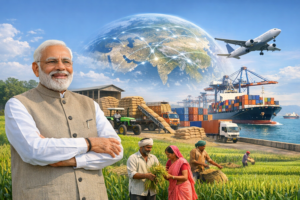
From Field to Global Market: Decoding PM Modi’s Vision for an Export-Led Agricultural Revolution
In a virtual address at a Post-Budget Webinar on ‘Agriculture and Rural Transformation’, Prime Minister Narendra Modi laid out a comprehensive and forward-looking blueprint for the future of Indian agriculture. The message was clear: Indian farms must transform into powerful engines of economic growth, driven not just by domestic needs but by the immense potential of global markets. The Prime Minister’s emphasis on making Indian agricultural products “export-oriented” and “globally competitive” signals a paradigm shift—from a system focused on subsistence and food security to one geared towards prosperity and market leadership.
This vision, woven into the fabric of the Union Budget 2026-27, is not merely about increasing the volume of exports. It is a holistic strategy that touches upon crop diversification, technological integration, value addition, and rural empowerment. It’s a roadmap to position India as a reliable and quality-driven powerhouse in the global food supply chain.
Leveraging India’s Greatest Asset: Climatic Diversity
PM Modi began by stressing the need for the “full utilisation of India’s diverse climate conditions.” This is a foundational point that is often underappreciated. India is not a monolith; it is a continent of climates, ranging from the temperate Himalayas to the tropical coasts, from the arid deserts of Rajasthan to the rain-soaked hills of the Northeast.
This natural advantage allows India to be a “year-round” producer of a vast array of agricultural commodities. The Prime Minister’s push is to move beyond the traditional focus on a few staples and strategically map crops to the regions where they can thrive best. For instance, instead of just growing wheat and rice in the north, the vision encourages leveraging the unique terroir of the Northeast for organic spices, the coastal regions for high-value coconuts and seafood, and the drylands for resilient pulses and oilseeds. By scientifically matching crop to climate, India can maximize both yield and quality, creating distinct, region-specific brands for the world market.
The Core of Competitiveness: Quality, Branding, and Value Addition
A key highlight of the Prime Minister’s address was the call for a “unified approach involving experts, industry, and farmers to meet global quality and branding standards.” This directly addresses the biggest hurdles Indian agri-exports have historically faced: inconsistency in quality, lack of processing, and weak brand identity.
For too long, India has been a primary exporter of raw commodities, which are then processed, packaged, and branded by other countries, who capture the lion’s share of the profit. For example, India grows some of the finest mangoes and spices, yet the branded mango pulp or spice blends on international supermarket shelves often come from other nations.
PM Modi’s vision aims to change this. By focusing on “processing and value addition,” the goal is to capture more value within the country. This means setting up food processing units closer to farms, investing in cold chains and logistics, and developing Indian brands that consumers in Dubai, London, or Singapore can recognize and trust. The creation of Kisan IDs and digital land surveys, mentioned by the Prime Minister, are critical digital public infrastructure (DPI) pieces that will enable traceability—a non-negotiable requirement for high-value global markets. A consumer in Europe will pay a premium for a product that can be traced back to a specific, certified farm in India.
High-Value Agriculture: Cashews, Cocoa, and the ‘Sandalwood’ Opportunity
The Union Budget 2026-27’s focus on high-value crops like cashew, cocoa, and sandalwood is a strategic masterstroke. These are not just cash crops; they are commodities with massive, growing global demand and high-profit margins.
- Cashew: India is one of the largest consumers and processors of cashews, but relies heavily on imports of raw nuts from Africa. A push for domestic cultivation can reduce this import dependence and create a robust value chain from farm to factory to export.
- Cocoa: With the global chocolate industry booming and traditional producers in West Africa facing climate challenges, there is a massive opportunity for India to fill the gap. Cocoa can be a lucrative crop for farmers in Southern India, offering a path away from volatile traditional crops.
- Sandalwood: This is a prime example of a high-value, long-gestation crop. By legalizing and promoting its cultivation, the government is opening a door to a multi-million dollar industry in perfumes, cosmetics, and pharmaceuticals. It encourages farmers to think in terms of “agro-forestry” and long-term wealth creation.
These missions, along with the National Mission on Edible Oils and Pulses, are designed to reduce India’s massive import bill while simultaneously creating new, high-value export streams. It’s a classic “import substitution” and “export promotion” strategy working in tandem.
The Blue Economy: India’s Untapped Aquatic Potential
The Prime Minister’s focus on the fisheries sector as a “major platform for export growth” is both timely and strategic. As the world’s second-largest fish producer, India has barely scratched the surface of its potential. The statistic he shared is staggering: a current production of ~4.5 lakh tonnes from reservoirs with a potential for an additional 20 lakh tonnes.
This isn’t just about catching more fish; it’s about a holistic “Blue Revolution.” The call for “new business models in hatcheries, feed, and logistics” points to the need to industrialize the sector scientifically.
- Hatcheries: Ensuring a consistent supply of high-quality, disease-resistant fingerlings.
- Feed: Moving from traditional feeding to scientifically formulated, high-protein feed to boost growth rates and fish health.
- Logistics: This is the critical link. Seafood is highly perishable. An efficient cold chain from the landing center to the processing plant to the airport is essential to maintain quality for export markets in the US, EU, and Southeast Asia.
By encouraging coordination between the fisheries department and local communities, the government aims to empower traditional fisherfolk with modern techniques and market access, turning a livelihood into a thriving enterprise.
Redefining Rural India: From ‘Annadata’ to ‘Urjadata’
Perhaps the most profound implication of this export-oriented vision is its impact on the rural economy. When farmers shift from growing surplus grain for government procurement to cultivating high-value crops for a global market, the entire rural ecosystem transforms. The Prime Minister rightly noted that export production will fuel rural employment through processing and value addition.
A processing unit for mangoes or a seafood packaging plant isn’t built in a city; it’s built near the source of the raw material, in a rural or peri-urban area. This creates jobs—for technicians, machine operators, quality control officers, and logistics personnel—right in the heart of the countryside. It stops the cycle of distress migration to cities.
This economic empowerment is amplified by the government’s existing rural schemes, which PM Modi highlighted as the supporting pillars of this transformation.
- Pradhan Mantri Gramin Sadak Yojana: Good roads are the arteries of trade, connecting farms to markets and processing centers.
- PM Awas Yojana & Swamitva Yojana: Providing housing and property rights gives families stability and the financial confidence to invest in new, riskier, but potentially more profitable crops.
- Financial Assistance to SHGs: This provides the working capital for small-scale processing and aggregation at the village level.
The success story of the Lakhpati Didi (women self-help group members earning over one lakh rupees annually) is a testament to this potential. The target to add another three crore Lakhpati Didis by 2029 is ambitious, but it becomes achievable when these women are integrated into the new agri-export value chains—as entrepreneurs running small processing units, as quality checkers, or as aggregators for export houses.
The Road Ahead: A Call for Collective Action
PM Modi’s address was not just a government policy announcement; it was a call to action for the entire agricultural ecosystem. He urged entrepreneurs to invest in storage, innovation in agri-fintech, and robust supply chains. He called upon scientists to develop climate-resilient, high-yielding varieties that meet global palates. He asked industry to work hand-in-hand with farmers to demystify global quality standards.
The vision is clear: to create an Indian agricultural sector that is resilient, profitable, and globally dominant. It is a vision that moves beyond the anxiety of the monsoon and the politics of the mandi, to embrace the opportunities of the global bazaar. By focusing on what India does best—leveraging its human capital and natural diversity—and combining it with modern technology and a clear export focus, the Prime Minister has laid the groundwork for a rural transformation that could redefine India’s economic destiny for the 21st century. The journey from the Indian field to the global plate is long, but the roadmap has now been firmly established.
You must be logged in to post a comment.