
From Digital Powerhouse to Regional Anchor: Reimagining India’s Strategic Toolkit for Tomorrow
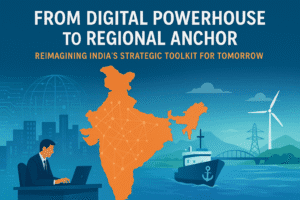
From Digital Powerhouse to Regional Anchor: Reimagining India’s Strategic Toolkit for Tomorrow
As the world order churns with uncertainty, a nation’s trajectory is no longer charted solely by its military might or resource wealth. The new currency of power is technological mastery, and the most valuable asset is a skilled, innovative citizenry. For India, now the world’s fourth-largest economy, the central question is not merely about sustaining growth but about defining its character as a leading power. The strategic choices made today—in harnessing technology, forging intelligent partnerships, and redefining its immediate neighborhood—will determine whether India becomes a passive participant in the global churn or an active architect of its own, and perhaps the world’s, future.
The Talent Paradox: From Brain Drain to Brain Gain
India’s most celebrated asset is its demographic dividend, particularly its vast pool of scientific and technical talent. This is evident in the global tech corridors from Silicon Valley to Singapore, where Indian professionals are pivotal drivers of innovation. Yet, this very success story underscores a persistent domestic paradox: a national policy framework that, by default, has excelled at exporting top-tier talent rather than fully leveraging it for domestic transformation.
The islands of excellence—the stunning successes of ISRO, the revolutionary Digital Public Infrastructure (DPI) stack, and the booming network of Global Capability Centres (GCCs)—prove the caliber of Indian intellect. However, they remain islands. What’s missing is the connective tissue of a nationwide innovation ecosystem: robust R&D funding, seamless academia-industry linkages, and a regulatory environment that rewards patient capital in deep-tech. The result is a staggering under-utilization of human potential.
This moment, however, presents a unique opportunity. Rising xenophobic sentiments and political fragmentation in traditional host countries in the West have created professional and personal insecurities for the Indian diaspora. This crisis can be turned into an opportunity. India needs a proactive, attractive, and streamlined “Return and Root” policy. This goes beyond symbolic appeals—it requires creating an ecosystem that offers cutting-edge research facilities, competitive intellectual stimulation, and a quality of life that retains talent. The goal must shift from outward mobility to inward circulation, where global experience flows back to fertilize the domestic landscape, creating a virtuous cycle of innovation.
Strategic Partnerships: The Art of Technological Statecraft
In its quest to bridge the technology gap, India cannot walk alone. It requires strategic partnerships, but these must be pursued with the nuanced lessons of economic history in mind. The journey from technology consumer to knowledge creator is a three-act play: Access, Assimilation, and Advancement.
Historically, India has sometimes stumbled in the second act—assimilation. This phase requires more than purchasing equipment or signing joint ventures; it demands a cultural willingness to learn, adapt, and build upon imported technology. It calls for humility and systematic investment in the learning process itself. Celebrating ancient scientific achievements is inspirational, but it cannot substitute for the gritty, disciplined work of mastering modern semiconductor fabrication, advanced materials science, or synthetic biology.
This is where foreign policy must be explicitly wired to the technological transformation agenda. The United States, despite the unpredictability of its political cycles, remains an indispensable partner, housing the world’s most dynamic tech corporations and research universities. Nurturing this partnership, especially in critical and emerging technologies, is non-negotiable.
However, putting all eggs in one basket is a strategic vulnerability. A multi-vector technology policy is essential. The European Union, with its strong regulatory frameworks and excellence in engineering; Japan and South Korea, leaders in precision manufacturing and electronics; each offers unique strengths. Russia remains a trusted, if technologically narrowing, partner in niche defense and nuclear sectors. Perhaps most strategically complex is the case of China, a leader in clean-tech and digital applications. While an adversarial relationship limits broad cooperation, a pragmatic, guarded engagement in specific, non-strategic domains where China leads could be explored, always with a clear-eyed view of the risks.
The Neighborhood: Reframing Liability into Strategic Asset
If technology is the engine of India’s global rise, its relationship with South Asia is the foundation. For too long, the neighborhood has been viewed through a lens of security threat and political headache—a liability to be managed. This perspective is not only cynical but also strategically myopic. India’s overwhelming size and economic power create an asymmetry that naturally breeds anxiety among its neighbors. Their attempts to balance this by engaging external powers like China is a predictable, textbook response to hegemony.
The path to breaking this cycle—and nullifying the potent Pakistan-China axis that seeks to pin India down—is not through greater bilateral pressure but through a transformative regional vision. India must consciously shift from a bilateral transactional approach to a regional transformational one.
The strategy is straightforward in concept yet profound in impact: Become the region’s indispensable economic hub. By throwing open its vast, growing market to its neighbors with minimal reciprocal demands, India can turn from a perceived bully into the primary engine of growth for South Asia. The cost to India’s economy would be negligible, but the gain in goodwill and stability would be immense.
This involves:
- Beyond Borders to Networks: Prioritizing region-wide connectivity—roads, rail, waterways, and digital grids—over just bilateral cross-border projects. Imagine Nepal or Bhutan having seamless, multi-modal transit to Bangladesh through India, paying tariffs to New Delhi’s ports and logistics providers.
- The Energy Node: Expanding the successful BBIN (Bangladesh, Bhutan, India, Nepal) grid concept to make India the renewable energy storage and distribution hub for the subcontinent.
- Exporting Digital Public Goods: Offering India’s DPI stack (UPI, Aadhaar, DigiLocker) as a plug-and-play solution for neighbors, binding them into a compatible digital ecosystem of India’s design.
In this framework, Pakistan presents the toughest challenge but also the greatest potential reward for stability. A policy of sustained, low-key economic and humanitarian engagement, when politically feasible, could slowly erode the bedrock of hostility. Managing this relationship, however difficult, is not an act of charity but a cold, strategic necessity to secure India’s western flank and fully unleash its regional potential.
Conclusion: The Dual Pillars of Influence
India’s tomorrow hinges on building two complementary pillars of influence. The first is Global Technological Clout, built by retaining its best minds, fostering an innovative ecosystem, and crafting shrewd, diversified tech partnerships. The second is Unassailable Regional Leadership, earned not by diktat but by becoming the benevolent, providing anchor of South Asia’s prosperity and connectivity.
These pillars are interconnected. A stronger, more technologically advanced India is a more attractive regional hub. A peaceful, integrated, and prospering neighborhood provides a stable base and extended market from which India can project its global power. The choice is between a future where India is a solitary giant, navigating a hostile periphery and dependent on external tech, and one where it is the confident core of a thriving region, generating its own knowledge and shaping its own destiny. The instrumentalities are at hand; the strategic choice is clear.
You must be logged in to post a comment.