
From Debt to Decarbonisation: Prashant Ruia on Essar’s $20 Billion Pivot and the Future of Indian Conglomerates
After emerging from a period of heavy debt and restructuring—during which it repaid over $20 billion and lost its flagship steel business—Essar Group, under Prashant Ruia, is charting a disciplined second act built on a balanced global portfolio. With a 50-50 split between India and overseas, the group is doubling down on its traditional strengths in energy and infrastructure but with a pragmatic twist: it is investing heavily in decarbonisation (such as a £1.5bn hydrogen hub at its Stanlow refinery in the UK) while still keeping the door open for fossil fuels, given ongoing geopolitical realities. At the same time, it is injecting technology and agility into its operations, expanding into electric heavy-duty trucks in India and data centres in the US. Ruia maintains that the group’s past investments were fundamentally sound and that the key lesson learned is not to abandon capital-intensive sectors but to adopt sharper risk management, deeper analysis, and a more resilient capital structure to withstand regulatory and market shocks.
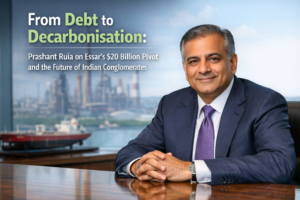
From Debt to Decarbonisation: Prashant Ruia on Essar’s $20 Billion Pivot and the Future of Indian Conglomerates
For a generation of Indian business watchers, the Essar Group was a quintessential symbol of the country’s aggressive industrial ambition. Alongside a handful of other family-run empires, the Ruia brothers—Shashikant and Prashant—built a sprawling colossus that touched everything from the steel in the ground to the telecom towers in the sky. But by the mid-2010s, that ambition collided with the brutal mathematics of leverage and an unforgiving regulatory environment.
Today, after a silence defined by consolidation and the painful process of insolvency, the group is re-emerging. In a recent interview with the Financial Times, Prashant Ruia—now steering the ship as director of Essar Capital—laid out a vision that is both a defense of the past and a blueprint for a radically different future.
While the headline might suggest a simple story of debt recovery, the deeper narrative is about the evolution of Indian capital. It is a story about how a family that once epitomized “old economy” heavy industry is attempting to reinvent itself as a nimble, technology-enabled, and globally diversified investor—without entirely letting go of the fossil-fueled engines that built its fortune.
The Anatomy of a Controlled Collapse
To understand where Essar is going, one must understand where it has been. When Prashant Ruia reflects on the period of deleveraging that consumed the better part of the last decade, he does so with a pragmatism that belies the magnitude of the crisis. At its peak, the group was saddled with nearly $25 billion in debt, culminating in the high-profile insolvency of its crown jewel, Essar Steel, which was eventually snapped up by the world’s largest steelmaker, ArcelorMittal.
Critics at the time pointed to over-aggressive expansion. Ruia, however, offers a nuanced counter-narrative. “I don’t think our investment decisions in the past were bad, they were good decisions,” he states. “We were caught out by some regulatory decisions and court orders.”
This distinction is crucial for understanding the group’s current psychology. Ruia argues that the core competency was never flawed: Essar built “world-class assets” in ports, power, and steel. The crisis was one of capital structure and external shocks, not operational failure. This belief explains why the group has not shied away from capital-intensive sectors in its second act. It also explains the confidence with which the Ruias approach new ventures; they have the scars, but also the proof that their underlying assets were valuable enough to eventually attract global buyers like ArcelorMittal and repay over $20 billion in dues.
A Portfolio Approach to the Energy Transition
The most striking aspect of Essar’s current strategy is its refusal to pick a single side in the energy debate. In an era where many conglomerates are racing to either go “pure green” or double down on hydrocarbons, Essar is attempting a straddle—a global portfolio approach that balances the old world with the new.
Nowhere is this duality more evident than in the United Kingdom. The group’s flagship European asset, the Stanlow refinery, is undergoing a transformation that encapsulates Essar’s new thesis. While the refinery continues to supply road transport fuels and aviation fuel to the UK market—a business that remains highly profitable—Essar is investing £1.5 billion to turn the site into an “energy transition hub.”
The centerpiece of this plan is a massive hydrogen plant and a power plant fueled by that hydrogen. The goal is to make Stanlow one of the most decarbonized refineries in the world. This is not a retreat from fossil fuels; it is an attempt to decarbonize the refining process itself, betting that the world will still need liquid fuels for the foreseeable future, but that the production process must become cleaner.
Simultaneously, back in India, Essar is placing a significant bet on the electrification of mobility. While the world focuses on electric passenger cars, Essar is targeting a more challenging and arguably more lucrative niche: heavy-duty trucks. By building a network and infrastructure for electric trucks, the group is betting that the commercial transportation sector will be the next frontier of the energy transition.
The American Gambit and the Return of Pragmatism
Ruia’s commentary on the global energy landscape is refreshingly pragmatic. When asked about the impact of a potential Donald Trump presidency and the resulting “drill, baby, drill” narrative, he dismisses the extremes of the energy debate.
“I think this is the pendulum swinging too far the other way,” he observes, adding that the current geopolitical instability in the Middle East has proven the critical role oil and gas still play in global security. For Ruia, the answer lies “somewhere in the middle.”
This middle-ground philosophy is mirrored in the group’s geographic diversification. Unlike the previous era of expansion, which was heavily focused on India’s high-growth domestic market, the “new” Essar is intentionally split: 50% in India, 50% globally. The United States has emerged as a key destination, with investments nearing $2 billion, primarily in technology infrastructure.
This geographic spread serves a dual purpose. It hedges against policy risks in any single jurisdiction—a lesson learned from the regulatory upheavals in India a decade ago—and it allows the group to capture growth cycles in different economies. The focus on the US for its tech investments (through its IT business, Black Box) and the UK for energy transition projects creates a portfolio that is resilient to localized downturns.
Technology: The Invisible Glue
One of the biggest challenges for legacy conglomerates is how to inject digital agility into capital-intensive, brick-and-mortar operations. Essar’s solution is to separate the technology business from the traditional business, allowing each to operate with its own culture and capital allocation.
Black Box, the group’s IT arm, is building network infrastructure and data centers globally, primarily in the US. This is a high-growth, high-margin business that looks nothing like the rest of the portfolio. But the real test is whether Essar can digitize its core manufacturing assets.
Ruia admits there is no single answer, but emphasizes a process of “cutting-edge automation” and AI integration across manufacturing plants. The goal is to use technology not as a separate silo, but as a tool to drive energy efficiency and operational excellence. In the context of Essar’s new focus on decarbonization, technology becomes the invisible glue that makes the hydrogen plants and electric truck networks economically viable.
Lessons in Leverage and Control
For the next generation of Indian entrepreneurs and family businesses watching Essar’s resurrection, the most valuable insights may lie in the question of risk management.
When pressed on what lessons were learned from the debt crisis, Ruia’s response is telling. He reiterates that the investment decisions themselves were sound, but acknowledges that “risk management has gone up.” The group now subjects decisions to “deep analysis” before committing capital.
This is a subtle but significant shift. In the past, the group’s power lay in its ability to move fast, secure land, and build massive infrastructure projects. Today, the emphasis is on operational excellence and disciplined capital allocation. The group is still building world-class assets—the core strength hasn’t changed—but the scaffolding around those decisions has been reinforced.
Moreover, the structure of the group itself has evolved. Essar Global now acts as a holding company, treating each of its nine or ten portfolio companies as distinct investment units. This structure allows for greater transparency, easier capital raising at the subsidiary level, and, crucially, the ability to monetize assets without destabilizing the entire group—a flexibility that was sorely missing during the debt crisis.
Conclusion: A Quiet Resurrection
As Prashant Ruia looks to the future, the tone is one of quiet confidence. The debt is 95% paid off. The assets that remain—from coalbed methane fields in India to iron ore projects in Minnesota to hydrogen hubs in the UK—are positioned at the intersection of global demand and local security.
Essar is no longer trying to be the biggest conglomerate in India. Instead, it is trying to be the most resilient. By balancing fossil fuels with renewables, India with the West, and heavy industry with digital infrastructure, the group is building a portfolio designed to weather the volatility of the 2020s.
For the broader Indian business community, Essar’s journey offers a powerful case study. It proves that even after a near-death experience involving insolvency and regulatory upheaval, a family business can not only survive but re-emerge with a sharper strategy. The lesson is not to avoid risk, but to build a structure—both financial and operational—that can absorb the shocks when the pendulum swings.
As Ruia puts it, the core strengths remain: building world-class assets and scaling them to meet market demand. The difference now is that the assets are cleaner, the balance sheet is cleaner, and the vision is global. The old Essar may have been dismantled, but the new Essar is being built on the steel-reinforced lessons of its past.
You must be logged in to post a comment.