
From Congestion to Levitation: How TuTr Hyperloop’s Breakthrough at Kandla Port Charts a New Course for India’s Logistics Future
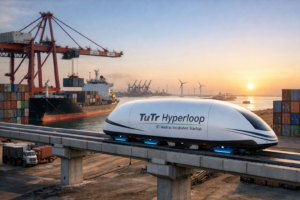
From Congestion to Levitation: How TuTr Hyperloop’s Breakthrough at Kandla Port Charts a New Course for India’s Logistics Future
In the bustling, diesel-fumed air of Deendayal Port in Kandla, a quiet revolution just took a decisive step out of the laboratory and onto the docks. The successful field trial of an indigenous electromagnetic cargo system by IIT Madras-incubated TuTr Hyperloop isn’t merely a tech demo; it’s a tangible signal that India is seriously re-engineering the very arteries of its trade economy. This trial represents a crucial pivot from theoretical sustainability goals to practical, high-throughput solutions for some of the nation’s most persistent infrastructure headaches.
The Gravity of the Problem: Why Ports Are India’s Next Critical Battleground
To appreciate the significance of this trial, one must first understand the immense pressure points at Indian ports. India handles over 95% of its trade by volume through maritime routes. Ports like Kandla are not just gateways; they are kinetic, complex ecosystems where delays ripple outwards, inflating costs, wasting fuel, and denting competitiveness.
The traditional model relies heavily on a chain of diesel-guzzling vehicles—trucks, tractors, and cranes—shuttling containers from ship to storage to hinterland. This creates a trifecta of challenges:
- Chronic Congestion: A patchwork of moving parts leads to bottlenecks, slowing turnaround times for both ships and cargo.
- Environmental Cost: The concentrated emission from this diesel-dependent dance significantly impacts air quality in port cities and contradicts net-zero commitments.
- Operational Inefficiency: High maintenance of heavy machinery, coupled with manual logistics, caps scalability and increases long-term costs.
Enter TuTr Hyperloop’s Linear Induction Motor (LIM)-based system. It’s not the fantasy of passenger pods in vacuum tubes (often associated with the Hyperloop name), but a grounded, intelligent application of electromagnetic propulsion to a very specific, high-value problem.
The Kandla Trial: Electromagnetic Pulse in a Live Environment
The prototype tested at Kandla operates on a simple yet profound principle: using electromagnetic force to propel cargo pods along a fixed guideway. Think of it as a sophisticated, linear electric motor where the track itself is part of the motor that pushes the pod forward.
The real breakthrough here is not the science, which is well-established, but the contextual application. Moving this technology from IIT Madras’s controlled labs to Kandla’s operational environment—with its salt-laden air, vibrations, and relentless 24/7 schedule—is a baptism by fire. It tested the system’s resilience, control software, and practicality in handling real-world cargo logistics.
The benefits observed are compelling:
- Reduced Physical Wear: With no direct contact between the moving pod and the track (aside from guidance wheels), friction and mechanical degradation plummet.
- Precision and Smoothness: Electromagnetic systems allow for exceptionally smooth acceleration and deceleration, crucial for protecting sensitive cargo and enabling precise positioning within a container yard.
- Inherent Sustainability: As a fully electric system, it can be powered by renewable sources, turning a major emission node into a potential green hub.
Beyond LIM: The Strategic Vision Towards Maglev and “Smart Ports”
The most telling part of this development is not what was tested, but what it’s paving the way for. Encouraged by the LIM success, Deendayal Port Authority and TuTr are already eyeing the next frontier: a magnetic levitation (maglev) cargo demonstration.
This is a strategic masterstroke. Maglev eliminates even the minimal friction of a LIM system, levitating the pod entirely using magnetic fields. For cargo logistics, this translates to even lower energy consumption per ton-kilometer, near-silent operation, and drastically reduced maintenance. If LIM is an upgrade, maglev is a paradigm shift.
By positioning Kandla as a testbed for maglev cargo, India is placing a strategic bet. It’s aiming to leapfrog incremental upgrades seen in global ports and directly embed next-generation infrastructure. This aligns perfectly with the concept of “Smart Ports”—where IoT, AI-driven logistics, and advanced propulsion integrate to create a self-optimizing, highly efficient ecosystem.
The Bigger Picture: Atmanirbhar Bharat Gets a Deep-Tech Engine
The narrative here transcends port logistics. This trial is a flagship example of the academia-startup-public sector triumvirate that India needs to excel in deep-tech.
- IIT Madras: Provides the foundational research, talent, and incubation ecosystem (through its IITM Incubation Cell).
- TuTr Hyperloop: Acts as the agile, risk-taking vehicle to translate that research into engineered, deployable solutions.
- Deendayal Port Authority: Offers the critical real-world testing ground and anchors the innovation to a concrete national need.
This model de-risks innovation for the public sector while giving startups unparalleled access to scale-defining problems. It’s a blueprint for how “Make in India” evolves into “Innovate in India.” Success here doesn’t just mean a faster Kandla; it means creating a globally exportable product—a “Port Mobility Stack” born out of India’s unique challenges.
Challenges on the Horizon: The Path from Pilot to Paradigm
Despite the promise, the road from successful pilot to widespread adoption is fraught with hurdles:
- Capital Intensity: The upfront cost of installing electromagnetic guideways across vast port areas is enormous. Detailed feasibility studies must prove a compelling ROI through efficiency gains and cost savings.
- Integration Complexity: Retrofitting this new layer into the intricate, legacy operations of a busy port is a monumental systems engineering challenge.
- Standardization: For it to become a national solution, interoperability standards will need to be developed.
Conclusion: A Defining Moment for India’s Logistic Ambitions
TuTr Hyperloop’s trial at Kandla is more than a news item; it’s a defining moment. It demonstrates a mature shift in India’s innovation narrative—from software and services to hardcore, infrastructure-deep technology. It moves the hyperloop conversation from sci-fi speculation to a focused, industrial tool.
As global trade lanes become more competitive and sustainability mandates tighten, the efficiency of ports will become a key national differentiator. By betting on indigenous systems like this, India isn’t just solving a congestion problem; it is actively building the intellectual property, engineering capability, and operational experience that could position it as a leader in the future of global logistics. The electromagnetic pulse at Kandla may be quiet, but its reverberations for India’s trade and tech destiny are poised to be profound.
You must be logged in to post a comment.