
From Confinement to Confidence: How a Motorised Wheelchair Is Restoring Dignity and Paychecks in India
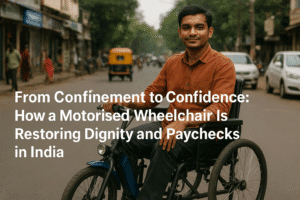
The NeoBolt, a motorized attachment that transforms standard wheelchairs into road-worthy vehicles, is restoring independence and livelihoods for thousands of Indians with disabilities. Born from a collaboration between Impact Guru Foundation’s Sundeep Talwar and IIT-Madras incubated NeoMotion, the initiative goes beyond mere donation by providing recipients with training and connections to employment opportunities like food delivery. This holistic approach has empowered over 7,000 individuals, enabling them to travel freely, earn a stable income of up to ₹50,000 monthly, and reclaim their dignity and role as providers, fundamentally shifting the narrative from dependency to self-reliance.
From Confinement to Confidence: How a Motorised Wheelchair Is Restoring Dignity and Paychecks in India
The Accident That Sparked a Revolution in Mobility
Imagine a life where a simple trip to the market, a visit to a friend, or the daily commute to work is an insurmountable challenge. For millions of Indians with mobility disabilities, this isn’t a hypothetical scenario; it’s a daily reality. Their world often shrinks to the four walls of their home, not by choice, but because the world outside is not built for their wheels.
This was the stark truth facing Mahesh, the young son of a Mumbai fruit vendor. His life changed in a moment when a tree, heavy with monsoon rain, collapsed on him. The accident crushed his spine and with it, his ability to walk. For Sundeep Talwar, a seasoned professional in the social impact space, meeting Mahesh was a pivotal moment.
While many saw a tragic story ending with the donation of a standard wheelchair, Sundeep saw a life sentence to a limited future. “A wheelchair might help him move,” Sundeep recalls, “but it would also limit his chances for education and work. I could not accept that as the end of his story.”
This refusal to accept a life of dependency ignited a quest for a better solution—a quest that would eventually empower over 7,000 individuals and counting.
Beyond Sympathy to Solution: The Birth of NeoBolt
Sundeep’s journey took him to the engineers at NeoMotion, an IIT Madras-incubated startup known for its innovative assistive devices. The initial response was that they had no ready-made solution. Instead of walking away, Sundeep posed a simple, game-changing question: What if we could motorise a wheelchair?
This wasn’t about reinventing the wheel, but about empowering it. That spark of an idea became the catalyst for the NeoBolt—a detachable, motorised front attachment that converts a manual wheelchair into a safe, road-worthy vehicle.
But the vision was always bigger than the technology. Sundeep, through the Impact Guru Foundation (IGF), understood that providing a device was only the first step. True empowerment required a holistic ecosystem: access, funding, training, and a pathway to economic independence.
The Anatomy of Independence: How the NeoBolt Works
So, what makes the NeoBolt more than just a scooter attachment? It’s a thoughtfully engineered key to a locked world.
- Seamless Integration: Using a patented Quadra-Lock system, the NeoBolt clicks onto a standard manual wheelchair in seconds. This means users can navigate their homes with a lightweight chair and attach the motor for outdoor travel, offering the best of both worlds.
- Designed for Real-World Use: With a 250W motor, it reaches speeds of up to 25 km/h and has a range of 25 km on a single charge. The 48V lithium-ion battery is removable, allowing it to be charged indoors easily.
- Safety First: The design includes essential features often overlooked in assistive devices: headlights for night travel, a parking brake, suspension for India’s uneven roads, and anti-tip mechanisms for stability.
- Customised for the Individual: Each unit is tailored to the user’s specific physical measurements and needs, ensuring comfort and preventing secondary health issues, all while adhering to international ISO quality standards.
This robust engineering, however, is merely the vessel. The true transformation happens in the lives of the people who use it.
Stories of Transformation: Wheels Delivering New Beginnings
The real impact of the NeoBolt is measured not in kilometres, but in reclaimed dreams and restored dignity.
Jyoti Tayade: From Tragedy to Top Delivery Partner
Jyoti’s life was on a happy trajectory. Engaged to Nitin, she was planning her wedding when a simple mistake—boarding the wrong train—led to a horrific accident. In a panic to get off, she fell, and the train wheels crushed her leg and hand. She woke up in a hospital to the devastating news of an amputation.
“My world shrank overnight,” Jyoti shares. “The independence I took for granted was gone. I felt like a burden.” For years, her mobility was restricted, and with it, her ability to contribute to her family.
In August 2024, Jyoti received her NeoBolt. It wasn’t just a vehicle; it was a key to her former self. With renewed confidence, she signed up as a Zomato delivery partner. Today, she navigates the streets of Pune with purpose, earning between ₹20,000 and ₹35,000 a month.
“The most profound change is the look in my son’s eyes,” she says. “He sees his mother as a provider, a fighter. I am not just living; I am living with purpose.”
Girish Patekat: Regaining His Role as a Provider
A spinal cord injury in 2018 left Girish confined to his home for six years. The mental anguish of being unable to support his family, especially his young son, was a heavier burden than his physical condition.
“I felt I had lost my identity as a father and a husband,” Girish confesses. “I couldn’t even take my child to school.”
The NeoBolt changed that narrative. Within a year of receiving it, Girish started working as a delivery partner for a local restaurant. The simple act of earning a living has been transformative. “I can now pay my son’s school fees myself,” he states, his voice filled with pride. “That responsibility, which was taken from me, has been given back. I have my dignity back.”
The Ripple Effect: Building an Ecosystem of Empowerment
The IGF team knew that dropping a device at someone’s doorstep wasn’t enough. Their model is built on creating sustainable change:
- Identification & Screening: A vast network of 500+ hospitals and NGOs helps identify potential beneficiaries, ensuring the device goes to those who need it most and are prepared to use it.
- Comprehensive Training: A 15-day training program ensures users are not just drivers, but safe and confident navigators of their urban environment. They learn vehicle operation, maintenance, and road safety.
- Economic Integration: Perhaps the most crucial step, the team actively connects recipients with employment opportunities, notably with gig-economy giants like Zomato and Swiggy, who have been partners in this inclusion journey. This turns mobility into earning potential.
Sundeep recalls a moment that crystallised the mission’s success: “A man named Ashok visited me with his wife. He told me that for the first time in nine years of marriage, he had bought her a saree with his own earnings. That’s when you understand you’re not just giving a machine; you’re giving people the ability to give, to love, and to participate fully in their own lives.”
The Road Ahead: Towards a More Inclusive India
With over 7,000 NeoBolts now empowering individuals across states like Tamil Nadu, Maharashtra, Karnataka, and Uttar Pradesh, the movement is gaining momentum. Each story adds to a powerful collective narrative: disability does not define potential.
The project, fully funded by corporate and individual donors, is expanding into new cities like Pune, with a clear vision for the future. The goal is to systematically break down the barriers—physical, economic, and social—that confine people.
“Our journey is far from over,” Sundeep affirms. “We envision a healthy and prosperous India where no one is left behind. Every time someone tells us they can now go to work or meet friends without asking for help, it reaffirms that we are on the right path.”
The story of the NeoBolt is a powerful reminder that the most profound innovations are not always the most complex. Sometimes, they are simply about listening to human need and having the determination to build a bridge—or in this case, a motorised wheel—from isolation to inclusion, from confinement to a life of confidence and purpose.
You must be logged in to post a comment.