
From Cell to Exile: Inside Israel’s First Use of the 2023 Law Erasing Palestinian Citizenship
In February 2026, Israel implemented its 2023 discriminatory citizenship revocation law for the first time, stripping two Palestinian citizens—one a former prisoner who had already served 23 years—of their nationality and ordering their deportation, a move human rights groups condemn as an “alarming precedent” enabling the mass expulsion of thousands more. The law selectively targets Palestinians by linking “terrorism” convictions to receiving Palestinian Authority compensation—criteria that never apply to Jewish Israelis, including convicted settlers—while recent amendments allow collective punishment, revoking citizenship from Palestinians whose family members are accused of offenses. This legislation is part of over 100 existing discriminatory Israeli laws, including the Nation-State Law, that render Palestinian citizenship perpetually conditional and revocable, effectively transforming what should be an inalienable right into a privilege contingent on ethnic identity and perceived loyalty, thereby violating international prohibitions against statelessness and institutionalizing a two-tiered legal system where Jewish citizenship remains absolute and Palestinian presence is treated as provisional.
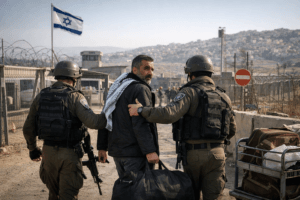
From Cell to Exile: Inside Israel’s First Use of the 2023 Law Erasing Palestinian Citizenship
On a Tuesday morning in February 2026, Prime Minister Benjamin Netanyahu signed an order that human rights lawyers had been dreading for nearly three years. It was not a military order issued from a bunker in Tel Aviv, nor a tactical wartime directive. It was a bureaucratic act—a signature on a document—that transformed two men who had already served their prison sentences into people who no longer legally exist as citizens of the only country they have ever called home.
Mohammed Hamad al-Salhi, 48, spent 23 years in an Israeli prison. He was released in 2024. He is a husband, a father, and a resident of East Jerusalem. Mohammed Halasah was sentenced at 17 years old; he has served roughly half of an 18-year term for an offense committed as a minor . Soon, when Halasah completes his sentence, he will not walk out into the streets of Jerusalem. He will be escorted directly to a border crossing and expelled to the West Bank or Gaza—territories where he may have no family, no home, and no legal status.
This is the first implementation of Israel’s 2023 Law for Revocation of Citizenship or Residency of a Terrorist who Receives Compensation. To understand why lawyers from Adalah, the Association for Civil Rights in Israel (ACRI), and HaMoked call it “an unprecedented act of state violence,” one must look not at the text of the law itself, but at who it excludes, who wrote it, and what it reveals about the redefinition of citizenship in a state that defines itself as Jewish .
The Architecture of Exclusion: How a “Neutral” Law Applies to Only One Population
On paper, the 2023 amendment appears facially neutral. It allows the Interior Minister to petition a court to revoke the citizenship of anyone convicted of an “act of terrorism” who also received monetary compensation from the Palestinian Authority. But legal neutrality is a myth when the definitions underpinning it are carved along ethnic lines.
Israel’s 2016 Counter-Terrorism Law defines an “act of terrorism” with breathtaking breadth. It includes “harm to property,” “harm to religious objects,” or even threats to commit such harm—provided the act is carried out with “nationalistic or ideological motives” . In practice, this definition has been selectively enforced almost exclusively against Palestinians. Official data from the State Prosecutor’s Office confirms that following the May 2021 unrest, Palestinian defendants were charged with “terror” offenses at rates significantly higher than Jewish Israelis in nearly identical circumstances .
The “Palestinian Authority compensation” clause functions as an ethnic filter. Jewish Israelis—including settlers convicted of lethal attacks against Palestinians—do not receive payments from the PA. They are therefore immune from this law, regardless of the severity of their crimes . As Hassan Jabareen, General Director of Adalah, stated, this creates a two-tiered citizenship structure: one tier for Jewish citizens, for whom citizenship is an inalienable birthright; another for Palestinian citizens, for whom citizenship is conditional, revocable, and contingent upon perpetual demonstrations of “loyalty” .
The legislative history removes any doubt about intent. During Knesset debates, MK Hanoch Milwidsky stated explicitly: “I prefer Jewish murderers to Arab murderers, and as a general rule in the Jewish state I prefer [having] Jews to disloyal Arabs here” . MK Limor Son Har-Melech, a drafter of the law, argued that citizenship should be revoked “for any terrorist who kills a Jew on the grounds that he is a Jew,” adding that the appropriate punishment should be death .
This is not legislation drafted in the language of public safety. It is legislation drafted in the language of ethnic supremacy.
The Men Behind the Headlines: Not Numbers, But Lives
In the rush of breaking news, the two individuals at the center of this order risk being reduced to their charges. Mohammed Hamad al-Salhi was convicted of shooting and weapons trafficking offenses dating back to 2002. He served his sentence in full and was released in 2024 . Upon release, he returned to his family in East Jerusalem—a city whose Palestinian residents are classified not as citizens in the full sense, but as “permanent residents.” This status, as human rights organization Al-Haq notes, is “a revocable privilege, not an inherent right” .
Mohammed Halasah presents an even more complex case. Sentenced at 17, he has spent his entire young adulthood in prison. His relative told AFP that Halasah was previously an Israeli citizen, but that status was stripped months before Netanyahu’s February 2026 order . When he is eventually released, he will be deported immediately, without ever having lived as a free adult in the society that has now rejected him.
The Palestinian Prisoner’s Society and the Commission of Detainees and Ex-Detainees Affairs issued a joint statement warning that this “alarming precedent” opens the door for thousands of former prisoners and detainees to face the same fate . Adalah confirmed that as of May 2025, the government had publicly declared that four individuals were already in advanced stages of revocation proceedings, with “hundreds more” reportedly being targeted .
Netanyahu himself acknowledged this trajectory. In his X post announcing the revocations, he thanked Coalition Chairman Ofir Katz for leading the law and added: “many more like them on the way” .
Collective Punishment: When Guilt Becomes Hereditary
The February 2026 revocations are the visible spearpoint of a much broader legislative assault—one that has quietly expanded to punish Palestinians not only for their own actions, but for the actions of their relatives, spouses, and even children.
In August 2025, the Knesset passed an amendment to the Citizenship Law that authorizes the revocation of status for Palestinians whose family members—broadly defined—are involved in security incidents. The law explicitly states that revocation applies even if the affected individuals had no connection to, knowledge of, or involvement in the alleged offense .
The Association for Civil Rights in Israel (ACRI), HaMoked, and Physicians for Human Rights immediately petitioned the Supreme Court, arguing that this constitutes collective punishment—a violation of the most fundamental principle of criminal law that a person bears responsibility only for their own actions. The amendment, they argued, is “destined to tear families apart and harm the rights of people who have done nothing wrong” .
Yet the amendment passed. It passed despite legal opinions from the Knesset’s own advisors. It passed despite the absence of any factual data supporting the government’s security justifications. It passed because, as Zulat’s Yael Stein documented, the post-October 7 atmosphere has created a legislative vacuum in which due process and evidentiary standards are dismissed as obstacles rather than safeguards .
Under this amendment, a Palestinian citizen of Israel whose brother is accused of an offense—even under the sweeping definitions of the Counter-Terrorism Law—can lose their residency or citizenship. Their children, who may be Israeli citizens by birth, can be rendered stateless. Their spouse can be expelled.
This is not counter-terrorism. This is demographic warfare conducted through legislative language.
The Numbers Behind the Rhetoric: Policing Thought, Punishing Speech
The revocation laws did not emerge in isolation. They are part of a synchronized campaign that has systematically criminalized Palestinian political expression since October 7, 2023.
Data obtained by Adalah through Freedom of Information requests reveals the scale of this crackdown. Between October 7, 2023, and April 26, 2025, Israeli police arrested 1,052 individuals for speech-related offenses under the Counter-Terrorism Law. Of these, 948 were Palestinians—either citizens of Israel or residents of East Jerusalem. Only 40 were Jewish Israelis .
These are not arrests for operational plotting or weapons possession. These are arrests for Facebook posts, for social media shares, for expressions of sympathy with Gaza, for attendance at protests. In the immediate aftermath of October 7, Police Commissioner Yaakov Shabtai announced a “zero tolerance” policy toward what he termed “incitement.” The State Attorney’s Office removed the requirement for prior approval before opening investigations into such offenses .
The result is a legal environment in which hundreds of thousands of Palestinian citizens understand that their political speech—indeed, their very identity—places their citizenship at risk. When the government announces that “hundreds” of former prisoners are being reviewed for revocation, it is not merely enforcing law. It is sending a message to the entire Palestinian community in Israel: Your status is provisional. Your loyalty is perpetually suspect. Your presence is conditional .
The Irony of “Loyalty” in a Jewish State
The legal mechanism for revocation predates the 2023 law. Since 2008, Israel’s Citizenship Law has permitted revocation for “breach of loyalty to the State of Israel”—a phrase defined to include “taking an active part in a terrorist organization” .
But here lies the constitutional paradox that Israeli courts have never resolved. How can a Palestinian citizen of Israel demonstrate “loyalty” to a state that defines itself as the nation-state of the Jewish people, granting “exclusive right to national self-determination” to Jews alone? The 2018 Nation-State Law rendered this contradiction explicit. Palestinian citizens are guaranteed individual rights, but they are excluded from the collective right of self-determination that forms the state’s constitutional identity .
The Supreme Court has upheld these revocation provisions. In the 2021 Zayoud case, the court ruled that the Interior Minister could revoke citizenship for “breach of loyalty” even if it rendered the individual stateless. The Ministry provided data showing that, of 31 cases where revocation was considered, not a single one involved a Jewish citizen .
The court’s reasoning was clear: citizenship is not a right that must be equally administered. It is a status that can be calibrated based on conduct—and, in practice, based on ethnicity.
The Human Cost of Revocable Citizenship
There is a temptation, when analyzing discriminatory legislation, to remain in the realm of policy: to count laws, to parse amendments, to compare statutory language. But laws do not exist on paper. They exist in the bodies and lives of the people they constrain.
What does it mean to be a Palestinian citizen of Israel today? It means watching the government announce that hundreds of people who share your identity, your history, your community, are being reviewed for deportation. It means knowing that a relative’s arrest—even an arrest without charges, even administrative detention without trial—could trigger the revocation of your own residency. It means raising children who may be stripped of citizenship because they were born in Gaza or because a grandparent once crossed the wrong border .
It means living, as Jabareen told Al Jazeera, with the knowledge that “this is just the beginning” .
The socioeconomic data contextualizes this legal vulnerability. Palestinian citizens constitute approximately 20 percent of Israel’s population—about 1.9 million people . Yet they face poverty rates of 38 percent, unemployment rates nearly double those of Jewish citizens, and routine violence that claimed 252 Palestinian lives in 2025 alone .
These are not statistics about “Arab Israelis.” These are statistics about a community that has been systematically marginalized, economically starved, and politically criminalized—and now faces the erasure of its citizenship altogether.
The International Law Deficit
International law prohibits states from rendering individuals stateless. The 1961 Convention on the Reduction of Statelessness, to which Israel is not a party but whose principles reflect customary international law, bars deprivation of nationality where it would leave a person without any nationality.
The 2023 amendment violates this principle explicitly. It authorizes the Interior Minister to revoke citizenship and deport individuals to the West Bank or Gaza—territories that do not constitute a state, do not automatically confer citizenship, and in the case of Gaza, are subject to ongoing military operations and, as the International Court of Justice is considering in South Africa’s genocide case, conditions that may amount to crimes under the Genocide Convention .
Israel is not alone in revoking citizenship for terrorism convictions. The United Kingdom and France have stripped dual nationals of citizenship in limited circumstances. But those states do not render individuals stateless; the affected individuals retain citizenship elsewhere. Israel’s law applies to citizens—individuals whose only nationality is Israeli. When their citizenship is revoked, they become, in the eyes of international law, ghosts .
What Comes Next
The February 2026 revocations are a watershed, but they are not a surprise. They are the logical endpoint of a legal architecture that has been under construction for decades: the 1952 Citizenship Law, the 2003 Citizenship and Entry into Israel Law, the 2016 Counter-Terrorism Law, the 2018 Nation-State Law, the 2023 revocation amendment, the 2025 family punishment amendment, and the proposed 2025 bill targeting children born in “enemy states” .
Each law layered additional conditionality onto Palestinian citizenship. Each law narrowed the gap between “citizen” and “resident.” Each law advanced the proposition that Palestinian presence in Israel is not a right but a privilege—revocable at the discretion of the Interior Minister, contingent upon behavior defined by a Knesset that increasingly excludes Palestinian voices.
Adalah has documented over 100 Israeli laws that discriminate against Palestinian citizens . The Institute for Palestine Studies reports that more than 30 discriminatory laws were passed in the two years following October 7, 2023, alone . This is not a series of isolated legislative overreaches. It is a coordinated, cross-branch, sustained campaign to redefine the relationship between the state and its Palestinian minority.
Netanyahu’s signature on February 10, 2026, did not create this reality. It simply confirmed what Palestinian citizens have long understood: that in a state defined by Jewish supremacy, their citizenship is always provisional. Their presence is always conditional. Their future is always pending review.
The question now is whether the international community will treat this as a discrete policy change or recognize it for what it is: the legal codification of ethnic expulsion, executed not with tanks and checkpoints, but with court orders and deportation stamps.
For Mohammed Hamad al-Salhi and Mohammed Halasah, the answer will determine whether they die in the land of their birth or are buried elsewhere, as strangers in the only home they ever knew.
You must be logged in to post a comment.