
From Cairo to Gaza: Can a Newly Minted Committee Rescue a Shattered Territory?
The newly announced Palestinian National Committee, tasked with administering Gaza, represents a internationally-backed technocratic effort to transition from humanitarian crisis to recovery, operating under a UN-adopted framework that deliberately sidelines political questions to focus on the immense practical tasks of emergency shelter, restoring health and education services, and launching reconstruction. However, its operational success remains critically dependent on factors beyond its control, including a durable ceasefire, full Israeli cooperation in opening border crossings for aid and materials, and its ability to navigate the fraught political landscape between Hamas, the Palestinian Authority, and international patrons while delivering tangible improvements to a devastated population.
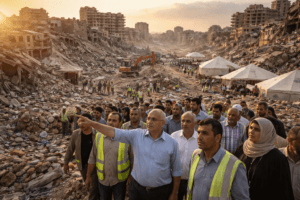
From Cairo to Gaza: Can a Newly Minted Committee Rescue a Shattered Territory?
An in-depth look at the Palestinian National Committee’s monumental task of governance, relief, and reconstruction amidst the ruins.
The announcement from Cairo this weekend felt, to many, like the first fragile breath after a long suffocation. Ali Shaath, an academic turned administrative chief, stood before cameras not in Gaza, but in Egypt’s capital, to formally introduce the members of the Palestinian National Committee tasked with running the Gaza Strip. This was not merely a bureaucratic rollout; it was the tentative activation of a framework born from unprecedented global pressure, a stalled war, and the desperate need to address a humanitarian cataclysm. The committee’s unveiling marks the beginning of what may be the most complex civil administration effort in modern Palestinian history—a mission to lift, as Shaath stated, “historic injustice” while navigating a minefield of political sensitivities, logistical nightmares, and the sheer scale of destruction.
A Committee Born from a Controversial Plan
To understand the committee’s potential and its profound constraints, one must look at its origins. It operates under the auspices of what is widely referred to as the “20-point plan” endorsed by the UN Security Council in November. This framework, emerging from prolonged ceasefire negotiations, explicitly designates the committee as a non-political, technocratic body. Its mandate is narrowly focused on daily civil-service affairs: restoring electricity, coordinating aid, rebuilding hospitals, and reopening schools. It is, by design, separate from the political questions of who ultimately governs Gaza or represents the Palestinian people in future statehood talks.
This delineation is its greatest strength and its most glaring vulnerability. By focusing on administration rather than politics, the committee has garnered a level of international acceptance, including critical backing from regional powers like Egypt, Qatar, and Türkiye. Hamas’s statement that it will “facilitate the handover process” suggests a wary, pragmatic acquiescence, likely contingent on the committee staying strictly within its humanitarian lane. However, operating in a post-conflict Gaza without addressing the underlying political tensions is akin to building a house on shifting sands. Every decision—from allocating reconstruction contracts to appointing local municipal heads—will carry political weight.
The Team and the Titanic Task
The committee’s composition, as announced, leans heavily on expertise. Shaath, a doctorate in engineering, leads a group of specialists: Ayed Abu Ramadan on economy and trade, Abdel Karim Ashour on agriculture, Ayed Yaghi on health, and so on. This emphasis on technocrats is deliberate, aiming to project competence and neutrality. Maj Gen Sami Nasman’s assignment to interior and internal security is particularly noteworthy, hinting at the monumental challenge of re-establishing basic law and order in a territory where institutional collapse is nearly total.
Their stated priorities, outlined by Shaath, are a stark chronology of immediate human suffering:
- Emergency Shelter: Acknowledging that tents are inadequate, the plan prioritizes prefabricated housing units, requiring the full and sustained reopening of the Rafah crossing—a lifeline currently controlled and severely restricted by Israel.
- Restoring Basic Services: With most hospitals destroyed, the committee is discussing deploying field hospitals and evacuating 20,000 wounded for treatment abroad—a logistically herculean task.
- Educational Catastrophe: Addressing a generation of children who have missed nearly two and a half years of schooling will require more than reopening buildings; it demands psychological support and accelerated learning programs.
- Livelihoods and Rubble: Shaath’s mention of creating immediate job opportunities through debris removal is a critical insight. Reconstruction cannot wait for grand plans; it must begin by putting people to work clearing their own neighborhoods, turning destruction into a grim form of economic stimulus.
The “Three-Phase” Vision: Relief, Recovery, Reconstruction
Shaath articulated a clear, phased vision: immediate relief, followed by recovery of infrastructure (power, water, telecoms), culminating in long-term reconstruction and development. This structured approach is sensible, but each phase is fraught with interdependencies. Recovery of the water system depends on reliable electricity. Reconstruction depends on the free flow of materials through borders Israel still controls. The committee’s entire plan hinges on one element it does not command: unimpeded access.
The repeated emphasis on Egypt’s reconstruction plan as the working blueprint underscores Cairo’s central role. Egypt seeks stability on its border and has strategic interests in leading Gaza’s rebuilding. This provides the committee with a powerful patron but also risks perceptions of being an external imposition rather than an organic Palestinian entity.
The Elephant in the Room: Sovereignty, Access, and Ceasefire Violations
The committee’s launch is shadowed by ongoing violence. The article notes Palestinian accusations of Israeli violations of the October ceasefire, with hundreds reported killed since the truce. This creates an impossible environment for any administration. How can engineers assess grid damage or health officials set up clinics under the threat of airstrikes? The committee’s work is predicated on a stable ceasefire that appears increasingly fragile.
Furthermore, Israel’s continued control over Gaza’s perimeter, airspace, and maritime access means the committee cannot function without Israeli coordination—a profound irony for a body created to administer Palestinian affairs. The success of every portfolio, from agriculture (needing export routes) to telecommunications (needing spectrum and equipment), is subject to Israeli security approval.
A Glimmer of Hope or a Well-Intentioned Mirage?
The formation of this committee is a significant development. It represents the international community’s move from crisis management to a semblance of structured recovery. It provides a focal point for aid coordination and a Palestinian face for governance. For the exhausted people of Gaza, it offers a sliver of hope that someone is finally tasked with the practical work of making life livable again.
However, the challenges are existential. The committee lacks its own security force, independent funding, or sovereign authority. It must balance the expectations of a traumatized population, the demands of international donors, the sensitivities of Hamas and the Palestinian Authority, and the security dictates of Israel. It will be judged not on its announcements in Cairo, but on its ability to deliver concrete change on the ground in Gaza: the first prefabricated house erected, the first hospital reopened, the first child returning to a safe classroom.
Ultimately, the Palestinian National Committee for the Administration of Gaza is a experiment. It tests whether a technocratic, humanitarian-focused administration can carve out space to function in one of the world’s most politicized conflicts. Its success or failure will determine more than the efficiency of aid delivery; it will shape the very possibility of Gaza’s future, proving whether a path exists from relentless cycles of war to the hard, unglamorous work of building a stable society from the rubble upwards. The world, and most urgently the people of Gaza, are watching to see if this committee can turn its Cairo blueprint into a Gaza reality.
You must be logged in to post a comment.