
From Bytes to Barrels: How Human Ingenuity and AI are Fueling a New Energy Era
ExxonMobil is leveraging the synergy between deep human expertise and artificial intelligence to tackle the dual challenge of ensuring energy security while reducing emissions, with its Bangalore Technology Center serving as a key hub where teams combine decades of domain knowledge in energy and manufacturing with AI’s ability to process vast datasets from sensors and imagery; this human-AI collaboration accelerates innovation in predictive maintenance, autonomous drilling, and emissions detection, transforming operations across the global energy value chain and positioning AI as a critical tool for a pragmatic and sustainable energy future.
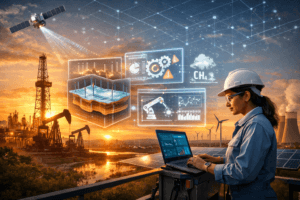
From Bytes to Barrels: How Human Ingenuity and AI are Fueling a New Energy Era
The world stands at a unique crossroads where two monumental challenges converge: the urgent need for energy security and the imperative to lower global emissions. At the heart of solving this dual challenge is an unlikely alliance—the fusion of deep human expertise with the predictive power of artificial intelligence (AI). In Bangalore, India, teams led by visionaries like Suchismita Sanyal are proving that this combination is more than theoretical; it’s driving a pragmatic revolution in one of the world’s most complex industries.
ExxonMobil’s Bangalore Technology Center has become a crucible for this transformation. Here, the equation is simple yet profound: it’s not AI versus humans, but AI plus humans. The “magic,” as Sanyal describes it, happens when decades of domain knowledge in energy and manufacturing are combined with AI’s ability to process vast, disparate datasets—from seismic sensors to thermal images—enabling faster, smarter decisions that were previously unimaginable.
The Strategic Crucible: Why India is Ground Zero for Industrial AI
India’s role in this story is no accident. With over 1.5 million engineering graduates produced annually and a demographic where more than 40% of the population is under 25, the country represents a fertile ground for technological innovation. ExxonMobil’s strategic investment in its Bangalore centers taps directly into this vibrant talent pool. What began in 2017 with a small team has grown into a hub of over 900 technologists supporting global operations from Guyana to Australia and pioneering carbon capture projects.
This focus on India is part of a broader recognition that Global Capability Centers (GCCs) in the country are evolving from back-office support units into genuine research and innovation hubs. For an energy giant, this means accessing not just technical skills, but a culture of problem-solving suited to tackling the “big question: How do we provide energy security while lowering emissions?”.
AI in Action: Transforming Core Energy Operations
The application of AI extends far beyond theoretical labs into the gritty reality of global energy operations. It manifests in several key areas:
- Predictive Maintenance and Reliability: Using machine learning algorithms to analyze lubricant data from equipment, ExxonMobil can predict failures before they happen. One application with an alumina producer in Texas reduced monthly sample collection time by 66%, saving significant labor costs and preventing unplanned downtime that can cost millions.
- Autonomous and Optimized Drilling: In deep-water operations off the coast of Guyana, the company employs a proprietary autonomous drilling system. This AI-driven technology determines ideal drilling parameters and allows for closed-loop automation, improving safety, efficiency, and consistency while freeing skilled personnel from repetitive tasks.
- Expediting Seismic Interpretation and Well Development: Traditionally, interpreting seismic data to plan new wells could take 12 to 18 months. By using AI to break down data silos and accelerate analysis, ExxonMobil has cut this timeline dramatically. In one initiative, collaboration with data scientists helped reduce drilling design planning by two months and cut data preparation time by 40%.
- Emission Detection and Efficiency: Across vast operations like the Permian Basin, networks of sensors feed data into the cloud. AI and machine learning models analyze this information in real-time to optimize performance, lower costs, and detect methane emissions, contributing directly to lower-carbon operations.
The Human Edge: The “Trinity” of Expertise
A recurring theme in ExxonMobil’s approach is a rejection of the idea of AI as a standalone solution. Sanyal emphasizes a powerful “trinity” of expertise: AI capability, deep domain knowledge, and engineering prowess.
This philosophy recognizes a critical truth: an AI model is only as good as the question it’s asked and the context in which its answer is validated. A data scientist might build a powerful algorithm, but it takes a seasoned reservoir engineer with decades of experience to ask the right question about well placement and to interpret the AI’s output against the physical realities of geology.
This synergy creates what Sanyal calls a “1+1 > 2” effect. AI excels at processing massive datasets, identifying invisible patterns, and automating routine tasks. Humans provide the strategic direction, the physical-world context, and the creative problem-solving. Together, they shorten the innovation cycle and tackle problems that neither could solve alone.
Building the Ecosystem: Upskilling and Partnerships
Investing in technology is futile without investing in people. ExxonMobil’s strategy acknowledges this through concerted efforts in continuous learning and strategic partnerships.
Internally, this means aggressive upskilling programs to ensure engineers are not just domain experts but also digitally savvy. Externally, it involves collaborating with academic institutions like the Indian Institute of Science Bangalore to tailor AI training courses. Furthermore, the company actively partners with the broader tech ecosystem, working with leaders like Microsoft and IBM on everything from Internet of Things (IoT) projects to exploratory quantum computing research, aiming to simulate chemistry in ways never before possible.
This ecosystem approach is designed to build lasting capability. As Sanyal highlighted in a recent LinkedIn post celebrating her team’s work, it’s about “**#buildingcapabilities in this fast evolving space**” and translating corporate strategy into actionable AI plans that deliver value across the entire energy value chain.
The Road Ahead: AI and the Sustainable Energy Transition
The trajectory of industrial AI points toward even deeper integration. The next frontier involves leveraging AI not only for operational efficiency but also as a core accelerator for lower-carbon technologies. This includes optimizing carbon capture and storage (CCS) processes, modeling complex hydrogen value chains, and accelerating the development of advanced biofuels.
The vision emanating from Bangalore is one of a balanced, pragmatic energy future. It acknowledges that powering a growing, aspiring world—including the massive data centers that underpin the AI revolution itself—requires substantial, reliable energy today. The goal is to use AI to provide that energy as securely and efficiently as possible while relentlessly innovating to reduce its environmental footprint.
Ultimately, the lesson from ExxonMobil’s Bangalore center is that the path to a sustainable energy future won’t be written by algorithms alone. It will be charted through the synergy of human experience and machine intelligence. In this collaboration, AI provides the powerful tools, but human wisdom—forged over decades of tackling the world’s energy needs—provides the direction, ensuring that technology serves the larger goals of security, sustainability, and progress. The magic, it turns out, isn’t in the code; it’s in the partnership.
You must be logged in to post a comment.