
From Brain Drain to Brain Gain: How Trump’s H-1B Curbs are Fueling India’s Tech Renaissance
In a significant shift from decades of “brain drain,” Trump’s announcement of steep new H-1B visa fees is being reframed as an opportunity within India’s elite tech circles, particularly at premier institutions like the IITs. Rather than causing alarm, the restrictions have underscored a growing sense of defiance and confidence, fueled by India’s own booming tech ecosystem.
The proliferation of high-end global capability centers for multinational firms and a vibrant startup scene offering lucrative, world-class opportunities are convincing the nation’s brightest engineers that career success no longer necessitates moving to the U.S., accelerating a strategic “brain gain” and reshaping the global flow of tech talent.
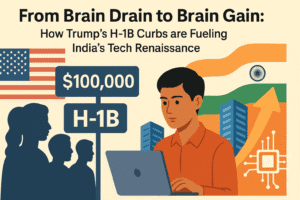
From Brain Drain to Brain Gain: How Trump’s H-1B Curbs are Fueling India’s Tech Renaissance
For decades, the narrative was as predictable as it was prestigious. The brightest engineering minds from India’s hallowed Indian Institutes of Technology (IITs), after surviving an admission process more selective than Harvard, would set their sights on one ultimate prize: a career in the United States. The H-1B visa was their golden ticket, a pathway to Silicon Valley’s innovation, Wall Street’s riches, and the American Dream.
That narrative is now undergoing a profound rewrite.
The recent announcement by the Trump administration to impose a staggering $100,000 fee on new H-1B applications sent shockwaves through the global tech community. Yet, in a striking display of shifting dynamics, the response from India’s elite tech circles is not one of panic, but of quiet defiance—and even opportunity. This isn’t just a story about visa restrictions; it’s the story of a maturing ecosystem realizing its own strength.
The Banner Heard ‘Round the Tech World
The symbolism was impossible to ignore. Weeks after the new fee structure was announced, banners appeared at a Delhi metro station outside IIT-Delhi, proclaiming: “We still sponsor H-1Bs” and “$100K isn’t going to stop us from hiring the best.” This campaign, by an AI recruiting platform, was more than an ad; it was a manifesto.
It captured a burgeoning sentiment that the gravitational pull of the U.S. tech sector is no longer absolute. The message was clear: the value of top-tier Indian talent now justifies a six-figure investment, and more importantly, that same talent has compelling alternatives much closer to home.
“The scene in India is changing very fast,” notes Arpan Tulsyan, a senior fellow at the Observer Research Foundation in New Delhi. “We are not so dependent on the U.S. visa, and we shouldn’t be, because their policy is not under our control.” This statement reflects a strategic pragmatism that is replacing a decades-old dependency.
Beyond Back-Offices: The Metamorphosis of India’s Tech Landscape
To understand this shift, one must look beyond the visa headlines and into the structural transformation of India’s own economy. The “global capability centers” (GCCs) established by multinational giants like Microsoft, Amazon, JPMorgan, and Goldman Sachs in cities like Bengaluru, Hyderabad, and Pune are a world away from the back-office support hubs of the 1990s.
These centers are now innovation powerhouses, handling critical, high-end work in areas like artificial intelligence, machine learning, quantitative analytics, and cloud architecture. The dependency is so deep that, as the article highlights, one European bank concluded a major disruption in India would have a greater global impact than a similar disaster at its headquarters. This isn’t outsourcing; it’s integration at the highest level.
Simultaneously, India’s domestic startup ecosystem has evolved from a promising seedling into a formidable forest. Homegrown unicorns, many founded by IIT alumni themselves, are not just thriving but achieving stellar public market debuts. The recent IPO of Groww, a fintech platform co-founded by IIT graduates, serves as a potent inspiration for current students. It tangible proof that you can build a world-class, globally competitive company from India.
“It’s possibly an opportunity for some of us,” says Rangan Banerjee, Director of IIT-Delhi, reframing the challenge as a catalyst. “We want our students to be job creators.”
The IIT Mindset: A Calculated Recalibration of Ambition
This changing landscape is directly influencing career decisions at the most prestigious engineering schools. The allure of the U.S. is being recalibrated against the tangible momentum at home.
Akshay Sharma, a 19-year-old student at IIT-Delhi, embodies this new pragmatism. “Last year, I would not have thought to do this,” he admits, explaining that he is now actively seeking internships in both India and the U.S., a balanced approach that would have been rare for a student of his caliber a generation ago.
The data supports this anecdote. At IIT Bombay, for the 2023-24 academic year, a overwhelming majority of the 1,475 accepted job offers were domestic. Only 78 came from international companies, a figure that underscores where the immediate opportunities—and interest—now lie.
“The kind of higher education system in the U.S. is unparalleled,” concedes Vineet Gupta of Jamboree Education, highlighting that the appeal of American academia remains. However, even this bastion is showing cracks. Applications from Indian students to U.S. colleges have dropped 14% since Trump’s return to the White House, signaling a cooling of aspirations in the face of political and financial uncertainty.
The Two-Tiered Reality: Elite Confidence vs. Broader Anxiety
It is crucial, however, to view this shift with nuance. The confidence radiating from the IITs represents the apex of India’s tech talent pyramid. These 23 institutes produce only about 25,000 of the 1.5 million engineers India graduates annually.
For students from the thousands of other engineering colleges across the country, the calculus is different. A U.S. degree and an H-1B visa remain a powerful engine of upward mobility, a way to bypass a crowded domestic job market. The anxiety over visa curbs is undoubtedly higher in these circles, where the brand value of an IIT and the lucrative domestic offers it commands are not a given.
This creates a two-tiered system: the elite IIT graduate who can afford to be choosy, weighing high-stakes domestic entrepreneurship against global roles, and the graduate from a less renowned institution for whom the U.S. path remains a primary, if now more difficult, objective.
The Long-Term Play: India’s Homegrown Tech Renaissance
The confluence of Trump’s H-1B fees, broader U.S.-India trade tensions, and India’s own economic rise is creating a perfect storm for a “brain gain.” For years, India lamented the “brain drain” of its best and brightest. Now, the barriers to leaving are rising just as the incentives for staying are multiplying.
This isn’t about closing doors to the world, but about opening more at home. As Karthik Ravi Kumar, a student at IIT-Delhi, succinctly put it: “It is looking less lucrative to go to the US, but there are a lot of other offers from other companies and countries.”
The long-term implication is profound. If a significant portion of India’s most brilliant technical minds begins to channel its energy into building companies and leading critical R&D within India, the country’s trajectory as a global tech superpower will only accelerate. The $100,000 H-1B fee may be remembered not as a barrier erected by Washington, but as an unexpected catalyst that helped India finally stem its brain drain and ignite a full-blown, homegrown tech renaissance. The banners outside the Delhi metro station weren’t just recruiting; they were announcing a new era.
You must be logged in to post a comment.