
From Blemishes to Business: How Solar Dehydrators Are Reshaping the Lives of Maharashtra’s Women Farmers
A campaign by The Better India and Mann Deshi Foundation aims to provide solar dehydrators to women farmers in Maharashtra’s Satara, Sangli, and Solapur districts to combat post-harvest losses, which cost Indian farmers nearly Rs 93,000 crore annually. The technology transforms blemished but perfectly edible produce like pomegranates and mangoes—often rejected by markets for cosmetic reasons—into shelf-stable products within hours, preserving nutrition and creating new income opportunities. Through the emotional stories of farmers like Varsha Dhanavade, who watches imperfect fruit rot, and Archana Babar, who mourns her daughter’s unfulfilled dream of studying in Japan, the initiative highlights how this technology represents more than food preservation—it offers women farmers control over their labor, financial independence, and the ability to dream bigger for themselves and their children.
From Blemishes to Business: How Solar Dehydrators Are Reshaping the Lives of Maharashtra’s Women Farmers
For women farmers in Maharashtra’s drought-prone regions, the difference between poverty and prosperity often comes down to what happens in the days immediately following a harvest. This Women’s Day, a new initiative aims to tip the scales in their favor.
The pomegranates hanging from Varsha Dhanavade’s trees this past season were beautiful—at least to anyone who understands what goes into growing them. Deep crimson, bursting with juice, and sweet enough to make your teeth ache. But when she loaded them onto trucks bound for the markets of Mumbai and Pune, the feedback was always the same.
“They want shiny,” Varsha says, running her fingers over a fruit with the slightest surface scarring. “They want perfect.”
The 42-year-old farmer from Mhaswad in Maharashtra’s Satara district knows what “perfect” means in the commodity markets. It means fruits that look like they’ve been airbrushed. It means rejecting anything with the minor blemishes that occur naturally when pomegranates spend months maturing under the harsh sun, occasionally brushed by wind-blown branches or kissed too long by morning dew.
Last year, nearly 30% of Varsha’s harvest fell into the “imperfect” category. The same sweetness. The same nutritional value. The same backbreaking labor invested. But different fate.
“We watch them rot,” she says quietly. “Every fruit that spoils is money we borrowed for fertilizers. Money we need for my children’s school fees. Money we hoped to save for the next season’s planting.”
Varsha is not alone in this struggle. Across the rain-shadow districts of Satara, Sangli, and Solapur, thousands of women farmers face the same cruel arithmetic of Indian agriculture: grow more, earn less; work harder, hope longer; harvest bountifully, watch silently as a portion of your labor returns to the earth uneaten.
But this Women’s Day, a partnership between The Better India and the Mann Deshi Foundation is offering an alternative—one that doesn’t require farmers to convince the market to change its standards, but instead gives them the tools to transform their “imperfect” produce into something the market actively seeks.
The Solar Solution to an Age-Old Problem
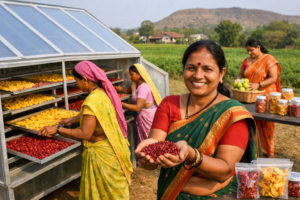
The technology is deceptively simple: a solar dehydrator that uses the sun’s heat—the same sun that bakes the black soil of these districts into cracked patterns during the long dry months—to gently and hygienically dry fruits and vegetables. Inside these units, hot air circulates evenly around trays of sliced produce, drawing out moisture while preserving color, nutrients, and flavor.
The contrast with traditional sun-drying is stark. When women spread chopped fruits on tarpaulins or rooftops, the process takes days. Dust settles. Insects explore. Unexpected rain can undo everything. The produce darkens unevenly, loses nutritional value, and often develops off-flavors that make it unsuitable for anything beyond household consumption.
Solar dehydrators compress that process into six to eight hours. The fruits dry evenly. They retain their vibrant colors. They remain free from contamination. And most importantly, they transform from perishable produce into shelf-stable products that can be stored for months or sold when market prices are favorable.
For women like Varsha, this technology represents something more fundamental than food preservation. It represents control.
The Invisible Women Who Feed India
The United Nations has declared 2026 the International Year of the Woman Farmer—a recognition that comes decades after women have been doing the actual work of feeding the nation. In Maharashtra’s agrarian districts, women participate in every stage of farming: sowing, weeding, fertilizing, irrigating, harvesting, and post-harvest processing. They rise before dawn to cook for their families, spend daylight hours in the fields, and return home to more domestic responsibilities.
Yet when it comes to ownership of land, access to credit, or control over farming decisions, they remain largely invisible.
“Women play a critical role in farming operations,” explains Anagha Kamath, Director of Innovation at Mann Deshi Foundation. “But they often have limited access to productive assets, technology, and market opportunities. The challenges of water scarcity, rising input costs, and post-harvest losses disproportionately impact women farmers, who must balance farm responsibilities with household care work.”
The Mann Deshi Foundation has spent nearly three decades working to change this equation. Since 1996, they’ve been providing women in these districts with financial literacy training, access to capital through community banking, and connections to markets that might otherwise remain closed to them. The solar dehydrator initiative represents the next logical step: giving women the tools to process their own produce and capture value that currently flows entirely to middlemen and traders.
When a Daughter Dreamed of Space
Archana Babar’s story illustrates both the stakes and the heartbreak that drives this work.
A mango farmer from Satara district, Archana has spent years coaxing fruit from her orchard, learning the rhythms of flowering and fruiting, the signs of pest infestation, the timing of irrigation that makes the difference between a good harvest and a great one. She knows her trees the way she knows her children—their needs, their vulnerabilities, their capacity to surprise.
Several years ago, unseasonal rains destroyed nearly 40% of her mango crop. The loss came to roughly Rs 4 lakh—a devastating blow for a small farmer. But the financial loss, as crushing as it was, wasn’t the deepest wound.
Around that time, Archana’s daughter, then in eighth grade, began talking about her dreams. She’d read about an institute in Japan that trained engineers to design equipment for astronauts—machines that could carry food into space. She wanted to go there someday. She wanted to work on problems that seemed impossibly distant from the dusty orchards of Satara.
“I could never promise her anything,” Archana recalls. “Not even that we could send her to study outside the village. Japan—that was a dream too big to even speak aloud.”
Her daughter passed away a few years ago. The dream died with her.
Today, when neighbors compliment Archana on the way she manages her orchard, on the quality of her mangoes, on her resilience in the face of unpredictable weather and volatile prices, she smiles a complicated smile. “If my daughter could dare to dream of space while living in this village,” she says, “then I should have at least some of the strength she had.”
This, ultimately, is what the solar dehydrator initiative is about: giving women farmers the tools to honor the dreams they hold for themselves and for their children. Financial security isn’t an abstraction when it translates into the ability to say “yes” to a child’s ambition.
Beyond Survival: Building Enterprises
The vision extends beyond preventing losses. Mann Deshi and The Better India are working to create pathways for women to build actual businesses around processed foods.
Once women have solar dehydrators, they can produce dried mango slices, pomegranate arils, banana chips, and vegetable powders that meet commercial quality standards. These products can be sold in local markets, through women’s cooperatives, or to urban consumers willing to pay premium prices for naturally dried, preservative-free produce.
“This isn’t just about reducing waste,” Kamath emphasizes. “It’s about enabling women to strengthen and grow their farming businesses through access to clean, cost-saving green technologies. Value addition opens new income opportunities. It improves shelf life. It gives women something they can sell on their own terms.”
The decentralized renewable energy (DRE) approach matters here. Solar dehydrators don’t require grid electricity or diesel generators. They work where the women work—in villages that may experience power cuts, in fields far from the nearest town. They represent technology designed for the actual conditions of rural India, not for the idealized version that appears in policy documents.
The Numbers Behind the Stories
The scale of post-harvest losses in India is staggering. According to government data, farmers lose approximately Rs 92,651 crore annually to spoilage—money that could otherwise flow into rural economies, children’s education, and household nutrition. For fruit growers in Maharashtra, the losses are particularly acute due to the region’s distance from major consumption centers and the perishable nature of their produce.
But statistics only tell part of the story. Behind each percentage point of loss is a farmer watching her labor decompose. Behind each rupee of waste is a calculation about which bills won’t get paid this month, which repairs will have to wait, which dreams will be postponed.
The solar dehydrator intervention addresses a specific point in the value chain where waste is most likely to occur: the period immediately after harvest when farmers must either sell quickly—often at whatever price buyers offer—or watch their produce spoil while waiting for better offers. By extending shelf life from days to months, dehydrators give women the power to wait. To store. To process. To sell when the time is right.
A Different Kind of Women’s Day Tribute
This Women’s Day, as bouquets are presented and speeches delivered about women’s empowerment, the women of Mhaswad, Satara, and Sangli will be doing what they do every day: working. But for those selected to receive solar dehydrators through this campaign, the work will gradually begin to look different.
Instead of watching blemished pomegranates rot while waiting for buyers who never come, they’ll slice those fruits, arrange them on trays, and let the sun—filtered through the dehydrator’s careful engineering—transform them into something valuable. Instead of accepting that a portion of their harvest is worthless by market standards, they’ll create their own market for products that retain all the nutrition and flavor of fresh fruit.
Varsha Dhanavade, for one, is ready for this shift. “If I can dry my pomegranates,” she says, “then even the ones with spots have value. Even the ones that aren’t pretty enough for Mumbai can become something people want to buy.”
She pauses, considering the implications. “Maybe then I can think about expanding my orchard. Maybe then my children won’t have to worry the way I do.”
In villages across Maharashtra’s drought-prone districts, these “maybes” represent the frontier of possibility. They’re not guarantees—farming never offers those. But they’re something more valuable than guarantees. They’re options. Choices. Paths forward that don’t depend entirely on the whims of weather and the dictates of distant markets.
The solar dehydrator initiative won’t solve every problem facing India’s women farmers. It won’t end climate change or stabilize prices or eliminate the middlemen who profit from farmers’ desperation. But it will do something perhaps more important in the daily lives of the women it reaches: it will give them more control over the fruits of their labor.
And in a world where women farmers have historically controlled very little, that’s a gift worth celebrating—on Women’s Day and every day.
You must be logged in to post a comment.