
From Barren to Bountiful: How One Techie’s 25-Year Journey Redefines Wealth, Land, and Legacy
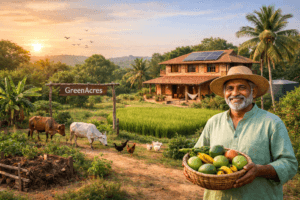
From Barren to Bountiful: How One Techie’s 25-Year Journey Redefines Wealth, Land, and Legacy
In a world obsessed with instant returns and digital gratification, the story of Venkateshwar Talla is a radical act of quiet rebellion. It’s a narrative not measured in quarterly profits, but in the slow, deliberate growth of roots—both of trees and of a profound personal philosophy. His transformation of 11 acres of neglected land near Hyderabad into GreenAcres, a self-sustaining food forest and homestay, is more than a farming success; it’s a masterclass in mindful living and a powerful blueprint for restoring our connection to the earth.
The Impulse Buy That Grew Into a Life’s Purpose
The journey began, as the best ones often do, with a “crazy impulse.” In 1999, while working in the US IT sector, Venkateshwar joined five friends in a collective farming dream, acquiring 30 acres near Yadagirigutta. A year later, he found his five-acre plot abandoned, overrun with thorns. His friends had moved on, but Venkateshwar saw not failure, but raw potential veiled by neglect.
This moment of decision is where most urban farming fantasies end. But in 2003, he moved back to India for good, bought six more adjoining acres, and began a ritual that would define the next two decades: the weekend pilgrimage. With his wife Anitha and their toddlers in tow, he spent every Saturday and Sunday on the land. There were no quick fixes, no industrial machines to clear the land overnight. Progress was measured in handfuls of compost, saplings nurtured, and lessons learned from local farmers. This was not a side hustle; it was a 500-weekend commitment to listening to the land.
The Anatomy of a Food Forest: More Than Just Planting Trees
Venkateshwar’s initial vision was simple: grow trees. But the land, with its thin, hard clay soil, was a stern teacher. The shift to organic farming in 2006 became the cornerstone. He introduced desi cows, not just for milk, but as vital participants in the ecosystem. Their dung and urine became the lifeblood of the soil, transformed into potent compost. He learned the art of mulching to retain moisture and the science of crop rotation between paddy and pulses.
Key to the transformation was understanding permaculture principles—working with nature, not against it. He planted neem trees not just for their medicinal value, but as natural soil looseners. He discovered why certain mango varieties struggled and adapted. Today, the 11 acres boast over 350 fruit trees, alongside pulses, rice, vegetables, and teak. It’s a functioning ecosystem where coconut groves yield oil, desi cows provide dairy, and hens supply eggs. The “forest” in “food forest” is literal; it’s a layered, symbiotic habitat that requires minimal external input and regenerates itself.
The Farmstay: Where Philosophy Meets Hospitality
The idea for the farmstay was born under a starry sky. After a breathtaking night camping on his own land, Venkateshwar wondered, “How can I get city people to experience this?” The answer evolved from a camping model to a sustainable homestay, built to accommodate all seekers of quiet, especially seniors.
The homestay itself is a lesson in repurposed beauty and passive design. Constructed with load-bearing bricks, it features antique doors and windows given a second life. Crucially, it has no air conditioning. Through strategic tree planting and natural airflow, the structure stays cool even in Hyderabad’s peak summer. A 3 kW solar setup powers it, and a two-lakh-litre rainwater harvesting system meets its water needs. This isn’t just low-impact living; it’s a working demonstration of a comfortable, modern life in harmony with natural systems.
The Real Yield: A New Metric for Success
When asked about monetary returns, Venkateshwar reframes the question entirely: “How do I measure the satisfaction of eating the food produced on my own farm? How do I put a price on that? It’s priceless.”
This is the core human insight of the GreenAcres story. In an economy that monetizes every experience, Venkateshwar champions a different currency: the taste of a sun-ripened fruit from a tree you planted, the silence broken only by birdsong, the profound satisfaction of creating abundance from barrenness. His wealth is security—food security, water security, and the profound psychological security that comes from self-reliance.
Broader Lessons for the Aspiring Steward
Venkateshwar’s journey echoes in the stories of other farmers featured alongside his, offering a consolidated manifesto for meaningful land transformation:
- Start with Observation, Not Action: Venkateshwar spent years understanding his plot’s microclimate, soil, and water flow. Like avocado farmer Chethan Shetty advises, start small, experiment, and let the land guide you.
- Feed the Soil, Not Just the Plant: The universal thread from GreenAcres to Parmeshwar Thorat’s avocado farm in Maharashtra is the shift to organic matter. Healthy soil, built with compost and cow dung, is the non-negotiable foundation.
- Diversity is Resilience: Monocultures are vulnerable. Venkateshwar’s forest includes fruits, timber, pulses, and grains. This biodiversity prevents pest explosions, enriches the soil, and ensures multiple yield streams.
- Build Closed-Loop Systems: Waste is a resource out of place. Cow waste becomes fertilizer, food scraps become compost, rainwater is harvested, and sunlight is captured. This minimizes cost and environmental impact.
- Value Experience Over Just Product: The farmstay model is ingenious. It creates a viable economic stream by sharing the experience of the farm—the peace, the knowledge, the connection—which is often more valuable to urban visitors than the produce itself.
- Embrace the Long Game: This is perhaps the most critical lesson. As shrimp farming pioneer Dr. Manoj Sharma of Gujarat exemplifies, perseverance through initial failure is key. Venkateshwar’s 25-year timeline recalibrates our understanding of success. It’s about legacy, not liquidity.
A Living Invitation
GreenAcres stands today as a quiet, green sanctuary and a powerful question. In an age of climate anxiety and disconnection, it asks: What are we truly cultivating? Venkateshwar Talla’s story proves that with patience, intuition, and respect for natural laws, we can heal both land and self. It’s a call to move beyond viewing land as a speculative asset and to rediscover it as a living partner in creating sustenance, beauty, and a legacy of abundance.
His 11 acres are more than a farm; they are a testament to the power of intentional living, a tangible reminder that the greatest returns aren’t found on a spreadsheet, but in the deep, rich soil of a life purposefully lived. It’s an invitation, not to escape modern life, but to rebuild it on a more sustainable, satisfying, and truly nourishing foundation.
You must be logged in to post a comment.