
From Bangalore to the World: Can NKRF Become India’s First Global RF Components Powerhouse?
After 15 years of dominating India’s domestic defense and aerospace sector, N.K. RF Products & Services (NKRF) is strategically pivoting to the global stage, leveraging its expertise in high-reliability RF components to capitalize on the worldwide shift toward supply chain diversification away from China. The Bangalore-based firm faces the significant challenge of obtaining stringent international certifications like AS9100, but aims to compete not on high-volume standardization, but on its proven ability to deliver customized, defense-grade components with the agility required by the growing commercial space and advanced communications sectors. This debut marks a critical test for India’s broader ambitions in deep-tech manufacturing, as NKRF seeks to transform from a protected domestic supplier into a trusted name in the global aerospace supply chain.
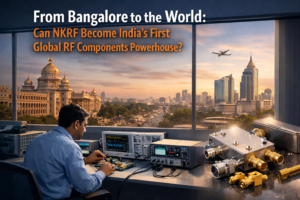
From Bangalore to the World: Can NKRF Become India’s First Global RF Components Powerhouse?
For fifteen years, N.K. RF Products & Services (NKRF) has been a silent sentinel of India’s defense and aerospace capabilities. Its components, the unsung heroes of radar systems and secure communications, have been specified into mission-critical platforms, operating under the radar of the global electronics industry. But silence, in the world of high-frequency electronics, is a strategic asset—one that NKRF is now ready to parlay into a very loud international debut.
Standing in the bustling aisle of an international trade show floor for the first time, a representative from the Bangalore-based firm isn’t just showcasing inductors and filters; they are showcasing a new ambition. After a decade and a half of dominating a protected domestic market, NKRF is making a calculated, high-stakes pivot onto the global stage. This move, captured in its debut at a major international exhibition, signals a profound shift not just for a single company, but for India’s broader aspirations in the global technology supply chain.
But the question on everyone’s mind is not if NKRF has the technical chops—its domestic track record is impeccable. The question is whether an Indian firm, long insulated from the brutal efficiency of the global RF market, can adapt quickly enough to seize a sliver of a supply chain currently dominated by entrenched players in the US, Europe, and increasingly, China.
The Comfort of the Cocoon: 15 Years of Domestic Dominance
To understand NKRF’s strategic pivot, one must first understand the unique ecosystem from which it was born. For a decade and a half, NKRF operated within the confines of India’s “Make in India” defense procurement framework. This policy, while designed to foster indigenous manufacturing, created a unique commercial reality. Companies like NKRF weren’t just competing; they were the preferred solution.
Working with organizations like the Defence Research and Development Organisation (DRDO), Hindustan Aeronautics Limited (HAL), and Bharat Electronics Limited (BEL), NKRF honed its expertise in designing and manufacturing RF components that could withstand the punishing demands of aerospace and military environments. These aren’t commercial-grade parts that can fail in a smartphone; these are components that must guarantee performance at 40,000 feet or in the searing heat of the Thar Desert.
This period of domestic focus was a crucible. It forced NKRF to master the art of high-reliability manufacturing, stringent quality control, and the complex lifecycle management required for defense contracts. They learned to navigate the labyrinthine bureaucracy of Indian defense procurement, a skill that, while not directly transferable to the commercial world, instilled a level of patience and compliance rigor that is rare among smaller component manufacturers.
Yet, this protection also created a ceiling. The Indian defense market, while significant, has finite volumes. True growth, true scalability, lies in the global commercial and aerospace supply chain. The “Make in India” cocoon was warm, but it was also limiting.
The Global Pivot: Why Now?
NKRF’s decision to go global in 2026 is not arbitrary. It is a response to a perfect storm of geopolitical and market forces that have created a gap in the RF supply chain.
- The Great Supply Chain Re-architecting:The global electronics industry is still reeling from the shocks of the pandemic and subsequent trade wars. The old mantra of “cheapest possible cost” has been replaced by “resilience and diversification.” Major OEMs and Tier-1 suppliers in the US and Europe are aggressively de-risking their supply chains, actively seeking second sources outside of China. For a company like NKRF, this is an unprecedented opening. India, with its democratic polity and growing reputation for engineering talent, is emerging as a primary beneficiary of this “China Plus One” strategy.
- The Commercialization of Defense Tech:Technologies that were once the sole purview of defense contractors are now bleeding into the commercial sector. The rise of Low Earth Orbit (LEO) satellite constellations, advanced drone systems, and 5G infrastructure requires RF components that offer defense-grade performance at commercial price points. NKRF’s expertise in high-reliability components is perfectly aligned with the needs of the burgeoning space tech and advanced communications sectors.
- Maturing Indian Manufacturing:The broader Indian electronics ecosystem has matured significantly. The government’s Production Linked Incentive (PLI) schemes have attracted global giants like Apple and Foxconn, creating a dense network of supporting industries. This ecosystem effect means NKRF no longer has to import every piece of raw material or sub-assembly. A local supply chain for PCBs, enclosures, and testing equipment is finally emerging, allowing NKRF to offer competitive lead times and pricing.
The Certification Gauntlet
The article snippet correctly highlights “certification” as a key tag. For NKRF, this is the single biggest hurdle between its domestic success and global relevance. Selling to a domestic defense PSU is one thing; selling to a multinational corporation like Lockheed Martin, Thales, or Airbus is an entirely different league of compliance.
The process is grueling. It requires obtaining and maintaining AS9100 (aerospace) and ISO 9001 certifications, but that is just the entry fee. The real work lies in achieving specific customer qualifications. A component destined for a satellite might need to pass NASA’s outgassing standards or the European Space Agency’s (ESA) rigorous testing protocols for vibration and radiation hardness.
For NKRF, this means its engineering teams must shift from a “design-to-spec” mindset to a “design-to-certification” mindset. Every design decision, from the choice of dielectric material to the soldering process, must be made with an eye on a future audit by a demanding global customer. It’s a costly, time-consuming, but absolutely necessary investment.
Adding Value: More Than Just a Component
If NKRF is to succeed where others have stumbled, it cannot simply be a vendor of off-the-shelf parts. Its value proposition must be more nuanced. Based on the trajectory of other successful mid-tier component makers, NKRF’s pitch likely centers on customization and agility.
While large players like Mini-Circuits or Murata excel at high-volume, standardized components, there is a “long tail” of demand for custom RF assemblies and modified standard parts. A startup building a niche radar system or a university launching a research satellite doesn’t need a million units; they need 50 highly specific, perfectly tuned components.
This is NKRF’s sweet spot. Having spent years fulfilling bespoke orders for India’s defense labs, they are inherently flexible. They can offer design consultation, rapid prototyping, and small-batch manufacturing with a turnaround time that the larger giants struggle to match. In the world of RF engineering, where impedance matching and signal integrity are everything, having a partner who can hand-hold the design process is a massive competitive advantage.
The Human Element: From Service to Sales
Perhaps the most significant cultural shift for NKRF will be moving from a service-oriented defense contractor to a sales-oriented global supplier. For 15 years, their customer was essentially the Indian government. Relationships were built over decades, contracts were negotiated, and requirements were known years in advance.
The global market is the polar opposite. It is fast-paced, relationship-driven in a different way, and brutally competitive. Making its international exhibition debut, NKRF’s team is now learning a new language—the language of “sell-by dates,” “distributor networks,” and “competitive benchmarking.” They are likely spending as much time talking to potential distributors and reps as they are to end customers, trying to build a sales pipeline from scratch.
The human story here is one of transition. The engineers who once prided themselves on solving a problem for a specific radar system are now having to think about total addressable markets (TAM) and bill of materials (BOM) costs. The leadership team, accustomed to annual planning cycles aligned with the Indian fiscal year, must now react to quarterly market shifts in London, Singapore, and Silicon Valley.
The Road Ahead: A Litmus Test for Indian Tech
NKRF’s journey from Bangalore to the global stage is more than just a corporate expansion plan. It is a litmus test for India’s ambitions in deep-tech manufacturing. If NKRF succeeds, it paves the way for dozens of other specialized Indian firms to follow. It proves that Indian companies can not only assemble phones but can also design and manufacture the critical, high-value components that power the world’s most advanced technologies.
The challenges are immense. The competition is fierce. The certification mountain is steep. But the opportunity is historic. As global supply chains fragment and rebuild, there is a space at the table for a reliable, technically proficient partner from a trusted geography. After 15 years of quiet service, NKRF is stepping forward to claim that seat. The world is now watching to see if it can hold its own.
You must be logged in to post a comment.