
From Assembly Lines to Global Lifelines: How India’s Electronics Export Surge is Redefining Its Economic Destiny
India’s electronics exports, reaching $31 billion in the first eight months of FY26 with a remarkable 38% year-on-year growth, signify a transformative strategic success, driven by targeted Production Linked Incentive (PLI) schemes and global supply chain diversification. This surge, making electronics the fastest-growing major export, is fueled by large-scale mobile phone manufacturing for global giants and represents a critical pivot from a services-led economy to becoming a trusted hardware manufacturing hub. Beyond the numbers, this growth is catalyzing substantial job creation, advanced skill development, and vital technology transfer, laying the foundation for a more integrated ecosystem. While challenges remain in boosting domestic value addition and infrastructure, this momentum positions India as a key player in global electronics, reducing import dependence and building a pathway toward greater technological sovereignty and economic resilience.
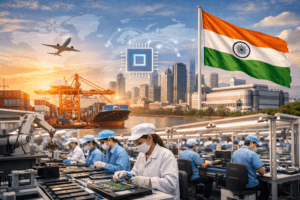
From Assembly Lines to Global Lifelines: How India’s Electronics Export Surge is Redefining Its Economic Destiny
In a testament to a strategic bet that is paying monumental dividends, India’s Electronics and Information Technology Minister, Ashwini Vaishnaw, recently announced a staggering milestone: the nation’s electronics exports hit $31 billion in just the first eight months of the current financial year (FY26). This isn’t just another statistic in a government press release; it is the loudest signal yet that India is successfully pivoting from a predominantly services-led economy to becoming a global powerhouse in hardware manufacturing and export. With a breathtaking 38% year-on-year growth, electronics now stand as the fastest-growing segment among India’s top 30 export categories, outpacing traditional stalwarts and rewriting the rules of global trade corridors.
Decoding the $31 Billion Figure: More Than Just a Number
At first glance, $31 billion in eight months projects to an annual figure nearing $46-47 billion—a quantum leap from the $11.7 billion recorded as recently as FY19. This exponential curve is no accident. It is the direct outcome of a deliberate, multi-pronged national strategy centered on the Production Linked Incentive (PLI) scheme. Launched for large-scale electronics manufacturing, this scheme didn’t just offer subsidies; it issued a clarion call to the world’s biggest tech giants, promising scale, stability, and a skilled workforce.
The beneficiaries of this policy are now the engines of this export boom. Think of the Apple iPhones assembled in Tamil Nadu and Karnataka, which now account for a significant share of this export basket. Companies like Foxconn, Wistron, and Pegatron, along with Samsung’s expansive facilities, have transformed Indian factories from mere assembly units into integral nodes in the global supply chain. The export figure, therefore, represents millions of smartphones, components, and other electronic devices stamped with “Made in India,” destined for markets in the United States, Europe, and the Middle East.
The Global Context: A Strategic Realignment in a Fragile World
India’s surge cannot be viewed in isolation. It arrives at a critical juncture of global “de-risking” and supply chain diversification. The over-concentration of electronics manufacturing in one region has led global brands to seek a “China+1” strategy. India, with its democratic credentials, vast domestic market, and improving infrastructure, emerged as the most compelling alternative.
This $31 billion export story is, in essence, India capturing a slice of the global electronics trade realignment. It signifies trust. It shows that global corporations now trust Indian factories with their flagship products, complex logistics, and stringent quality standards. This trust translates into tangible economic gains and positions India not as a backup, but as a primary manufacturing hub for the future.
The Human Engine: Jobs, Skilling, and the Silent Revolution
Minister Vaishnaw rightly highlighted that this growth is “driving jobs, skilling and technology transfer.” This is the most profound, human impact of the export numbers. In cities like Noida, Sriperumbudur, and Hosur, a silent revolution is underway.
- Job Creation: The electronics manufacturing sector is inherently employment-intensive. From assembly line technicians and quality inspectors to engineers and logistics managers, hundreds of thousands of direct jobs have been created. The multiplier effect generates even more indirect employment in ancillary services, housing, and transportation, revitalizing entire industrial corridors.
- The Skilling Wave: This industry demands a specific skill set. Recognizing this, government initiatives like the Skill India Mission have aligned with corporate training programs. Polytechnics and ITIs are now tailoring courses in mechatronics, surface-mount technology (SMT) line operation, and precision engineering. This is creating a new generation of blue-collar and white-collar workers equipped for 21st-century manufacturing, moving the workforce narrative beyond IT services.
- Technology Transfer – The Crown Jewel: Perhaps the most significant long-term benefit is the embedded knowledge and technology transfer. As global firms set up shop, they bring cutting-edge processes, automation technologies, and management practices. Indian engineers and managers are absorbing this know-how. This transfer is the foundational step for moving up the value chain—from assembly to component manufacturing, and eventually, to indigenous design and innovation.
Beyond Smartphones: The Ripple Effects and Emerging Clusters
While mobile phones dominate the current export basket, the growth is seeding a broader ecosystem. The success is catalyzing investments in related verticals:
- Component Manufacturing: To reduce import dependence and increase value addition, there is a growing push for manufacturing displays, battery cells, camera modules, and PCBs within India. The PLI scheme for IT hardware and components is beginning to attract players here, promising a more integrated and resilient supply chain.
- Electronics Manufacturing Services (EMS): Indian EMS players are scaling up rapidly, serving not just global brands but also nurturing domestic brands. This creates a virtuous cycle, supporting homegrown innovation and product development.
- Semiconductor Ambitions: The crown jewel of electronics, semiconductor fabrication, is the next frontier. While the journey is long and capital-intensive, the government’s $10 billion semiconductor mission has seen its first major breakthrough with groundbreaking ceremonies for fabrication and packaging units. The current export momentum builds the demand base and expertise needed to eventually feed into these advanced fabs.
Challenges on the Road Ahead: Sustaining the Momentum
Celebrating the $31 billion milestone must be tempered with a clear-eyed view of the challenges:
- Value Addition: A substantial portion of the export value still comes from imported components. The true measure of success will be increasing the domestic value addition, which currently lags behind competitors like Vietnam and China.
- Infrastructure & Logistics: While improving, consistent power supply, efficient port clearances, and robust logistics networks remain areas requiring continuous investment to keep costs competitive.
- Deepening the Ecosystem: Attracting tier-2 and tier-3 component suppliers is crucial. This requires a focus on ease of doing business at the state level, competitive utility costs, and developing specialized industrial clusters.
- Global Competition: Vietnam, Thailand, and Mexico are also aggressively courting the same supply chains. India’s value proposition must remain compelling through policy stability, skilled labor quality, and infrastructure development.
The Bottom Line: A Defining Chapter in India’s Economic Story
The announcement by Minister Vaishnaw is more than a monthly trade update. It is a report card on a national strategic shift. The $31 billion in electronics exports symbolizes a tangible, job-creating, skill-generating transformation of India’s economic fabric.
This growth narrative moves India beyond its iconic status in software services. It proves the country can excel in precision hardware, global-scale logistics, and complex manufacturing. For the global economy, it means a more diversified and resilient supply chain. For the Indian worker, it means new, high-quality employment avenues. For the Indian economy, it reduces a massive import bill, strengthens the rupee, and builds a foundation for technological sovereignty.
The next eight months will be crucial to see if this blistering pace can be maintained and if the foundations laid today can support the even more ambitious goal of $300 billion in electronics production by 2026. One thing is clear: India is no longer just a promising market for electronics consumption. It has decisively emerged as a critical, trusted, and rapidly growing source for the world’s electronics. The assembly lines are humming, and their sound is the sound of a changing economic destiny.
You must be logged in to post a comment.