
From Assembly Lines to Ecosystems: Decoding the FICCI-Mercedes-Benz Bharat Challenge and India’s New Blueprint for Innovation
In a strategic move to bridge the gap between grassroots innovation and industrial-scale application, industry body FICCI and Mercedes-Benz India have launched the ‘Bharat Innovation & Business Ideas Challenge Programme.’ Designed to strengthen India’s startup ecosystem, this initiative uniquely focuses on core developmental sectors—manufacturing, sustainability, decarbonization, electric mobility, and education—by offering selected early-stage innovators far more than just funding. Beyond a grant of up to ₹30 lakh for top winners, the programme provides critical year-long mentorship, direct industry exposure, and access to flagship platforms, representing a mature shift from simple contests to structured, long-term partnerships that aim to translate pioneering ideas into viable solutions for India’s key economic and environmental go
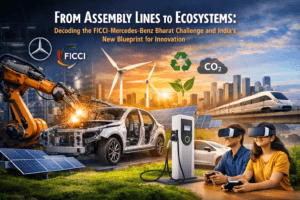
From Assembly Lines to Ecosystems: Decoding the FICCI-Mercedes-Benz Bharat Challenge and India’s New Blueprint for Innovation
In a move that signals a strategic shift in how corporate India engages with grassroots innovation, the Federation of Indian Chambers of Commerce & Industry (FICCI) and Mercedes-Benz India have jointly launched the ‘Bharat Innovation & Business Ideas Challenge Programme.’ While corporate-startup challenges are not new, the nuanced focus and structure of this initiative reveal a deeper, more mature understanding of what India’s innovation ecosystem truly needs to transition from ideation to industrial-scale impact.
Beyond the press release, this partnership is a fascinating case study in aligning global corporate excellence with national developmental pillars. It’s not merely a competition; it’s a curated intervention designed to bridge the critical gap between visionary ideas and viable, market-ready solutions.
The Strategic Imperative: Why This Partnership Matters
At first glance, the alliance between a premier industry body and a luxury automotive giant might seem unusual. However, a closer look reveals a powerful synergy. FICCI brings its unparalleled network across traditional and emerging industry sectors, an understanding of policy landscapes, and a conduit to government initiatives. Mercedes-Benz India, beyond its brand prestige, contributes cutting-edge global R&D perspectives, a culture of precision engineering, and a supply chain that demands world-class quality and sustainability standards.
This program is a tacit acknowledgment that the next wave of Indian innovation cannot be siloed in tech parks alone. It must be integrated into core sectors like manufacturing, energy, and logistics—the backbone of the economy. The chosen focus areas—Manufacturing, Sustainability, Decarbonisation, Electric Mobility, and Education—are not random. They are the precise pressure points where innovation can catalyze monumental progress toward India’s goals of a $5 trillion economy, net-zero emissions, and global manufacturing leadership.
Deconstructing the Focus Areas: More Than Buzzwords
- Advanced Manufacturing: India’s ‘Make in India’ 2.0 needs smart manufacturing. The challenge likely seeks innovations in robotics, AI-driven quality control, IoT for predictive maintenance, and additive manufacturing. It’s about making factories leaner, smarter, and more competitive globally. For a company like Mercedes-Benz, which operates a state-of-the-art production facility in Chakan, insights into frugal yet advanced manufacturing tech can be invaluable.
- Sustainability & Decarbonisation: This goes beyond planting trees. The hunt is for circular economy models, carbon capture technologies, green materials (especially in packaging and construction), and energy efficiency breakthroughs for industries. It targets the hard-to-abate sectors. Mercedes-Benz’s global “Ambition 2039” to become carbon-neutral directly feeds into this search for scalable local solutions.
- Electric Mobility Ecosystem: The vision extends far beyond vehicles. The program likely aims to unearth innovations in EV charging infrastructure (like affordable fast-charging or battery-swapping models), battery recycling, thermal management, and power electronics. It’s about building the entire supporting cast for the EV revolution.
- Education for the Future: This is the most profound pillar. Innovators might be working on AR/VR for skill training, platforms for reshooting engineers for Industry 4.0, or STEM tools that make complex concepts accessible. It addresses the fundamental need for a future-ready workforce to sustain all other sectors.
The “Value-Add”: Beyond the ₹30 Lakh Prize
While the innovation support grant for the top seven winners is a significant catalyst, the real gold lies in the non-monetary offerings:
- Expert Mentorship: This isn’t generic advisory. Startups will gain access to mentors from Mercedes-Benz’s global and local R&D teams and FICCI’s industry veterans. This means feedback rooted in real-world engineering constraints, supply chain logistics, and compliance standards—knowledge often missing in typical accelerator programs.
- Industry Exposure & Access: For an early-stage innovator, getting a pilot project within a reputable corporate’s operations or supply chain is a game-changer. It provides validation, stress-tests the product, and offers a referenceable client. Mercedes-Benz’s ecosystem of suppliers and partners presents a massive potential playground.
- FICCI’s Flagship Platforms: Presenting at a FICCI forum puts innovators in front of policymakers, corporate leaders, and investors in one room. This is a unique opportunity for advocacy and high-stakes networking that can alter a startup’s trajectory.
- Year-Long Handholding: The commitment to sustained support suggests a partnership model, not a one-off transaction. This long-term engagement is critical for navigating the “valley of death” between prototype and commercial success.
The Larger Context: India’s Evolving Innovation Landscape
This program arrives at a pivotal moment. India is now the third-largest startup ecosystem globally. The first wave was dominated by consumer internet, fintech, and e-commerce. The second, more complex wave—where this challenge sits—is about DeepTech and ImpactTech. It’s about solving fundamental problems in energy, climate, health, and production.
The FICCI-Mercedes-Benz model represents a maturation from broad-based startup challenges to “Themed Innovation.” It’s a focused, sector-specific sieve designed to catch the most relevant ideas. This is a trend gaining momentum globally, as corporations move from being mere sponsors of innovation to becoming active architects of their future supply chains and problem-solvers.
A Critical Perspective: Potential Pitfalls and The Road Ahead
For the program to truly stand out, it must navigate certain challenges:
- Avoiding the “Pilot Purgue”: Many corporate-startup programs end with a successful pilot that never scales. The structure must include clear pathways for procurement, investment, or integration.
- IP Clarity: Early-stage innovators are often wary of corporate partnerships due to intellectual property concerns. A transparent, fair IP policy will be crucial to attracting the best talent.
- Inclusivity Beyond Metros: The name “Bharat Innovation” carries a responsibility. The outreach must actively engage innovators from tier-2 and tier-3 cities, universities, and rural areas, where ground-level problems inspire the most pragmatic solutions.
Conclusion: Building Bridges, Not Just Trophies
The FICCI Mercedes-Benz Bharat Innovation & Business Ideas Challenge Programme is more than a headline; it is a blueprint. It underscores that the future of Indian innovation is not just in disruption, but in meaningful collaboration. It’s about marrying the agility and fresh perspective of startups with the scale, experience, and rigour of established industry.
For the aspiring innovator, this is a call to align their genius with the nation’s pressing needs. For the ecosystem, it’s a model of how corporate capital and expertise can be deployed constructively. And for India, it’s a step toward a vision where solving local challenges with homegrown technology becomes the ultimate marker of a self-reliant, developed nation. The challenge now is not just to launch ideas, but to launch them on a trajectory that ensures they land where they are needed most: into the heart of Indian industry, making it cleaner, smarter, and more resilient for the future.
You must be logged in to post a comment.