
From Ancient Archives to Modern Ark: How Climate and Catastrophe Sculpted Kaziranga’s Last Stand for the One-Horned Rhino
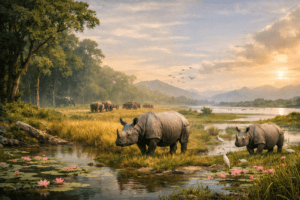
From Ancient Archives to Modern Ark: How Climate and Catastrophe Sculpted Kaziranga’s Last Stand for the One-Horned Rhino
Beneath the tranquil, water-lily dotted swamps of Kaziranga National Park, a drama spanning millennia lies buried in the mud. It is not a tale written in stone or bone, but in pollen and spores—microscopic whispers of lost forests, shifting climates, and the great, trudging footsteps of megaherbivores. Recent groundbreaking research has deciphered this muddy archive, revealing a profound narrative of resilience, retreat, and refuge. It tells us why the iconic Indian one-horned rhinoceros, once a lord of landscapes across the subcontinent, now makes its final great home in the floodplains of Assam.
This isn’t just a story of a species in decline; it’s a testament to how landscapes remember, and how the ghosts of past ecosystems directly inform the urgent conservation battles of today.
Unearthing a Microscopic Time Capsule
The study, led by scientists from the Birbal Sahni Institute of Palaeosciences (BSIP), employed a technique as elegant as it is revealing: palynology, the study of pollen and spores. By extracting a 1.2-meter sediment core from the Sohola swamp within Kaziranga, they obtained a continuous chronological record. Each layer of silt, accumulated year after year, captured and preserved the pollen rain from surrounding vegetation and, crucially, fungal spores that grow specifically on herbivore dung.
Think of it as a natural history book, with each page a thin layer of mud. By “reading” these pages—identifying the types of pollen and the concentration of dung fungi—the researchers could reconstruct two parallel histories: the changing plant communities and the intensity of large herbivore activity over the last 3,300 years.
The Schematic Story: A Forest Transformed
The research paints a dynamic picture of Kaziranga’s evolution, which can be visualized in three key phases:
- The Deep Forest Refuge (~1300 BCE – 300 BCE): The core’s deepest layers tell of a Kaziranga quite different from today’s mosaic of grasslands, woodlands, and wetlands. The pollen evidence points to a denser, broader forest canopy with slower-growing tree species, interspersed with permanent, deep-water swamps. The low presence of dung fungi suggests this environment, while pristine, did not support the high density of large grazing animals we associate with modern Kaziranga. It was a wet, closed forest, a refuge but not yet a paradise for mega-grazers.
- The Great Transition (~300 BCE – 1600 CE): A significant shift begins. Pollen records show a decline in dense forest trees and a marked increase in grasses, shrubs, and plants that thrive in disturbed, open landscapes. Concurrently, the spores from coprophilous (dung-loving) fungi spike dramatically. This is the smoking gun of paleoherbivory. The landscape was opening up, and large herds of herbivores—ancestors to the rhinos, elephants, and buffaloes of today—were actively maintaining it. Their grazing and trampling prevented forest regeneration, promoting the expansion of the grasslands and shallow wetlands that define Kaziranga.
- The Modern Mosaic (~1600 CE – Present): This trend intensifies, solidifying Kaziranga’s current identity. The forest becomes even more open, the wetlands shallower and more seasonal, and the grassland complex reaches its peak. The dung fungus signal remains persistently high, confirming that the megaherbivores are now the dominant ecological engineers, their lifecycles locked in a symbiotic dance with the grass-forb ecosystem they helped create.
The Grand Migration: Why Kaziranga?
This local transformation is set against a continent-spanning tragedy. Fossil evidence is clear: the Indian one-horned rhinoceros was once widespread, roaming the fertile floodplains of the Indus, Ganges, and beyond. So why did it vanish from the west and crowd into the east?
The BSIP study ties Kaziranga’s local ecological story to the grand, crushing forces of climate change and human expansion.
- The Northwest’s Downfall: During the late Holocene, particularly the climatic upheavals of the Little Ice Age (approx. 1300-1850 CE), northwestern India experienced pronounced climate deterioration. This likely meant increased aridity, unpredictable rainfall, and the fragmentation of vital riverine habitats. As ecosystems strained, the arrival of accelerating human activities—agricultural expansion, urbanization, and, critically, hunting—proved the final blow. The rhino, a large, slow-breeding target, was eradicated from these regions. Its habitat was destroyed from the ground up by farmers and from the top down by hunters.
- The Northeast’s Fortuitous Stability: In stark contrast, the paleo-records suggest northeastern India, and the Brahmaputra floodplain in particular, enjoyed remarkable climatic stability. While the west dried and fractured, Assam continued to receive robust, seasonal rainfall from the monsoons, maintaining its complex wetland systems. Crucially, until much more recently, human population pressure here was lower. This provided a dual sanctuary: a stable climate and a landscape of refuge.
The rhinos didn’t simply wander east. They were squeezed out of the west by a pincer movement of climate change and human pressure, and funneled into the last remaining, large, suitable habitat: the Brahmaputra floodplains. Kaziranga, with its evolving open grasslands and wetlands, became their unintended ark.
The Human Insight: Lessons from the Mud for Today’s Crisis
The profound value of this research lies not in nostalgia, but in application. It offers indispensable, long-term insights for modern conservation:
- Kaziranga is Not a “Pristine” Wilderness, But a Dynamic Creation: The park we cherish is the product of millennia of interaction between climate, vegetation, and, importantly, megaherbivore activity. This underscores that active management— mimicking natural grazing and hydrological patterns—is not interference but a continuation of the historical processes that formed this biodiversity hotspot.
- Climate Stability is the Unsung Hero of Conservation: The study highlights that Kaziranga’s ultimate value was as a zone of climatic refuge. As anthropogenic climate change now threatens to destabilize weather patterns globally, ensuring the resilience of such refuges—by protecting watersheds, maintaining connectivity, and reducing non-climate stresses—becomes paramount. Can Kaziranga remain a stable haven in a 21st-century climate crisis?
- The “Why” Behind the Concentration: Understanding that rhinos were concentrated here by forces from outside the region reframes our responsibility. Kaziranga isn’t just an Assamese or Indian treasure; it holds a global population because of pan-regional historical events. Its burden and its safeguarding are of international significance.
- The Paleo-Perspective on Invasive Species: The pollen record shows how native species composition changed with climate and herbivory. Today, Kaziranga faces threats from invasive plants like water hyacinth and mimosa. The long-term view reminds us that ecosystems are always in flux, but that modern, human-introduced changes occur at a blinding pace against which native species may not adapt.
Conclusion: The Archive and the Ark
The mud of Sohola swamp has spoken. It tells us that Kaziranga’s rhinos are more than charismatic residents; they are legacies of an ancient ecological journey, survivors of a continental squeeze. Their home is not a static postcard but a living, breathing landscape with a deep memory.
This research transforms our understanding from a snapshot to a epic film. It shows that conservation is not about freezing a moment in time, but about stewarding an ongoing process. As we face a future of escalating climate uncertainty and habitat fragmentation, the lessons from Kaziranga’s past are clear: protect the processes, safeguard the refuges, and understand that the survival of giants like the one-horned rhino depends on our ability to read the subtle stories written in the mud, and to act on the profound truths they reveal.
The study, “Late Holocene vegetation dynamics, palaeoherbivory and implications for the conservation of Kaziranga National Park, Assam, India,” is published in the journal Catena (Elsevier).
You must be logged in to post a comment.