
From Ambition to Action: Why Indian Pharma’s Digital Dream is Stuck in Pilot Purgatory (And How to Break Free)
Indian pharmaceutical companies increasingly recognize automation, AI, and cybersecurity as critical digital priorities to enhance efficiency, quality, and competitiveness, particularly in response to complex regulations and advanced drug modalities. However, a significant gap exists between ambition and execution, with only a third of firms achieving substantial digital transformation in their quality functions, while over half remain in partial implementation due to entrenched legacy systems, cultural resistance, stringent compliance requirements, and challenges in scaling pilot projects. To bridge this divide, the sector must focus on building robust data foundations, adopting phased “phygital” transitions, reframing cybersecurity as integral to quality, and pursuing strategic partnerships, thereby evolving from fragmented technological adoption to a fully integrated, data-driven ecosystem that ensures future resilience and global leadership.
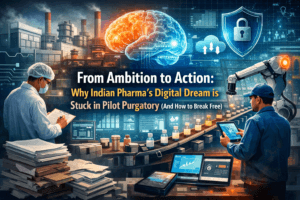
From Ambition to Action: Why Indian Pharma’s Digital Dream is Stuck in Pilot Purgatory (And How to Break Free)
The narrative surrounding Indian pharmaceutical companies has long been one of agile generics manufacturing and cost leadership. Today, a new chapter is being written, one where digital transformation is heralded as the key to future dominance. A recent industry analysis underscores this shift, pinpointing automation, artificial intelligence (AI), and cybersecurity as the triumvirate of technological priorities for the sector. Yet, in a revealing twist, the same report delivers a sobering reality check: only a third of companies have achieved significant digital transformation within their critical quality functions. This gap between ambition and execution isn’t just a minor setback; it’s the central drama playing out in boardrooms across the country. The journey from paper-based legacy systems to a seamless, data-driven ecosystem is proving to be a complex formulation to master.
The Digital Prescription: What Indian Pharma Says It Needs
The priorities are clear and logical. In an industry where precision is synonymous with safety, these technologies promise a revolution:
- Automation: Moving beyond repetitive manual tasks in manufacturing and labs. Think electronic Batch Manufacturing Records (eBMRs) that eliminate transcription errors, or automated environmental monitoring systems that ensure sterile conditions 24/7. This is the bedrock for efficiency and data integrity.
- Artificial Intelligence & Machine Learning: The potential here is vast. AI can predict machine failures before they disrupt production (predictive maintenance), optimize complex fermentation processes for biologics, or accelerate drug discovery by analyzing vast datasets for novel patterns. In quality control, ML algorithms can analyze visual inspection data with superhuman consistency.
- Cybersecurity: As operations digitize, they become targets. Protecting sensitive patient data, proprietary R&D information, and manufacturing formulas from cyber threats is no longer an IT issue but a core business imperative. A single breach can shatter regulatory trust and brand reputation overnight.
- Supporting Cast (Data Analytics & Cloud): These are the essential enablers. Cloud computing offers the scalable infrastructure to deploy these technologies without monumental capital expenditure. Advanced data analytics is the lens that turns the vast data generated by automation and IoT sensors into actionable insights for continuous improvement.
As Duraisamy Rajan Palani of Archimedis Digital notes, this shift is foundational. It’s a response to a perfect storm: increasingly complex generics and novel biologics, hyper-scrutiny from global regulators (USFDA, EMA, etc.), and the relentless pressure to reduce time-to-market while cutting costs.
The Diagnosis: Why Transformation is Stalling at “Partial Implementation”
If the roadmap is so clear, why are over 55% of companies stuck in “partial implementation”? The diagnosis reveals several chronic, interrelated conditions:
- The Legacy System Quagmire: Indian pharma grew on the back of robust, but often siloed and paper-based, systems. Integrating sleek new AI platforms with decades-old ERP or LIMS (Laboratory Information Management System) is a Herculean task. The integration challenge isn’t merely technical; it’s a data architecture nightmare. Data trapped in incompatible formats and systems cannot fuel the AI engines promised.
- The Cultural Conundrum: From Paper to Algorithm: A shop floor veteran who has trusted his handwritten logbook for 30 years must now trust a tablet and an algorithm. This human element is critical. Digital transformation demands a cultural shift towards data-driven decision-making, psychological safety to report digital-system glitches, and upskilling at every level. Without addressing this change management puzzle, the best technology will be underutilized or resisted.
- The Regulatory Compliance Double-Bind: The industry is regulated by principles of Data Integrity (ALCOA+) and validation. Every new digital tool must be meticulously validated to prove it works as intended in a GxP environment. This process is slow, expensive, and fraught with uncertainty. Companies fear that adopting a cutting-edge AI solution could lead to lengthy regulatory queries, slowing approvals. Thus, a risk-averse mindset often favors the “devil you know” (paper) over the “algorithm you don’t.”
- The Talent Gap: The fusion of deep pharma domain expertise with advanced skills in data science, AI modeling, and cybersecurity is rare. Hiring this talent is expensive and competitive, putting smaller and mid-sized players at a particular disadvantage.
- Pilot Purgatory: Many companies have successful, gleaming proof-of-concept projects—a single production line automated, a pilot AI project for predictive maintenance. The stumbling block is scaling. Moving from one line to ten, from one plant to five, requires strategic capital allocation, standardized processes, and company-wide buy-in that often fizzles after the initial pilot’s success.
The Treatment Plan: Bridging the Ambition-Action Gap
Moving from partial to pervasive digital maturity requires a holistic strategy, not just a technology procurement list.
- Prioritize Foundations Over Flash:Before chasing complex AI, solidify the data foundation. This means: *Implementing core digital quality systems like eBMRs and Quality Management Systems (QMS) that generate structured, reliable data. * Investing in cloud-based platforms that offer scalability and easier integration than on-premise legacy hardware. * Developing a clear data governance framework—who owns it, how is it stored, secured, and retired?
- Adopt a “Phygital” Transition Strategy:An abrupt switch from paper to digital can be disruptive. A phased, “phygital” (physical + digital) approach can ease the transition. For instance, running a new eBMR system in parallel with paper records for a period builds confidence and helps identify process gaps before full cut-over. This reduces risk and aids change management.
- Reframe Cybersecurity as Quality Assurance:Cybersecurity must be baked into the design of every digital initiative, not bolted on as an afterthought. It should be presented not as an IT cost, but as a direct investment inproduct quality and supply chain integrity. A cyber-attack that shuts down production is a quality and compliance event.
- Forge Strategic Partnerships:Given the talent and integration challenges, partnering with specialized tech firms, consultancy groups (like the report’s publisher), and even academic institutions can be faster than building all capabilities in-house. Look for partners who understand theGxP landscape, not just the technology.
- Start with “Augmented Intelligence,” Not “Artificial Intelligence”:To build trust and demonstrate value, frame early AI projects as tools toaugment human expertise, not replace it. An ML model that flags potential anomalies for a quality expert to review is easier to adopt and validate than a fully autonomous system. It shows tangible assistance, reducing cultural friction.
The Prognosis: A Digitally-Enabled Future
The 2.2% who haven’t started are at existential risk. The 8.9% in planning must move swiftly. For the majority in the “partial implementation” cohort, the next phase is the most critical.
The companies that successfully navigate this transition will unlock a new era of competitive moats. They will move from being suppliers of generic medicines to providers of consistent, high-quality, data-rich drug products that global regulators and partners trust implicitly. They will accelerate R&D for novel biologics and complex generics through digital twins and AI-driven discovery. Their manufacturing agility will make supply chains more resilient.
The digital transformation of Indian pharma is not a destination but a continuous state of evolution. The initial report of partial implementation is not a failure, but a baseline. The true insight is that the hard work of integration, culture change, and scaling now separates the leaders from the laggards. The priorities are set. The blueprint is understood. The next decade will belong to those who can turn their digital plans from fragmented projects into a unified, operational reality. The prescription for success is clear; the industry must now find the will to administer it fully.
You must be logged in to post a comment.