
From Agnipath’s Shadow to the IMA’s Proud Parade: The Unyielding Journey of Lieutenant Hardeep Gill
Hardeep Gill’s journey from a Haryana village to the Indian Military Academy is a powerful testament to resilience after his selection as an IAF Airman was halted by the Agnipath scheme’s introduction, leading him to pivot toward becoming an officer; despite failing the Services Selection Board eight times, he persevered through nine attempts while supported by the immense sacrifices of his widowed mother, Santro, and ultimately passed out as a Lieutenant in the Sikh Light Infantry, transforming a profound setback into an even greater achievement through sheer determination and unwavering belief.
From Agnipath’s Shadow to the IMA’s Proud Parade: The Unyielding Journey of Lieutenant Hardeep Gill
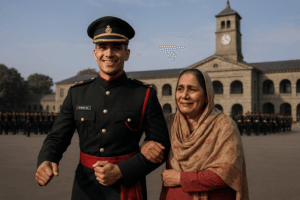
Beneath the iconic Chetwode Tower at the Indian Military Academy in Dehradun, where the words “The safety, honour and welfare of your country come first…” are etched in stone, a young man from a Haryana village took the final, purposeful stride of his transformation. On a crisp December morning in 2025, Lieutenant Hardeep Gill, with his proud mother Santro watching through tears of triumph, marched into a future he had forged through sheer, unrelenting will. His commission into the 14th Battalion of the Sikh Light Infantry was not just a personal victory; it was a powerful testament to the human spirit’s capacity to convert profound disappointment into legendary resilience.
This is more than a motivational success story. It is a layered narrative about navigating abrupt policy shifts, the silent sacrifices of a mother, and the psychological marathon of pursuing a dream against a chorus of doubt. Hardeep’s journey from a selected Airman to a commissioned Army Officer maps the complex emotional and strategic terrain faced by countless aspirants in contemporary India.
The Dream Deferred: When Policy Alters Personal Destiny
Hardeep Gill’s story is inextricably linked to a national inflection point: the introduction of the Agnipath scheme in 2022. Hailing from Alipur village in Jind, Haryana—a state with a deep-seated culture of military service—Hardeep’s initial ambition was grounded in tradition. After completing his schooling and helping his widowed mother farm their small landholding, he set his sights on the Indian Air Force. His path seemed clear when he cleared the selection process for an Airman, ranking an impressive 59th all-India among nearly 3,000 selected candidates.
Then came the pivot. The launch of Agnipath, a transformative recruitment policy for the armed forces, placed many conventional recruitment processes, including his batch, on hold. Overnight, a confirmed future vanished. “That dream was dashed,” Hardeep recalls. For many, this could have been a permanent full stop—a reason to retreat into bitterness. For Hardeep, it became a semicolon; a forced pause that redirected his ambition toward an even higher goal: an officer’s commission.
This pivot highlights a critical, often overlooked, human dimension of structural reforms. Policy is macro, but its impact is intensely micro. Hardeep’s response—channeling frustration into fuel—exemplifies how individual agency can rewrite a seemingly closed narrative.
The Foundation: A Mother’s Silence and a Son’s Resolve
Behind every step Hardeep took stood his mother, Santro. Her story is the bedrock of his. Widowed when Hardeep was less than two, she raised four children on a mid-day meal worker’s salary of Rs 800 a month, supplementing it by selling milk from their two buffaloes. Her resilience was a daily, quiet lesson. Hardeep internalized this, tending to fields while studying, understanding that endurance was not a theoretical concept but a lived reality.
This context is crucial. It reframes his subsequent nine attempts at the Services Selection Board (SSB) not as stubborn obsession, but as a logical extension of the perseverance he witnessed at home. Giving up was a luxury his life circumstances had never afforded him. When villagers suggested he was wasting time and should settle for a “lower-level job,” he was not just rejecting their advice; he was honoring the scale of sacrifice already invested by his mother. His dream became a joint venture, its fulfilment a shared debt of honour.
The Crucible: Nine Rounds at the SSB
The heart of Hardeep’s saga is his eight rejections and final triumph at the SSB—the gruelling five-day assessment that evaluates an aspirant’s officer-like qualities. Each attempt is not merely an interview; it is a deep psychological probe, a test of character, intelligence, and leadership under stress. Failing it once can be devastating. Facing it eight times requires a unique mindset.
Major General Yash Mor (retd), who mentored Hardeep online, underscores this. Clearing the SSB on a ninth attempt is exceptionally rare. It speaks to a profound capacity for self-audit and growth. With each failure, Hardeep didn’t just “try again”; he had to dissect his performance, confront his shortcomings, and rebuild his approach—all while managing societal pressure and financial constraints.
This iterative process is where true insight lies. Modern success narratives often glorify the “first-try” victory, but Hardeep’s path celebrates the “refiner’s fire.” Each rejection likely stripped away a layer of preconception, performance anxiety, or unpreparedness, gradually revealing the core of a genuine leader. By his final attempt, he wasn’t just presenting a polished version of himself; he was presenting an authentic, tested, and resilient self, which the SSB board ultimately recognized.
The Ascent: From IGNOU to IMA Merit
Denied the Airman position, Hardeep strategically navigated his new path. He first completed his graduation through IGNOU, ensuring he met the educational benchmark for the Combined Defence Services (CDS) examination. Clearing the written CDS exam was one hurdle; conquering the SSB was the mammoth task that awaited. His eventual success, landing him 54th on the all-India merit list for IMA, was a monumental validation.
His passing out from IMA is more than a personal milestone. It represents a fundamental reclamation of agency. A systemic change (Agnipath) had closed one door. Through unwavering effort, he didn’t just find another door—he entered through a more prestigious gate, transforming a setback into a setup for a greater role. As an officer in the Sikh Light Infantry, he will now lead men, a responsibility far beyond his initial aspiration.
The Larger Narrative: Grit in the Age of Instant Gratification
Lieutenant Hardeep Gill’s journey resonates because it counterpoints a culture increasingly oriented towards instant results and quick fixes. In a world of shortcuts, his story is a nine-chapter manifesto on the power of the long game. It underscores that some of the most worthy destinations have no direct flights.
For young aspirants across India, his experience offers critical lessons:
- Adaptability is Critical: The willingness to pivot from an Airman to a CDS aspirant, from the IAF to the Army, shows strategic flexibility. When one path is blocked, the goal remains, but the route may need recharting.
- Failure is Diagnostic, Not Definitive: Each SSB attempt provided data. The key was to analyze it without letting it erode self-worth.
- Purpose Fuels Perseverance: His drive was rooted in tangible love for his family and country, not abstract ambition. This purpose provided an inexhaustible fuel tank.
Furthermore, his story adds a human face to the ongoing discourse about military recruitment. It doesn’t engage in policy debate but powerfully illustrates that talent and determination exist in abundance across India’s hinterlands, waiting for an opportunity—or determined enough to create their own.
Conclusion: A Legacy Forged in Fortitude
As Lieutenant Hardeep Gill pins on the insignia of the Sikh Light Infantry, his journey completes a profound arc: from the fields of Jind to the parade ground of IMA, from a selected Airman to a commissioned officer, from a son of struggle to a leader of soldiers.
His mother Santro’s Rs 800-a-month struggle and his own nine attempts are now part of a legacy that will inspire far beyond his village. It is a reminder that national service comes in many forms—sometimes, it is the quiet service of a mother raising a future officer, and sometimes, it is the relentless perseverance of a son who refuses to let any obstacle, be it policy or rejection, define his limits.
In the end, Hardeep Gill’s story is not about defeating a system. It is about mastering oneself within it. It confirms a timeless truth: the highest rank one can ever earn is not on the shoulder, but in the heart—the rank of ‘Never Giving Up.’ And that is a title Lieutenant Hardeep Gill earned long before his first salute.
You must be logged in to post a comment.