
From Activist to Aspiring Politician: When Moral Certainty Meets Geopolitical Complexity
Cameron Kasky’s transition from a prominent gun-control activist, born from the trauma of the Parkland shooting, to a congressional candidate in a heavily Jewish district, ultimately foundered on the fundamental conflict between activist moral certainty and political nuance, particularly regarding the Israeli-Palestinian conflict. His campaign, defined by an uncompromising anti-Israel stance that employed charged language like “genocide” and a secretive, one-sided fact-finding trip to the West Bank, demonstrated how the tools of grassroots mobilization—sharp rhetoric and a singular narrative of victimhood—can alienate a diverse constituency and fail to engage with complex geopolitical realities.
While his advocacy reflected a sincere moral impulse, it lacked the intellectual curiosity and balanced perspective required for effective governance, leading to his political withdrawal and retreat to pure activism, serving as a cautionary tale about the perils of applying a simplified domestic activist framework to deeply entrenched, multifaceted foreign conflicts without engaging with historical context, security dilemmas, or competing legitimate claims.
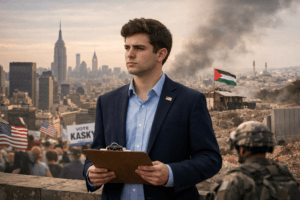
From Activist to Aspiring Politician: When Moral Certainty Meets Geopolitical Complexity
The journey from activist to elected official is a well-trodden path, often celebrated as democracy in action. It’s the story of the outsider, armed with passion and firsthand experience, seeking to transform the system from within. Yet, this transition is rarely seamless. The skills that make a powerful advocate—moral clarity, uncompromising messaging, the mobilization of anger and hope—can become profound liabilities in the nuanced arena of governance, where coalition-building, compromise, and a deep understanding of complex systems are paramount. The recent, short-lived congressional campaign of Cameron Kasky, a Parkland shooting survivor, offers a poignant and timely case study in this very tension, revealing the pitfalls when the framework of a domestic activist is applied unaltered to a deeply intricate foreign conflict.
Kasky’s emergence as a national figure was both tragic and inspiring. In the aftermath of the 2018 Marjory Stoneman Douglas High School shooting, his raw grief was channeled into potent advocacy. Co-founding Never Again MSD and helping organize the March for Our Lives, he leveraged his victimhood into a platform, using sharp, morally unambiguous language to challenge powerful entities like the NRA. His influence was real and earned. This background made his entry into the race for New York’s 12th Congressional District, a diverse and heavily Jewish district, a narrative of natural progression for many observers. Here was a young man who had turned personal trauma into a movement, now seeking a larger podium.
However, the rupture occurred not around gun control, but around Israel. Kasky’s campaign platform included a fierce, unequivocal condemnation of Israel, pledging to vote against all aid and accusing the state of “genocide” in Gaza, a term loaded with specific legal and historical weight. He framed this stance as a logical extension of his activism: “I’m a school shooting survivor turned activist. I started my adult life demanding an end to American-made weapons slaughtering children.” In his moral framework, the through-line was clear—the prevention of violence against civilians, regardless of geography.
The Clash of Frameworks: Advocacy vs. Representation
This is where the activist’s playbook collided with the realities of political representation. For an activist, taking a stark, uncompromising position galvanizes a base, draws media attention, and sharpens the edges of a debate. It is about speaking truth to power, not navigating its corridors. For a congressional candidate, especially in a district with a significant Jewish population holding diverse views on Israel, such a stance is not merely a policy position; it is a direct challenge to the lived experiences, historical trauma, and complex allegiances of a substantial portion of the electorate. As one Democratic operative noted, it became “political kryptonite.” The district, while containing a progressive base sympathetic to Palestinian rights, also includes many who support Israel’s right to exist securely. Kasky’s language did not distinguish between criticism of policy and the wholesale adoption of a narrative that delegitimizes the state itself, alienating potential allies and voters.
The situation was compounded by Kasky’s secretive trip to the West Bank. While firsthand observation is invaluable, the manner of this “fact-finding” mission raised questions about judgment and transparency. Wearing a mask through an airport, hiding his identity from constituents, and partaking in a tour explicitly designed to present a Palestinian narrative, he operated like an undercover journalist or guerrilla activist, not a prospective representative. Upon his return, his descriptions—powerfully emotional and one-sided—focused entirely on alleged settler violence, which he described in harrowing, generalized terms. His video was later amplified by Iranian state television, a platform with its own transparent agenda, further complicating the perception of his political independence.
The Peril of the “Tear-Jerking Tour” and the Search for Nuance
This gets to the heart of the critique: the danger of the curated, experiential deep dive. There is immense value in witnessing hardship. The problem arises when that witness is presented not as a piece of a puzzle, but as the complete picture. As the article’s author, Mayor of Mitzpe Yeriho, notes, Kasky was shown “a one-sided, tear-jerking tour of Palestinian villages.” The narrative presented was one of unrelenting victimhood and perpetrator-driven violence, devoid of historical context, the ongoing threat of Palestinian terrorism, the complex legal status of the territories, or the legitimate historical and security claims of Israelis living there.
This is not to dismiss the very real suffering Kasky witnessed or the legitimate criticisms of Israeli settlement policy and extremist violence. It is to question the intellectual honesty of forming a definitive, campaign-defining geopolitical stance based on such a narrowly curated experience. True moral courage in this context might have been to declare, “I have seen profound suffering that demands our attention. I must now seek to understand the other perspectives, the history, and the security dilemmas to form a responsible policy position.” Instead, the activist’s instinct prevailed: bear witness, assign blame, and demand immediate, total action.
The outcome was predictable. Polling at around 6%, Kasky withdrew from the race, citing not the numbers, but a desire to pivot fully to activism focused on the West Bank. This final move is perhaps the most telling. Confronted with the political unsustainability of his stance, he retreated to the realm where that stance is an asset, not a liability: pure activism. He chose the comfort of moral certainty over the messy compromise of political engagement.
A Larger Lesson for a Polarized Time
Kasky’s story is more than a local political footnote. It reflects a broader trend in our polarized discourse, where complex international issues are flattened into domestic activist paradigms. The Israeli-Palestinian conflict, with its layers of history, religion, law, and trauma, becomes a simple binary of oppressor and oppressed, mapped neatly onto other social justice frameworks. This does a disservice to all involved. It ignores the agency and responsibility of Palestinian leadership, the existential security concerns of Israelis, and the genuine grievances on both sides.
For young, passionate activists like Kasky, the lesson is not to abandon their moral compass, but to complicate it with intellectual humility. Engaging with a conflict like this requires more than a visceral reaction to suffering; it demands historical study, conversations with people across the spectrum, and an acknowledgment that real-world solutions are almost always gray, negotiated, and incremental. It requires understanding that “siding” with one narrative often means blindly rejecting another, which is the opposite of leadership.
Cameron Kasky possesses undeniable courage and a compelling voice. His work on gun control has had a tangible impact. His foray into politics, however, reveals a crucial distinction: the power to mobilize a protest is not the same as the wisdom to craft policy. The hope is that his retreat to activism is not an end, but a pause—a chance to deepen his understanding beyond a single narrative. The path to genuine human rights advancement, both in the Middle East and elsewhere, is built not by those who shout the loudest from a single hilltop, but by those willing to traverse the entire, difficult terrain in search of a just and sustainable peace for all its inhabitants. That is the transition from activist to statesperson, and it remains a journey worth taking.
You must be logged in to post a comment.