
Freedom for a Murderer, but Not for His Victim: The Release of Ibrahim Abu Mukh and Israel’s Unresolved Reckoning with Terror
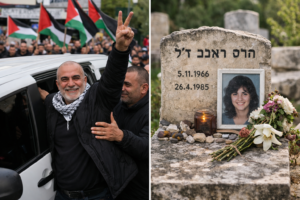
The release of Ibrahim Abu Mukh, who led the terrorist cell that kidnapped, tortured, and murdered 19-year-old IDF soldier Moshe Tamam in 1984, has reignited outrage in Israel after his life sentence was commuted in 2012 as a political gesture, allowing him to walk free this week. The Tamam family and terror victims’ advocacy groups are now urging Prime Minister Netanyahu to revoke Abu Mukh’s Israeli citizenship and deport him under the 2023 Terrorist Deportation Law, pointing not only to his crime but also to the hundreds of thousands of dollars he has reportedly received in Palestinian Authority “pay-for-slay” stipends—payments that critics argue violate Israeli anti-terror laws and underscore a broken system where convicted murderers are released while victims’ families endure endless grief.
Freedom for a Murderer, but Not for His Victim: The Release of Ibrahim Abu Mukh and Israel’s Unresolved Reckoning with Terror
The olive groves of Samaria have long since returned to their ancient rhythms—the slow dance of leaves in the Mediterranean breeze, the patient labor of harvest, the indifferent passage of seasons. But for the Tamam family, August 1984 remains frozen in time, a wound that refuses to close. This week, that wound was torn open again.
Ibrahim Abu Mukh, the man who led the terrorist cell that kidnapped, tortured, and murdered 19-year-old IDF soldier Moshe Tamam, walked free from an Israeli prison on Monday. His release—forty years after a crime so brutal it defies easy description—has reignited a painful debate that cuts to the very heart of Israeli society: How does a nation balance the principles of justice against the raw, unyielding demands of security? And what does it say about a country when the men who murdered its soldiers are released, while the families of their victims are left to carry a sentence that never ends?
The Crime That Defined a Generation
To understand the fury surrounding Abu Mukh’s release, one must first understand what he did. In August 1984, Moshe Tamam was 19 years old—a young soldier with his entire life ahead of him. He was hitchhiking home on leave, a common practice among Israeli soldiers at the time, when Abu Mukh and three accomplices from the Popular Front for the Liberation of Palestine (PFLP) pulled alongside him.
They took Tamam to Abu Mukh’s home in Baqa al-Gharbiye, an Israeli Arab town that, in the decades since, has become a symbol of the complex, often tortured relationship between Israel’s Arab citizens and the state. There, in a private residence, in a town that fell under Israeli jurisdiction, they tortured the young soldier. What happened in those hours remains largely undocumented in the public record—the details too horrific, perhaps, or too private for a family that has spent forty years grieving.
What is known is that after the torture, they drove Tamam to an olive grove in Samaria. They shot him through the chest. He died there, alone, far from his family, his body left among the trees that had stood for generations.
The terrorists were not arrested until two years later. They were tried, convicted, and sentenced to life in prison. For the Tamam family, and for many Israelis, that was the end of the matter. Justice, however imperfect, had been served. The men who murdered Moshe would spend the rest of their lives behind bars.
But that is not what happened.
The Politics of Mercy
In 2012, then-Israeli President Shimon Peres made a decision that would alter the course of the Tamam family’s lives forever. He commuted the life sentences of seven Arab Israelis who had killed IDF soldiers. Among them was Ibrahim Abu Mukh.
The official explanation, according to Itamar Marcus, founder and director of Palestinian Media Watch (PMW), was that the commutation served as “a gesture to [Palestinian Authority chief Mahmoud] Abbas.” Peres reduced the sentences to 40 years—a number that, while substantial, meant that Abu Mukh would eventually walk free.
The President’s Residence defended the decision at the time, citing a legal statute that required the president and justice minister “to limit the duration of life sentences for prisoners in Israel.” It was, they argued, a matter of law, not politics.
But the Tamam family saw it differently. And they were not alone.
Rushdi Hamdan Abu Mukh, Ibrahim’s cousin and fellow participant in Tamam’s murder, also had his sentence commuted. He was released in 2021. When the Tamam family turned to then-Interior Minister Aryeh Deri, requesting that Rushdi’s Israeli citizenship be revoked, they were met with inaction. The decision, family lawyer Maurice Hirsch told JNS, was “shamefully” not carried out.
Now, with Ibrahim’s release, the family is once again forced to confront the reality that in Israel, even a life sentence for murder is not always life.
The Economics of Terror
If the moral calculus of releasing convicted murderers is difficult enough, the financial dimension adds another layer of complexity—and outrage.
According to Itamar Marcus, Abu Mukh has been receiving monthly stipends under the Palestinian Authority’s “pay-for-slay” program, which provides payments to terrorists imprisoned for attacks against Israelis. The program, which has been widely condemned by the international community, rewards violence with financial security, creating a perverse incentive structure that encourages rather than deters terrorism.
Marcus calculated that under the PA’s system, Abu Mukh should have accrued approximately 2.5 million shekels—roughly $800,000—in terror payments over the years. In a post on X, Marcus argued that this violates Israel’s 2016 Law on Combating Terrorism, which prohibits the receipt of such funds and carries a minimum sentence of seven years in prison per violation.
“After 40 years, he should have received 480 salaries,” Marcus wrote. “When sentenced to 7 years per salary, he should receive 3,360 years in prison. Arrest him today. Throw away the key.”
It was a rhetorical flourish, to be sure. But it underscored a deeper frustration: that the very mechanisms designed to combat terrorism often seem powerless against the individuals who benefit most from it.
A Family’s Final Plea
On Sunday, the Tamam family, together with the Choosing Life forum—a group founded by more than 100 Israeli families of terror victims—sent an urgent letter to Prime Minister Benjamin Netanyahu, Justice Minister Yariv Levin, and Shin Bet Director David Zini. Their request was straightforward: revoke Abu Mukh’s Israeli citizenship and deport him immediately to the Gaza Strip under the 2023 Terrorist Deportation Law.
“The law was intended exactly for such cases,” the Choosing Life forum said in a statement. “Abu Mukh and his partners gave up their membership in Israeli society as soon as they kidnapped and murdered an IDF soldier. We expect the prime minister to act already before the terrorist has time to celebrate.”
Netanyahu himself has employed this law before. In February, he signed papers revoking the citizenship of two terrorists and ordering their deportation. For the Tamam family, the precedent offers a glimmer of hope—though one tempered by the bitter experience of past disappointments.
Moshe Tamam’s niece, Ortal Tamam, spoke to the Hebrew daily Makor Rishon about the family’s anguish. “Throughout the years, the murderer received money from the Palestinian Authority as a sign of heroism and encouragement for the murder of an IDF soldier,” she said. “And now he is returning to the State of Israel to live alongside us, and to live off the tax money we pay.”
Her words capture a profound sense of betrayal—not just by the legal system that allowed Abu Mukh’s release, but by a society that, in the family’s view, has failed to understand the magnitude of what was taken from them.
The Legacy of Hostage Deals
Itamar Marcus sees Abu Mukh’s release as part of a larger pattern—one that has fundamentally altered the nature of the Israeli-Palestinian conflict. He traces the problem back to the 1985 Ahmad Jibril deal, in which Israel released 1,150 terrorist prisoners in exchange for three Israeli soldiers.
That deal, Marcus argues, made kidnapping “the most potent tool and most dangerous terror strategy” of the Palestinians. It established a precedent that would be repeated in the Gilad Shalit deal, where another 1,000 terrorists were released, and in countless smaller exchanges over the decades.
“The law needs to be amended to remove the president’s authority to reduce sentences for convicted terrorists,” Marcus told JNS. His argument is simple: if sentences for terrorists were permanent, there would be no incentive to kidnap Israeli soldiers in the first place.
But the calculus is never that simple. Israel is a nation that places an almost sacred value on the return of its soldiers—living or dead. The principle of “no one left behind” is woven into the fabric of Israeli society, a promise that the state will do whatever it takes to bring its sons and daughters home. That principle has saved lives. It has also, as Marcus points out, created a system in which the kidnapping of Israeli soldiers becomes a strategic asset for terrorist organizations.
A Question of Justice
The release of Ibrahim Abu Mukh forces Israelis to confront uncomfortable questions about the nature of justice in a country that has been in a state of conflict for its entire existence.
Is justice served when a murderer walks free after forty years? For the Tamam family, the answer is clearly no. For those who believe in rehabilitation and the possibility of redemption, the answer might be more complicated. But Abu Mukh’s case offers little evidence of either. His receipt of PA stipends suggests not a man who has renounced his past, but one who continues to be celebrated for it.
Is justice served when the legal system is manipulated for political purposes? The commutation of Abu Mukh’s sentence as a “gesture” to Mahmoud Abbas raises troubling questions about the politicization of mercy. If a president can reduce sentences for convicted terrorists as a diplomatic offering, what does that say about the value placed on the lives they took?
Is justice served when a nation that demands accountability from its enemies cannot hold itself accountable to its own citizens? The Tamam family has spent forty years watching the men who murdered their son and uncle receive payments, commutations, and ultimately freedom. They have watched while the state they trusted to protect them failed, again and again, to protect their most fundamental interest: the assurance that justice would be done.
The Road Ahead
As Ibrahim Abu Mukh walks free, the Tamam family waits. They wait to see whether the prime minister will act on their request. They wait to see whether the law that was supposed to prevent exactly this scenario will finally be enforced. They wait, as they have waited for four decades, for a resolution that may never come.
But their fight is not just for themselves. It is for every Israeli family that has lost a loved one to terror. It is for a principle that transcends politics: that those who take a life should forfeit their own claim to live freely in the society they sought to destroy.
The olive groves of Samaria still stand. Moshe Tamam does not. And now, the man who orchestrated his murder is free—a fact that, for his family, and for anyone who believes in the fundamental promise of justice, is a wound that will not heal.
Whether that wound will fester or finally be addressed is now in the hands of Israel’s leaders. The Tamam family has made their plea. The law provides the mechanism. What remains to be seen is whether the will exists to use it.
You must be logged in to post a comment.