
Forging Frontiers: How the Indian Army’s 3D-Printed Bunkers Are Redefining Mountain Warfare
The Indian Army’s Trishakti Corps, in collaboration with IIT Hyderabad, has achieved a significant strategic and engineering milestone by deploying indigenous, vehicle-portable 3D concrete printing technology in forward high-altitude areas like Sikkim under Project PRABAL. This innovation enables the rapid, on-site construction of bunkers and sentry posts with enhanced ballistic and blast resistance, having successfully passed live-fire trials. By utilizing local materials and allowing for terrain-specific designs, the technology drastically reduces logistical burdens and construction time, bolstering operational readiness and offering a paradigm shift in building resilient, mission-critical infrastructure in some of the world’s most challenging and hostile environments.
Forging Frontiers: How the Indian Army’s 3D-Printed Bunkers Are Redefining Mountain Warfare
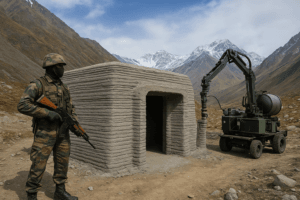
In the thin, frigid air of the Sikkim Himalayas, where the terrain is as much an adversary as any conventional foe, a quiet revolution is taking place. It’s not the rumble of tanks or the whistle of artillery, but the steady, mechanical hum of a robotic arm, layering concrete with digital precision. The Indian Army’s Trishakti Corps, in a pioneering leap, has operationalised on-site 3D concrete printing technology in forward locations, marking a watershed moment not just for military engineering, but for the very philosophy of building in some of the world’s most hostile environments.
This isn’t science fiction materialising in a lab; it’s Project PRABAL (Portable Robotic Printer for Printing Bunkers and Accessories) in action—a tangible outcome of a strategic collaboration between the Indian Army and IIT Hyderabad. The development speaks to a deeper narrative: India’s accelerating drive towards strategic self-reliance and its nuanced adaptation to the unique demands of high-altitude warfare.
The Anatomy of a Game-Changer
At the heart of this innovation is an indigenous Robotic 3D Concrete Printer, a system engineered with the explicit challenges of the Himalayan frontier in mind. Its design lexicon includes keywords like “vehicle-portable” and “mountain-terrain optimized.” Imagine a setup comprising a robotic arm, a circular mixer, a piston pump, and a generator—all modular enough to be transported by military vehicles along treacherous roads, and agile enough to be deployed on rugged, uneven forward positions where traditional construction is a logistical nightmare.
The process is a marvel of modern engineering. Using locally available materials where possible, the printer interprets digital design files, extruding a specially formulated concrete mix layer by additive layer. It follows a computer-controlled path to build structures from the ground up, without the need for formwork—the temporary moulds that are a staple of conventional construction. This isn’t just automation; it’s a fundamental rethinking of how to create solid, protective architecture.
Beyond Bricks and Mortar: The Strategic Imperative
Why does this matter so much? The answer lies in the brutal arithmetic of mountain warfare.
- Time, the Unforgiving Factor: In forward areas, time is measured in exposure. Traditional bunker construction using sandbags, timber, and manual labour is slow, labour-intensive, and leaves troops vulnerable for extended periods. The 3D printer can erect a robust sentry post or bunker in a fraction of the time, dramatically reducing the window of vulnerability. This “rapid construction” capability allows for swift consolidation of captured positions and dynamic response to operational needs.
- Strength from Precision: These are not mere concrete shells. The Army has confirmed that printed installations have “passed live ballistic trials.” This is the ultimate validation. The technology allows for controlled density, uniform material distribution, and customised geometric designs—like curved walls that better deflect blasts or irregular shapes that blend into the landscape—offering “enhanced blast and ballistic resistance” compared to heterogeneous traditional builds.
- Logistics Unshackled: Mountain logistics is a beast of its own. Transporting prefabricated structures or vast quantities of construction material through limited and vulnerable supply lines is a Herculean task. The 3D printer’s ability to use local aggregates and its portable nature slashes the logistical tail. It brings the factory to the field, turning raw, available materials into sophisticated structures on demand.
- Customisation at the Click of a Button: Every ridge and valley presents a unique tactical puzzle. A one-size-fits-all bunker design is often a compromise. With 3D printing, the design is a digital file. Need a structure with a specific firing arc, a lower silhouette, or an integrated storage niche for a particular terrain feature? Engineers can modify the design digitally and print it on-site, enabling truly “mission-oriented infrastructure development.”
The Human-Machine Nexus: IIT Hyderabad and the Army’s Mindset
The success of Project PRABAL is a textbook case of successful academia-defence synergy. IIT Hyderabad brought to the table cutting-edge research in robotics, material science, and additive manufacturing. The Army provided the non-negotiable operational requirements: ruggedness, portability, simplicity of operation in harsh conditions, and of course, the ultimate benchmark of battlefield survivability.
This collaboration moves beyond the mere purchase of technology. It represents a shared journey of problem-solving, where theoretical expertise is stress-tested against the brutal realities of Siachen’s glaciers and Sikkim’s ridges. It reflects the Army’s evolving mindset—from being a pure consumer of technology to a co-creator, demanding innovations that solve very specific Indian challenges.
The Ripple Effect: From Forward Posts to Future Cities
While the immediate application is military, the implications ripple far beyond. The technologies refined in Project PRABAL—portable printing, rapid-setting mixes for cold climates, resilient design algorithms—have profound civilian potential.
Imagine disaster relief: printing emergency shelters in flood-hit plains or earthquake-ravaged towns within days. Envision remote area development: creating community centres, water tanks, or even resilient housing in India’s inaccessible villages, bypassing the chronic shortage of skilled labour. The “efficient use of local materials” principle is a boon for sustainable construction, reducing the carbon footprint of transporting cement and steel over long distances.
Furthermore, the “quality control” inherent in automated printing could address chronic issues of construction integrity in public infrastructure. This military-born innovation could, in time, contribute to building a more resilient nation.
A Quiet Paradigm Shift
The deployment of 3D concrete printing by the Trishakti Corps is more than a tactical upgrade. It is a quiet paradigm shift in military engineering. It moves the paradigm from construction—a slow, linear, logistical heavy process—to deployment—a rapid, agile, and responsive capability. It enhances operational readiness not by adding more firepower, but by providing smarter, faster, and more resilient protection for the soldiers who wield that firepower.
In the grand chessboard of geopolitical standoffs in high mountains, infrastructure is power. The ability to quickly build superior, survivable structures directly translates into tactical stamina and strategic advantage. As this technology evolves and scales, it promises to reshape the very landscape of frontier defence, allowing India to secure its formidable borders with a blend of ancient fortitude and 21st-century ingenuity. The message is clear: in the mountains, the future is being printed, layer by resilient layer.
You must be logged in to post a comment.