
Forging a New Partnership: How India’s Steel Ambitions Are Driving a Strategic Alliance with Canada
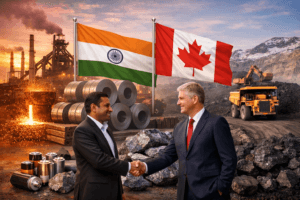
Forging a New Partnership: How India’s Steel Ambitions Are Driving a Strategic Alliance with Canada
India’s announcement that its state-run mining giant, NMDC, is actively exploring coal reserves in Canada is more than a business headline. It is a strategic maneuver at the intersection of global industrial ambition, resource geopolitics, and the complex realities of the energy transition. This move signals India’s urgent quest to fuel its rise as an industrial superpower while navigating a world of uncertain supply chains. For Canada, it represents a pivotal opportunity to diversify its economic partnerships and solidify its role as a reliable supplier of critical resources in a shifting global order.
The Engine of Ambition: India’s Colossal Steel Targets
The drive behind NMDC’s overseas exploration is rooted in a national vision of monumental scale. India, already the world’s second-largest crude steel producer, has set staggering production targets: doubling output to 300 million tonnes per year by 2030, and reaching 500 million tonnes by 2047. This expansion is the bedrock of initiatives like “Viksit Bharat” (Developed India), supporting everything from infrastructure and urbanization to manufacturing and job creation.
This relentless growth creates an insatiable appetite for metallurgical (coking) coal, a key ingredient in traditional blast-furnace steelmaking. India’s coking coal import dependency is a critical vulnerability, with about 95% of the steel sector’s needs currently met through imports. In the 2025 fiscal year, these imports surged by 32% year-on-year to 73.53 million tonnes. The financial and strategic cost of this dependency is immense, prompting a two-pronged strategy: turbocharging domestic mining and securing diversified, reliable overseas sources.
India’s Current Coking Coal Import Landscape (Key Suppliers)
This table illustrates India’s existing import portfolio and recent growth trends, highlighting its reliance on a few key nations and the search for diversification.
| Supplier Country | Import Volume (Dec 2025) | Year-on-Year Change (Dec) | Key Role/Notes |
| Australia | 3.29 million tonnes | +40% | Dominant supplier, provides premium low-volatile coal. |
| Russia | 1.16 million tonnes | +155% | Fast-growing source, filling gaps amid global shifts. |
| United States | 1.22 million tonnes | +181% | Volatile but significant supplier, volumes fluctuate. |
| Mozambique | 0.71 million tonnes | +314% | Emerging supplier, demonstrating India’s global search. |
A Strategic Pivot: More Than Just Coal
While the exploration of Canadian coal reserves is the immediate news, the context of the ministerial meeting reveals a far broader and more strategic agenda. The discussions between India’s Steel Minister H.D. Kumaraswamy and Canada’s Natural Resources Minister Tim Hodgson explicitly aimed to deepen cooperation in critical minerals, clean mobility, advanced manufacturing, and sustainable industrial development.
This reflects a sophisticated understanding from both sides. For India, securing lithium, cobalt, graphite, and rare earth elements is just as crucial as coking coal for its parallel goals in electric vehicle manufacturing, battery production, and renewable energy. Canada, rich in these very resources, is not just a coal pit but a potential strategic partner for India’s entire clean energy transition.
For Canada, under the Carney government, the logic is compelling. The country is explicitly pursuing a policy to “build Canada Strong” by deepening global partnerships and leveraging its natural resource advantages. With India projected to have the largest growth in global energy demand through 2030, it represents a monumental market opportunity. This engagement is a key part of Canada’s goal to double exports to non-U.S. markets by 2035.
The Domestic Catalyst: India’s “Critical Mineral” Gambit
Coinciding with the international outreach is a significant domestic policy shift. Just days ago, the Indian government officially notified coking coal as a “Critical and Strategic Mineral” under its mining law. This classification is a game-changer for the domestic industry, as it:
- Expedites mining clearances and environmental approvals.
- Exempts projects from public consultation requirements in certain cases.
- Attracts private investment into exploration and advanced mining technologies.
The goal is to unlock India’s own substantial reserves, estimated at 37.37 billion tonnes. However, experts recognize that even with a successful domestic push, imports will remain essential for decades to meet the quality and quantity demands of a 500-million-tonne steel industry. Therefore, the international and domestic strategies are not in conflict but are complementary pillars of a single objective: secured supply chain resilience.
Canada’s Role: A Strategic Counterbalance
India’s import portfolio shows a heavy reliance on Australia, which, while reliable, exposes India to regional volatility and price shocks. The search for alternatives has led to increased imports from Russia and the U.S., but both come with their own geopolitical or price volatility challenges.
Canada emerges as an attractive strategic counterbalance. It offers:
- Political and Regulatory Stability: A predictable, rules-based investment environment.
- Geographic Diversification: A supplier located far from the tense Indo-Pacific region.
- Resource Complementarity: Possessing not just high-quality coking coal but also the full suite of critical minerals India seeks.
- Infrastructure and Expertise: World-class mining technology, logistics, and environmental standards.
The re-launch of the Canada-India Ministerial Energy Dialogue (CIMED) and a planned high-level Indian delegation to a major mining convention in Toronto in March 2026 signal that this is being structured as a long-term, institutional partnership, not a one-off deal.
Navigating the Contradictions: Coal in a Clean Energy World
The most intriguing layer of this partnership is its inherent duality. It is advancing on two parallel tracks: traditional fossil resources (coking coal, LNG) and future-facing clean energy minerals and technology. This mirrors India’s own pragmatic energy transition path, where building industrial capacity with current technology runs concurrently with investing in the green infrastructure of tomorrow.
Minister Hodgson’s statement that “we are in the midst of a rupture, not a transition” captures this realism. For India, high-quality coking coal is essential for building the wind turbines, railway lines, and cities of the future, even as it invests heavily in green hydrogen-based steelmaking for the long term. Canada’s willingness to engage across this spectrum positions it as a comprehensive partner in India’s complex development journey.
Challenges and the Road Ahead
The path forward is not without obstacles:
- Logistical Hurdles: Transporting coal from Canadian mines to Indian steel plants involves long sea routes and cost considerations.
- Investment and Project Timelines: Turning “exploration” into producing mines requires billions in investment and years of development.
- Geopolitical Undercurrents: The broader diplomatic relationship between India and Canada must remain stable to support deep commercial ties.
- Global Market Dynamics: Fluctuating coal prices and competition from other global buyers will influence the economic viability of projects.
Conclusion: A Partnership Forged in Strategic Necessity
NMDC’s exploration in Canada is a single move in a much larger strategic game. It represents India’s determined leap to secure the resources needed to realize its economic destiny, moving beyond dependency to diversified, strategic partnerships. For Canada, it is a test case for its ambition to be a global energy and resource superpower, leveraging its natural endowments to build durable ties with the world’s most important emerging economies.
This partnership transcends a simple buyer-seller transaction. It is a recognition that in an era of geopolitical fractures and supply chain anxieties, long-term resilience is built through deep, multidimensional alliances that address both the foundational needs of today’s industry and the critical materials for tomorrow’s clean economy. The success of this venture will be measured not just in tonnes of coal shipped, but in the strength of the industrial and technological bridge being built between two major democracies.
You must be logged in to post a comment.