
Forging a Green Hydrogen Future: How the India-Netherlands Alliance is Powering a Strategic Energy Shift
The recent strengthened partnership between India’s Department of Science and Technology and the Netherlands, marked by the launch of the India-Netherlands Hydrogen Fellowship Programme and a wide-reaching MoU between the University of Groningen and 19 IITs, represents a strategic and deep investment in the human capital required to realize a green hydrogen economy. This collaboration moves beyond symbolic diplomacy to directly address the critical, interdisciplinary challenges of system integration, safety, and economic viability that will determine hydrogen’s practical success. By facilitating an extensive exchange of researchers and knowledge, the alliance leverages Dutch expertise in logistics and systems architecture with India’s scale and engineering prowess, aiming to build the foundational research and skilled innovators necessary to transform ambitious national goals—like the National Green Hydrogen Mission and Energy Independence 2047—into tangible, scalable reality, thereby securing India’s position in the global clean energy landscape.
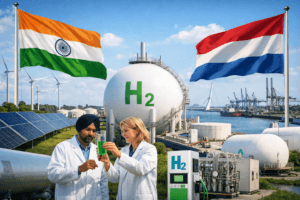
Forging a Green Hydrogen Future: How the India-Netherlands Alliance is Powering a Strategic Energy Shift
In a world grappling with the twin imperatives of energy security and climate urgency, international collaboration is no longer a diplomatic luxury but a technological necessity. A recent, quiet signing ceremony in New Delhi has set the stage for what could be a transformative partnership in one of the most promising arenas of clean energy: green hydrogen. The strengthened cooperation between India’s Department of Science and Technology (DST) and the Kingdom of the Netherlands, featuring a dedicated fellowship programme and a sweeping academic pact, is more than just another MoU. It is a meticulously crafted alliance that targets the very backbone of a future hydrogen economy—human capital and deep-tech research.
This initiative arrives at a critical juncture. India, with its colossal energy appetite and soaring renewable energy ambitions, has staked its future on green hydrogen through its ambitious National Green Hydrogen Mission. The goals are audacious: to become a global hub for the production, use, and export of green hydrogen and its derivatives, a cornerstone for achieving “Energy Independence by 2047” and the longer-term “Net-Zero by 2070” vision. However, the gap between ambition and reality is bridged not by targets alone, but by cutting-edge research, skilled innovators, and pragmatic international technology sharing. This is where the Dutch partnership proves strategically astute.
Decoding the Partnership: Beyond Diplomacy to Capacity Building
The two key pillars of this collaboration address fundamental gaps in the innovation ecosystem.
- The India-Netherlands Hydrogen Fellowship Programme:
This is a direct investment in India’s most valuable resource—its scientific minds. By enabling Indian doctoral candidates, post-docs, and faculty to immerse themselves in advanced hydrogen research within Dutch institutions, the programme does more than transfer knowledge. It fosters a mindset. The Netherlands, a European leader in hydrogen infrastructure, port logistics, and systems integration, offers a living laboratory. Indian researchers can engage with real-world challenges: from integrating hydrogen into the bustling Port of Rotterdam—a model for India’s own coastal hubs—to studying the safety protocols in a nation that has pioneered natural gas networks for decades.
The fellowship’s focus areas are telling: system integration, safety, techno-economic analysis, and life cycle assessment. These are not merely academic disciplines; they are the make-or-break factors for the entire hydrogen economy. India can produce green hydrogen, but can it be stored safely, transported cost-effectively, and integrated into industrial clusters without exorbitant cost? Answering these questions requires the nuanced, applied research this fellowship promises to cultivate.
- The IITs-University of Groningen MoU:
The scope of this agreement is notably vast, linking 19 IITs with the prestigious Dutch university. The absence of mandated financial arrangements is its genius—it removes bureaucratic barriers and emphasizes organic, interest-driven collaboration. This creates a dynamic network where any IIT specializing in, say, material science (for better electrolyzers) can seamlessly connect with Groningen’s expertise in electrochemistry, or where IITs focusing on policy can collaborate on socio-economic models for hydrogen adoption.
This “network-of-networks” approach accelerates innovation exponentially. It prevents duplication of effort, allows for diverse problem-solving perspectives, and builds a robust Indo-Dutch academic community that will outlive political cycles. The free flow of students and faculty ensures a continuous cross-pollination of ideas, embedding European pragmatism and Indian scale-thinking into the next generation of engineers and scientists.
The Strategic Synergy: Why the Netherlands, and Why Now?
The choice of the Netherlands as a primary partner is a masterstroke in strategic alignment. The Dutch are not just technology developers; they are unparalleled systems architects and logistics pioneers. Their national strategy views hydrogen as a core economic sector, focusing on:
- Import, Storage, and Transit: Developing major hydrogen corridors, directly relevant to India’s ambition to become an export hub.
- Industrial Decarbonization: Using hydrogen to clean up heavy industry (chemicals, refining), mirroring India’s need to decarbonize its own industrial heartlands.
- Research Ecosystem: Hosting world-class institutes like the Institute for Sustainable Process Technology and a strong private sector commitment.
India brings to the table its massive scale, declining renewable energy costs, and a formidable engineering talent pool. The Netherlands offers granular experience, operational excellence, and a gateway to the wider European market. Together, they form a complementary alliance where pilot-scale Dutch innovations can find scalable, globally significant applications in India.
The Human Insight: Building the Bridge to a Market
The true value of this news lies beneath the announcements. It signals a maturation of India’s clean energy strategy. The nation is moving beyond mere capacity installation (solar parks, wind farms) to mastering the complex, interdisciplinary technologies of integration and utilization. Green hydrogen is the ultimate “vector” for renewable energy, and understanding its entire value chain is paramount.
This partnership implicitly acknowledges that the challenges are not solely technological. They are also about economic viability and policy frameworks. Techno-economic analysis and life cycle assessment—highlighted in the fellowship—are the tools that will convince investors, guide government subsidies, and shape competitive pricing. By training a cadre of experts in these areas, India is building internal capability to answer the hard questions: Is green hydrogen competitive with grey hydrogen today? What will make it so? What are the true environmental benefits across its full life cycle?
Furthermore, by embedding safety as a core research pillar, the initiative addresses the foremost public and industrial concern head-on, paving the way for smoother social acceptance and robust regulatory standards.
The Road Ahead: From Labs to Life
The tangible outcomes to watch for in the coming years will be:
- Joint Prototypes: Development of indigenized electrolyzer designs or safety monitoring systems suited to Indian conditions.
- Policy White Papers: Influential studies on hydrogen blending in pipelines or storage regulations, co-authored by Indo-Dutch teams.
- Start-up Genesis: Researchers-turned-entrepreneurs launching ventures to commercialize technologies born from this collaboration.
- Skilled Workforce: A generation of Indian engineers and scientists with direct experience in European hydrogen projects, ready to lead domestic initiatives.
The disclaimer citing the National Green Hydrogen Mission, Energy Independence 2047, and Net-Zero 2070 is not merely procedural. It is the narrative thread that binds this academic cooperation to India’s grand strategic vision. Every fellowship granted, every research paper co-published, and every student exchanged is a step toward weaving green hydrogen into the fabric of the nation’s energy sovereignty.
In conclusion, the DST-Netherlands partnership is a classic example of far-sighted policy. It bypasses short-term gains to invest in the long-term engines of innovation—people and partnerships. In the global race to dominate the green hydrogen economy, India is wisely choosing not just to run alone but to forge a powerful alliance, ensuring its journey to 2047 and 2070 is powered by cutting-edge knowledge, shared risks, and a collaborative vision for a cleaner planet. This isn’t just news about a fellowship or an MoU; it’s a blueprint for building intellectual sovereignty in the age of energy transition.
You must be logged in to post a comment.