
Flames in Jerusalem: The Burning of UNRWA’s HQ and the Incineration of a Delicate Status Quo
Flames in Jerusalem: The Burning of UNRWA’s HQ and the Incineration of a Delicate Status Quo
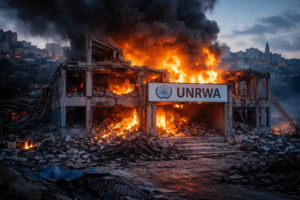
In the pre-dawn hours of a Jerusalem Sunday, flames licked at the skeleton of a building that was once more than just concrete and steel. The partially demolished headquarters of UNRWA, the United Nations Relief and Works Agency for Palestine Refugees, was set ablaze, casting a literal and metaphorical firelight over one of the world’s most intractable conflicts. This was not merely an act of vandalism; it was the fiery culmination of a deliberate, year-long process of dismantlement, a physical manifestation of a political struggle over history, identity, and the very future of the Palestinian refugee issue.
The event, reported on January 26, 2026, marks a stark new low in the relationship between Israel and the UN agency. To understand the gravity of the smoke rising over East Jerusalem, one must first understand the profound symbolism UNRWA embodies. Created in 1949 as a temporary body to aid the approximately 700,000 Palestinians displaced during the 1948 Arab-Israeli war, it has become a perpetual institution. Its existence is a living archive of the refugee condition, providing not just vital services—education for over 500,000 children, healthcare, social safety nets—but also the administrative continuity of refugee status across generations. The Jerusalem headquarters was a physical anchor of that institutional memory in a city both sides claim as a capital.
Israel’s move to ban UNRWA operations in 2025 and subsequently seize and demolish its compound was a seismic policy shift, long threatened and finally realized. The Israeli government’s accusation is stark: that UNRWA is not a neutral humanitarian body but an entity that provides cover for, and is infiltrated by, militant groups like Hamas. While independent investigations have pointed to “neutrality-related issues” within the agency, they have also noted a lack of conclusive evidence for broader claims. For Israel, however, UNRWA’s definition of refugees—which includes descendants—perpetuates a narrative of a “right of return” it sees as an existential threat. Dismantling its presence is framed as a security necessity and a step toward dissolving what it views as a unique and perpetuated refugee status.
The demolition last week was met with fierce UN condemnation. The world body insisted the property remained protected by international law and the privileges and immunities accorded to UN facilities. Jonathan Fowler, UNRWA’s spokesman, underscored this plainly: “Like any UN Member State… Israel is legally obliged to protect and respect UN facilities.” The subsequent arson attack, therefore, is a double violation: first of the agency’s operational rights, and second, of the fundamental principles of international diplomatic protection.
Who Lit the Match? The Unanswered Question
The fire service extinguished the flames; it did not name a cause. UNRWA’s statement described it as part of an “ongoing attempt to dismantle the status,” carefully attributing the action to the environment created by the demolition, not to a specific actor. This ambiguity is itself incendiary. It leaves open a spectrum of possibilities: a hate crime by ideological extremists emboldened by the state’s actions; an act of protest by those seeing the building as a symbol of an unwanted international presence; or, in the darkest conspiracy theories, a false flag operation. The absence of a clear perpetrator allows the event to become a Rorschach test, where observers see confirmation of their deepest fears and biases.
The Larger Conflagration: Beyond the Physical Fire
The burning of the UNRWA compound is a potent symbol of several accelerating trends:
- The Unraveling of Consensus: For decades, despite tensions, UNRWA’s operations were a grudgingly accepted part of the regional landscape. Its deliberate closure within Israel and East Jerusalem represents a fracture. It signals a move from contesting how the refugee issue is managed to contesting its very management and the narrative underpinning it.
- The Erosion of International Law’s Shield: The calculated seizure and demolition of a UN facility, followed by its burning, challenges the enforceability of international norms. It asks a dangerous question: if a UN agency’s immunity can be so blatantly overridden in such a contested area, what protections truly remain for the vulnerable populations it serves?
- The Human Cost in the Shadows: While the building in Jerusalem stood empty since the 2025 ban, its burning is a psychological blow to refugee communities. It is a stark signal of permanence—the reversal of their institutional presence is not a temporary policy glitch but a solidified reality. For staff in the West Bank and Gaza, where UNRWA still operates, it raises fears of what might come next and deepens a siege mentality.
The Path Forward: Ashes and Implications
The immediate aftermath will involve forensic investigations, diplomatic demarches, and likely a heated debate at the UN Security Council. But the long-term implications are more profound.
For the Palestinian leadership, this event underscores the rapid erosion of institutional footprints in Jerusalem, further complicating any future claims. It may galvanize calls for the International Criminal Court or other bodies to investigate the demolition and fire as part of broader probes.
For Israel, the act may satisfy domestic political constituencies demanding a hard line against UNRWA. However, it risks further isolating Israel diplomatically and could be used by critics as evidence of a policy not just of border security, but of the deliberate erasure of Palestinian institutional memory.
For the international community, particularly donor nations, the crisis presents a dilemma. Do they redouble funding and political support for UNRWA in the West Bank and Gaza, affirming its irreplaceable role, or does the continued controversy around the agency lead to further fragmentation and a search for alternative, less politicized channels for aid?
The burnt-out shell in East Jerusalem is more than a ruined building. It is a monument to a collision between a state’s sovereign security narrative and an international body’s mandate born of a collective, albeit failing, responsibility. The flames have now subsided, but the heat they generated will linger, warming old animosities and casting a grim light on a path forward that appears increasingly charred and fraught. The real fire to be feared is not the one that consumed concrete, but the one that threatens to consume the last vestiges of a fragile, institutionalized framework for managing a crisis that, with this act, has been pushed further from resolution than ever.
You must be logged in to post a comment.