
First the Cherokee, Now the Palestinians: The Unchanged Rhetoric of Ethnic Cleansing
In this powerful and timely essay, Norman Finkelstein draws a direct historical parallel between the forced removal of the Cherokee Nation in the 19th century and the ongoing displacement of the Palestinian people, arguing that the rhetoric and tactics of ethnic cleansing remain remarkably consistent across time and place.
Through extensive historical documentation, he demonstrates how both the U.S. government and Israeli authorities employed strikingly similar justifications—dehumanizing indigenous populations as “savages” or “backward,” claiming the land was empty or underutilized, framing conquest as benevolent progress, using treaties as instruments of dispossession rather than genuine agreements, and ultimately resorting to military force to expel native peoples from their ancestral lands. The essay traces the Cherokee experience from initial contact through the Trail of Tears to the ultimate dissolution of their nation, drawing explicit parallels to the Palestinian Nakba of 1948 and the ongoing occupation, concluding with the hope that just as Americans now view their history of indigenous displacement with horror, Israelis may one day similarly rue what was done to the people of Palestine.
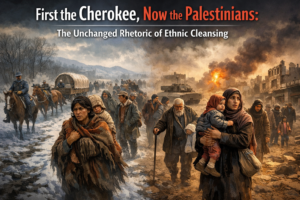
First the Cherokee, Now the Palestinians: The Unchanged Rhetoric of Ethnic Cleansing
This powerful and timely essay by Norman Finkelstein, republished on March 11, 2026, draws a direct line between two histories separated by a century and an ocean: the forced removal of the Cherokee Nation and the ongoing displacement of the Palestinian people. Finkelstein argues that the “rationalizations for ethnic cleansing do not change,” and by revisiting the rhetoric and tactics used against Indigenous Americans, we can see a disturbing template still being used today.
Below, we explore this comparison in depth, examining the historical parallels, the rhetoric of conquest, and what this means for our understanding of contemporary events in Israel/Palestine.
The Unbroken Thread of Conquest Rhetoric
Finkelstein opens his essay by noting a profound shift in American consciousness: what was once celebrated as “manifest destiny” is now widely condemned as a crime against humanity. The conquest of the American continent, once justified as the triumph of civilization over savagery, is now viewed through a more critical lens. This shift in perspective, he suggests, offers a roadmap for how the world may one day view the Zionist project.
The core of the article juxtaposes quotes from American and Israeli figures that are strikingly similar in their dehumanization of the indigenous population. A Georgia congressman in 1830 casually dismissed the Cherokee’s fate, asking, “What is history but the obituary of nations?” . Just over a century later, an Israeli foreign ministry official coldly predicted the fate of displaced Palestinians: “Some of them would die and most of them would turn into human dust and the waste of society…” . This comparison is not merely rhetorical; it is the central thesis of Finkelstein’s argument: the powerful use the same language to erase the humanity of those who stand in the way of their ambitions.
The rhetoric of progress as a justification for dispossession is a key theme. Finkelstein quotes Theodore Roosevelt from his The Winning of the West, where the future president frames the conquest of North America not as theft, but as destiny. Roosevelt spoke of the “spread of the English-speaking peoples over the world’s waste spaces,” arguing that the land was essentially empty and that the “settler ousts no one” . He believed that conquest was justified by the “comparative worth of the conquering and conquered peoples,” a sentiment echoed decades later by Winston Churchill. Churchill, defending the Zionist project, compared the Palestinian Arab to a “dog in a manger,” arguing that a “stronger race” had the right to take their place, just as Europeans had in America and Australia .
This is the foundational myth of settler colonialism: the land is empty (terra nullius), or if inhabited, the inhabitants are too primitive to have a legitimate claim to it. They are not seen as peoples with cultures, economies, and deep spiritual ties to the land, but as obstacles to progress, “squalid savages” standing in the way of a “masterful people” .
The Cherokee Nation: A Case Study in Ethnic Cleansing
To ground his argument, Finkelstein provides a detailed history of the Cherokee experience, showing how a once-sovereign nation was systematically destroyed. The Cherokee were not nomadic hunter-gatherers; by the 19th century, they were a “predominantly agricultural society with a constitutional structure that made it a mirror image of the American Republic” . They had their own written language, a newspaper, and a government modeled on that of the U.S. They had, in short, done everything the white man asked of them. And yet, it was their very success that sealed their fate. As a Rhode Island senator put it during the removal debates, “Ill-fated Indians! Barbarism and attempts at civilization are alike fatal to your rights.”
The process unfolded in stages, each of which has a modern parallel:
- Legal Chicanery and Broken Treaties: Between 1785 and 1835, the Cherokee signed 16 treaties with the U.S. government, each “solemnly guaranteeing” their land rights, and each one broken as soon as white settlers coveted new territory . This pattern of signed agreements followed by relentless encroachment mirrors the fate of countless UN resolutions and peace accords related to Palestine.
- State Encroachment and Federal Collusion: The state of Georgia extended its laws over Cherokee territory, effectively nullifying their sovereignty. President Andrew Jackson, who spearheaded the removal policy, articulated a clear strategy: “You must get clear of them by legislation. Take judicial jurisdiction over their country; build fires around them, and do indirectly what you cannot do directly” . This policy of making life so unbearable that the indigenous population chooses to leave is a tactic now widely recognized as a key component of ethnic cleansing.
- The “Treaty” of New Echota: In 1835, a small, unauthorized faction of Cherokee leaders signed the Treaty of New Echota, ceding all Cherokee lands east of the Mississippi in exchange for territory in Oklahoma. Despite the fact that the vast majority of the Cherokee nation opposed it, and the principal chief, John Ross, protested vehemently, the U.S. Senate ratified the treaty by a single vote . This “agreement” became the legal justification for the U.S. Army to move in and forcibly remove the remaining 15,000 Cherokees.
- The Trail of Tears: The forced march of the Cherokee to the West is one of the darkest chapters in American history. Rounded up by troops and herded into internment camps, the Cherokee were then forced to walk over 1,000 miles in brutal conditions. Disease, starvation, and exposure killed as many as 4,000 of them along the way . A Georgia volunteer who later fought in the Civil War recalled, “I fought through the civil war and have seen men shot to pieces and slaughtered by thousands, but the Cherokee removal was the cruelest work I ever knew.”
The Palestinian Nakba and its Echoes
Finkelstein argues that the Palestinian experience is a direct parallel to the Trail of Tears. The term Nakba, or “catastrophe,” refers to the ethnic cleansing of approximately 750,000 Palestinians from their homes in 1947-1948 to make way for the new state of Israel . Just as the Cherokee were driven from lands they had inhabited for centuries, Palestinians were expelled from their villages, often at gunpoint, and never allowed to return.
Count Folke Bernadotte, the UN mediator assassinated by Jewish extremists in 1948, described the “Lydda Death March”—an expulsion ordered by Yitzhak Rabin—as one of the most “ghastly” sights he had ever seen . This was a foundational event for the state of Israel, just as the Indian Removal Act was for the expanding United States. In both cases, the creation of a new political entity was built upon the violent erasure of the people who lived there first.
This historical analysis is given contemporary urgency by scholars like Lorenzo Veracini, a leading voice in settler colonial studies. In a recent interview, Veracini explains that settler colonialism is a “structure, not an event” . It is an ongoing process of elimination and replacement. He argues that while Israel’s project was for decades a form of settler colonialism, the failure of that project—the inability to make the Palestinians disappear or accept subordinate integration—has now led to a shift towards “unrestrained violence sustained by a collection of genocidal fantasies” . This analysis, published in 2025, chillingly echoes Finkelstein’s 1996 conclusion that the rationalizations for ethnic cleansing do not change.
Modern Displacement in Gaza and the West Bank
The connection between past and present is not just theoretical. Journalist J. Denny Weaver draws a direct line from the Indian Removal Act of 1830 to the situation in Gaza today . He notes that in 2024, following the Hamas attack on October 7, Israel launched a massive military campaign that killed over 44,000 people and destroyed Gaza’s infrastructure. Crucially, he highlights reports that Palestinians are being told they will not be allowed to return to northern Gaza, and that the territory will be repopulated by Israeli settlers. This is the exact pattern of the Trail of Tears: first displacement, then expropriation, followed by repopulation.
In the West Bank, the process has been more gradual but no less destructive. Palestinians are steadily squeezed into smaller and smaller enclaves as illegal settlements expand, mirroring the way Cherokee territory was chipped away by successive treaties and settler encroachment throughout the 19th century . The U.S. government’s role, as the primary arms supplier and diplomatic backer of Israel, makes it a direct participant in this dynamic, just as the federal government ultimately backed the “wilderness vanguard” of white settlers against the Cherokee .
A Contested Analogy: The Debate Over Indigeneity
While Finkelstein’s comparison is compelling to many, it is not without its critics. The analogy is fiercely contested, and exploring these counterarguments adds depth to our understanding.
A LinkedIn discussion about the parallels between the “Five Civilized Tribes” and Palestinians reveals the sharp divide in public opinion . Critics of the analogy raise several points:
- The “Arab Settler Colonialism” Argument: Some argue that Palestinian Arabs are not indigenous to the land because they are descendants of earlier Arab conquests. One commenter stated that their presence in the land “goes back about 600 years, about the same amount of time that Americans of European descent have been in the United States.” From this perspective, comparing them to Native Americans “erases Jewish indigeneity.”
- The “They Chose to Leave” Argument: A common refrain is that Palestinians in 1948 “chose to leave” rather than live in a Jewish state, or that they are simply residents of Gaza who have been governed by Hamas.
Proponents of the analogy, however, push back forcefully. Other commenters point to the sheer scale of the death and displacement, with one noting that “over 14 thousand Cherokee died on their forced March to Oklahoma” . They argue that dehumanization based on race is a constant throughout history, whether the victims are “brown skinned” Native Americans or Palestinians.
Scholar Lorenzo Veracini offers a nuanced take on the indigeneity question. He defines indigeneity as a “relational category,” meaning a person is Indigenous because they are “facing a settler.” It is the settler colonial regime that creates the Indigenous person as a political category . This framework suggests that the crucial factor is not how many centuries a population has lived in a place, but the nature of the power dynamic: a外来 settler society that seeks to displace and replace the native population. By this definition, the Palestinian experience is a textbook case of settler colonialism.
Conclusion: History’s Obituary or a Call to Action?
Norman Finkelstein’s essay, written three decades ago, feels as urgent as ever. The Georgia congressman’s cynical observation that “history is but the obituary of nations” hangs over this entire discussion . Is it the fate of all indigenous peoples to be merely footnotes in the story of their conquerors?
The Cherokee survived the Trail of Tears and rebuilt their nation in Oklahoma, only to have it dismantled again by the allotment acts and the push for Oklahoma statehood . The question Finkelstein leaves us with is whether the same epitaph will be written for the people of Palestine.
The answer is not yet written. The debate itself—the fierce arguments in the press, on social media, and in academic journals—is part of the story. The analogy between the Cherokee and the Palestinians is more than a historical curiosity; it is a powerful tool for understanding the present. By recognizing the old scripts of dehumanization and dispossession, we are better equipped to challenge them. Whether the world will look back on the Nakba with the same horror it now reserves for the Trail of Tears depends on the actions we take today.
You must be logged in to post a comment.