
First Drive Review: Mercedes-Benz CLA 250+ EQ – Is the Star-Studded Screen Gem Worth the Hype?
The Mercedes-Benz CLA 250+ with EQ Technology arrives in India as a striking, tech-forward electric sedan that prioritizes digital immersion and dramatic design over pure practicality; while its 272 hp rear-wheel-drive setup with a novel two-speed transmission delivers impressive real-world efficiency and a claimed 792 km range, the car’s true party trick is its NVIDIA-powered AI cabin capable of 508 trillion operations per second, though this “full experience” depends heavily on stable connectivity. With a sloping roofline that compromises rear passenger comfort and an estimated Rs 67-70 lakh price tag, the CLA positions itself as an emotional purchase for tech-obsessed, brand-conscious urbanites seeking a stylish glimpse into a connected future, rather than a sensible family sedan.
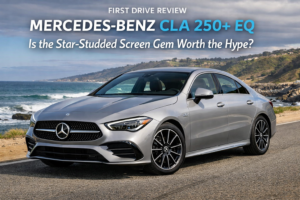
First Drive Review: Mercedes-Benz CLA 250+ EQ – Is the Star-Studded Screen Gem Worth the Hype?
There’s a moment, just after the pre-drive briefing, where you’re left alone with a car that costs more than most people’s homes. My first question to the Mercedes representative wasn’t about horsepower or range. It was, “Can I drive it without scanning the QR code?”
The answer was a polite, “Yes, but you won’t get the full experience.” In the context of the all-new, all-electric Mercedes-Benz CLA 250+ with EQ Technology, the “full experience” has very little to do with the act of driving. It has everything to do with the digital universe you’re meant to inhabit while sitting inside it.
This is the paradox of the new CLA. It arrives in India not as a gentle hybrid or a petrol holdover, but as a ground-up electric vehicle (EV) built on the new Mercedes Modular Architecture (MMA). It is, on paper, the new entry point to the three-pointed star. But calling it an “entry-level” car feels disingenuous when you’re surrounded by more computing power than a SpaceX rocket and a cabin designed to cosset you in digital luxury.
We spent a day with the CLA 250+ on the chaotic, tech-challenged roads of Bengaluru to see if this digital-native sedan can survive—and thrive—in the real world.
The Theatre of Entry: More Than Just a Car
Let’s start with the spectacle. If you are the type of person who believes a car should be an extension of your personal brand, the CLA delivers a standing ovation before you’ve even turned a wheel. There is no start button; the car awakens when it senses your approach. The illuminated grille, a solid panel of black glass by day, erupts into life with over 100 individual three-pointed stars dancing in a choreographed light sequence. It’s dramatic. It’s intentional. It screams, “Look at me.”
This is the CLA’s primary mission: to be seen. Its design language is aggressive and sleek, a four-door coupé silhouette that has grown significantly. It now rides on a wheelbase roughly 90 mm longer than before, pushing its dimensions closer to the C-Class than ever before. Yet, it retains that hunkered-down, cab-rearward stance that defines the coupé shape.
However, this theatre comes with a practical trade-off that Indian buyers will immediately notice. Getting in is not graceful. For anyone above average height, you perform a slight duck-and-dive maneuver to slide into the low-set sports seats without collecting the door frame with your forehead. It’s a small price to pay for the aesthetics, but it’s a reminder that form often follows function in reverse here.
The Drive: Efficiency as an Athletic Pursuit
Once inside, the cabin is a lovely place to be. The AMG Line seats, wrapped in crisp white and black upholstery with bold red stitching, are visually striking and supportive. The materials feel premium, and the dual-screen setup (a 14-inch centre touchscreen) dominates the dashboard in typical modern Mercedes fashion.
Slotting the drive selector (mounted on the column, where you’d expect a wiper stalk) into ‘D’ reveals the CLA’s secret weapon: a two-speed transmission on the rear axle. This is a big deal for an EV. Most electric cars use a single-speed gearbox, which is fine for efficiency but can make them feel breathless at high speeds or rubber-band-like during hard acceleration.
The CLA’s gearbox solves this. It uses a short first gear for punchy, immediate launches from a standstill, making the car feel significantly quicker than its 6.7-second 0-100 km/h claim suggests. In the stop-and-go mayhem of Bengaluru traffic, this responsiveness is a genuine asset. You’re not waiting for power; you’re managing it.
Slot into a faster-moving thoroughfare, and the gearbox shifts almost imperceptibly into a taller second gear, optimizing the motor’s revs for relaxed high-speed cruising and, crucially, efficiency. The claimed range is a staggering 792 kilometers, and while real-world driving will never match that, my time with the car showed the potential is real. Starting with 85% charge showing 569 km, a spirited 80-km loop through varying terrain left the meter reading 564 km with 75% charge remaining. The energy recuperation system, controlled via paddles behind the wheel, is intuitive and helps maximize every kilowatt.
The CLA handles its two-tonne heft surprisingly well. The steering is direct and weights up nicely, making the car feel agile and “flickable” in a way that defies its mass. It’s not a sports car, but it’s a very competent, comfortable grand tourer that shrinks around you on a winding road. The ride, thanks to India-specific suspension tweaks (slightly taller springs to handle our less-than-perfect roads), is compliant without being floaty.
The Digital Cocoon: 508 TOPS and the Art of Overthinking
But let’s return to that QR code. The reason Mercedes is so keen on you scanning it is the fourth-generation MBUX (Mercedes-Benz User Experience) system. This is where the CLA 250+ either becomes a genius companion or a frustrating glimpse into a future that isn’t quite ready for India.
The system is powered by an NVIDIA DRIVE Orin platform capable of 508 Trillion Operations Per Second (TOPS). To put that in perspective, the most powerful laptop processors on the market today hover around 50 TOPS. This car has ten times that power dedicated solely to processing data from its array of cameras, sensors, and radar units, and running its AI-powered Virtual Assistant.
The goal is Level 2+ ADAS (Advanced Driver-Assistance Systems) and a voice assistant that feels less like a command prompt and more like a passenger. The car is trained on yottabytes of data to predict scenarios: Will that autorickshaw swerve? Will that pedestrian step off the curb? Will that dog chase a ball into the road? The CLA is constantly running millions of simulations in the background to keep you safe.
In theory, it’s revolutionary. In practice, during my drive outside mainland Bengaluru, the car’s built-in data card struggled to latch onto a network signal. The QR code was useless. I was disconnected from the matrix.
This highlights a crucial point about the CLA’s value proposition in India. The “full experience”—the AI companion powered by ChatGPT and Google Gemini, the real-time traffic updates, the streaming, the gaming—is entirely dependent on a stable, high-speed internet connection. On the crumbling highways and in the network-shadow zones that define much of India’s geography, the CLA becomes a stunningly beautiful, incredibly capable, but digitally mute EV. The core driving experience remains intact, but the unique selling point—the “wow” factor—flickers out until you’re back in a 5G zone.
The Practicality Paradox
As a car for the owner-driver, the CLA 250+ makes a compelling case for itself. It’s fast, efficient, packed with tech, and dripping with curb appeal. But as a family vehicle, the compromises of the coupé shape are stark.
The rear seat is where good intentions go to die. While knee room is adequate, the seatback is set at a rake that is far too upright for comfort. It feels like a church pew. Headroom is also at a premium thanks to the sloping roofline. As the review rightly states, it’s best suited for children or small adults on short trips.
Practicality is redeemed slightly by clever storage. The 405-litre boot is respectable for a car of this size, and the “frunk”—a 101-litre storage space under the bonnet—is a genuinely useful feature, perfect for storing charging cables or a weekend bag, keeping the cabin pristine.
The Verdict: A Star-Studded Statement, Not a Sensible Sedan
The Mercedes-Benz CLA 250+ with EQ Technology, priced at an estimated Rs 67-70 lakh (ex-showroom), is a difficult car to categorize. It is not the smartest financial decision in the segment. It is not the most practical vehicle for a family of five. And its most advanced features are currently at the mercy of India’s spotty telecom infrastructure.
However, buying a car, especially a Mercedes, is rarely about pure logic. It’s about emotion. And the CLA 250+ is an emotional purchase. It’s for the tech-obsessive early adopter who wants to sit inside a piece of the future. It’s for the brand-conscious individual who wants the drama of the light show and the prestige of the star, but in a package that signals a commitment to sustainability. It’s for the urban professional who primarily drives alone or with one passenger and wants their commute to feel like a private tech sanctuary.
Yes, you can drive it without scanning the QR code, and you’ll find a brilliant, refined, and efficient electric sedan. But to truly understand what the CLA 250+ is trying to be, you need to scan the code, log in, and let the AI take you for a ride. It’s a gamble on a fully connected future. For now, in the India of 2026, it’s a stunning, intelligent, and slightly impractical glimpse of what that future might look like.
You must be logged in to post a comment.