
Fertilizer Policy Overhaul: How GST and Licensing Reforms Could Transform Indian Agriculture
Ahead of the Union Budget, the Indian Micro-Fertilizers Manufacturers Association (IMMA) has called for critical reforms to resolve a persistent inverted GST structure, where higher taxes on raw materials than on finished products lock up manufacturers’ working capital in unrefunded credits. The association seeks a uniform 5% GST rate for all fertilizers to create a level playing field and expedited refunds for accumulated tax credits to ease financial strain.
Simultaneously, IMMA advocates for a “One Nation, One Licence” system to replace the cumbersome state-by-state licensing process, which causes delays and increases costs. These combined reforms aim to unlock capital for innovation, reduce operational friction, lower costs, and ultimately ensure farmers get faster and more affordable access to next-generation, quality fertilizer products, modernizing a legacy regulatory framework for today’s agricultural needs.
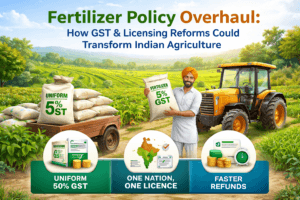
Fertilizer Policy Overhaul: How GST and Licensing Reforms Could Transform Indian Agriculture
India’s micro-fertilizer manufacturers are pushing for a regulatory revolution ahead of the Union Budget 2026, proposing reforms that could unlock billions in working capital and accelerate the delivery of vital nutrients to the nation’s farms.
The call for a uniform 5% GST across all fertilizers and a “One Nation, One Licence” system represents more than just industry lobbying—it’s a critical plea to modernize a regulatory framework still rooted in an era of scarcity, which now hinders innovation, ties up capital, and ultimately affects farmer prosperity.
01 The Heart of the Matter: Inverted GST and Trapped Capital
The Indian Micro-Fertilizers Manufacturers Association (IMMA) acknowledges the “landmark reform” of GST 2.0, which reduced rates on certain fertilizer items from 12% to 5%. However, this partial fix has left a persistent and damaging anomaly: the inverted duty structure (IDS).
Under this structure, manufacturers pay a higher Goods and Services Tax on their raw materials (like specific chemicals and services) than the rate applied to their finished fertilizer products. This mismatch results in the accumulation of unutilized Input Tax Credit (ITC). Essentially, money that should be circulating within businesses to fund operations, purchase supplies, and drive growth is locked away in a bureaucratic limbo.
As Rahul Mirchandani, President of IMMA, explains, this directly “locks up working capital for manufacturers”. For an industry dominated by Micro, Small, and Medium Enterprises (MSMEs) that operate on thin margins and are crucial for regional agricultural support, this liquidity crunch is debilitating. It restricts their ability to invest in quality improvements, expand production capacity, or enhance direct farmer outreach programs.
02 A Comparative Look at GST’s Uneven Impact
The GST 2.0 reforms, which simplified India’s tax system into primary slabs of 5% and 18%, were a significant step forward. Yet, they created both winners and losers, highlighting the inconsistent application of tax policy across related agricultural sectors.
Sectors Where the IDS Problem Was Eased:
- Fertilizers & Agriculture: Key chemical inputs saw rates cut to 5%, aligning with finished product rates.
- Textiles: The man-made fiber chain (fiber-yarn-fabric) was aligned at 5%, relieving a major inversion.
- Renewable Energy: Taxes on solar components were reduced to 5%, lowering the cost of trapped capital in tax-free electricity projects.
Sectors Where the IDS Problem Worsened:
- Pharmaceuticals: Finished drug rates were cut to 5% or zero, but Active Pharmaceutical Ingredients (APIs) remained at 18%, widening the inversion gap.
- Farm Machinery: Tractors and agricultural machinery moved to 5%, while the steel used to make them stayed at 18%.
- Packaged Foods: Many consumer goods were moved to 5%, but their packaging materials often remained at higher slabs, creating widespread small-value inversions.
This table illustrates the specific GST realignments and their varying impact:
| Sector/Product Category | Key Inputs (Post-GST 2.0) | Finished Goods (Post-GST 2.0) | Nature of IDS Impact |
| Micro-fertilizers | Certain chemicals, services (18%) | Schedule 1G items & mixtures (5%) | Persistent Problem |
| Pharmaceuticals | APIs (18%) | Medicines (5% or 0%) | Worsened |
| Textiles | Man-made fiber, yarn (5%) | Fabric, apparel (5%) | Largely Resolved |
| Farm Machinery | Steel (18%) | Tractors, machinery (5%) | Newly Created |
03 The Core Demands: Uniformity, Speed, and Simplification
IMMA’s pre-budget submission is built on three interconnected pillars designed to resolve structural inefficiencies.
- Universal 5% GST:The association is urging the government toextend the 5% GST rate uniformly to all fertilizers notified under the Fertilizer Control Order (FCO). A common rate would eliminate classification disputes, ensure a level playing field, and remove tax considerations from product innovation decisions. The government has shown some receptivity, with the CBIC agreeing to consider this plea in consultation with the Agriculture Ministry.
- Expedited Refund Mechanism:For inversions that persist, IMMA demands a“clear and time-bound mechanism” for the swift refund of accumulated ITC. Faster refunds would act as a direct stimulus, easing working capital stress and freeing up funds for critical business investments. The industry has even committed to “anti-profiteering”, pledging to pass on tax savings to farmers through MRP reductions.
- One Nation, One Licence:This is perhaps the most transformative demand. The current system requires manufacturers to obtainseparate licences for each state and sometimes each district they operate in. This leads to duplication, delays, and significant avoidable compliance costs. IMMA proposes a centralized digital repository for license documents, accessible to all states, to enable seamless verification and faster marketing permissions. This reform aligns with the spirit of GST—creating a unified national market.
04 The Bigger Picture: Rewriting a Legacy Regulatory Framework
The push for licensing reform exposes a deeper, historical misalignment. The Fertiliser Control Order (FCO) was established under the Essential Commodities Act in an era defined by food scarcity and the need for strict quality control. Today, India’s agricultural context is radically different, characterized by food surpluses, resilient supply chains, and digital infrastructure.
Continuing to regulate fertilizers with a “scarcity mindset” creates tangible roadblocks. As noted in industry discussions, the complex web of state-level compliance raises product costs by an estimated 8 to 15%, a hidden burden ultimately borne by farmers. Furthermore, the threat of criminal prosecution for minor labelling deviations stifles entrepreneurship and innovation in a sector that desperately needs new, climate-resilient solutions.
There is a growing call for a bifurcated regulatory approach. Subsidized fertilizers like urea could remain under stricter oversight, while non-subsidized, specialty fertilizers could transition to a more agile, market-friendly framework centered on truthful labelling and post-market surveillance.
05 The Ripple Effect: From Factory to Field
The implications of these reforms extend far beyond corporate balance sheets. They are fundamentally about strengthening the last link in the chain: the Indian farmer.
- Access to Innovation: Regulatory delays and high compliance costs slow the introduction of next-generation products like micronutrients, water-soluble blends, and bio-stimulants. In an era of climate volatility and depleting soil health, timely access to these precision tools is not a luxury but a necessity for sustainable productivity.
- Cost and Availability: Simplifying the licensing regime and resolving the GST inversion would reduce operational friction and lower costs. These savings can improve farm-gate prices and ensure wider, faster availability of quality products across the country.
- Empowering MSMEs and Startups: A streamlined, digital “One Nation, One Licence” system would significantly lower the barrier to entry for agile MSMEs and agri-startups. This is essential for fostering a competitive, innovative domestic industry that can support the Atmanirbhar Bharat (Self-Reliant India) vision and even position India as a “fertilizer factory for the world”.
06 The Path Forward: Smart Regulation for a New Era
The government’s previous initiative, “One Nation One Fertilizer” —which mandated the sale of subsidized fertilizers under the single “Bharat” brand—demonstrates an intent to create uniformity and reduce confusion. The industry’s call for “One Nation, One Licence” is a logical, complementary step focused on the manufacturing and supply side of the equation.
The upcoming Union Budget presents a decisive opportunity. Adopting these reforms would signal a shift from restrictive control to enabling governance. It would recognize that in the 21st century, food security is not just about having enough food, but about having a resilient, efficient, and innovative agricultural input ecosystem that empowers farmers and entrepreneurs alike.
As one industry representative starkly put it, the question is whether India’s innovators will remain “entangled in compliance” or finally be “empowered by it”. The answer will shape the future of Indian agriculture for decades to come.
You must be logged in to post a comment.