
Ferrari’s Middle-East Crossfire: How War is Reshaping Luxury Car Deliveries to Asia
The article reports that Ferrari’s deliveries to Asia are facing delays and increased costs due to the ongoing Middle-East conflict, which has disrupted shipping routes and impacted the company’s regional operations hub in Dubai. However, executives highlighted that Ferrari’s unique business model—producing cars only against firm, pre-sold orders that already extend through the end of 2025—provides significant protection against this volatility by preventing inventory buildup and cash flow issues. Amidst these challenges, the company is focusing on India as a major long-term growth opportunity, citing the country’s rising number of billionaires and passionate car culture, while emphasizing that employee safety in affected regions remains its top priority.
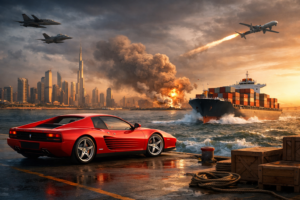
Ferrari’s Middle-East Crossfire: How War is Reshaping Luxury Car Deliveries to Asia
As geopolitical tensions escalate across the Middle-East, even the world’s most iconic luxury automaker isn’t immune—but its unique business model is proving to be an unexpected shield.
On a sweltering March evening in Mumbai, amidst the clinking of champagne glasses and the murmur of India’s ultra-wealthy, Ferrari CEO Benedetto Vigna stood beside the legendary 849 Testarossa. The iconic sports car, with its aggressive lines and thunderous legacy, gleamed under the lights of a private gathering that felt worlds away from the airstrikes now rocking the Middle-East.
Yet, even here, in the relative calm of India’s financial capital, the shockwaves of war were being felt.
“Like every company, it is impacting us too,” Francesco Bianchi, Ferrari’s head of the Far and Middle-East hub, admitted to select media after the launch. His words carried weight—because Bianchi operates from Dubai, a glittering city that has suddenly found itself in the crosshairs of one of the most volatile conflicts the region has seen in decades.
The Dubai Hub: Luxury’s Unexpected Frontline
When Ferrari established its regional headquarters in Dubai years ago, the decision made perfect sense. The Middle-East has long been one of the world’s most lucrative markets for ultra-luxury automobiles, with oil wealth and a culture of conspicuous consumption creating insatiable demand for Prancing Horses. Dubai’s geographic position also made it an ideal logistics hub for managing dealerships across Asia, from Tokyo to Mumbai.
What no one anticipated was that this gleaming city of superlatives would become a frontline in an escalating regional war.
Recent weeks have seen sustained airstrikes from Iran targeting strategic locations, with Israel conducting retaliatory bombings. The United States has now entered the fray, claiming to have pounded a crucial oil hub on Iran’s Kharg Island—claims Tehran has refuted while vowing retaliation. For companies like Ferrari that operate regional nerve centers in Dubai, this isn’t just geopolitical theater; it’s a daily operational crisis.
Bianchi’s first concern, he told reporters, has been ensuring employee safety. “We are adapting to the changing situation and hoping that the escalation subsides,” he said. It’s a sentiment echoed by countless business leaders across the region who suddenly find themselves navigating not just balance sheets but air raid sirens.
The Logistics Nightmare: When Supply Chains Become War Zones
For Enrico Galliera, Ferrari’s chief marketing and commercial officer, the conflict has created a more tangible business challenge: getting cars to customers.
“Deliveries to Asia are taking more time due to a longer route and costs are also going up,” Galliera explained. The statement carries implications that ripple far beyond Ferrari’s showrooms.
When a regional conflict erupts in the Middle-East, it doesn’t just affect the countries directly involved. The region serves as a critical transit corridor for global trade. Ships that would normally pass through the Red Sea, the Suez Canal, or the Strait of Hormuz suddenly face heightened insurance premiums, crew safety concerns, and the very real risk of being caught in crossfire or collateral damage.
For Ferrari, this means rerouting vessels carrying precious cargo—cars that represent not just transportation but dreams realized for wealthy buyers across Asia. Each delay represents not just logistical inconvenience but disappointed customers who have been anticipating their vehicles for months, sometimes years.
The cost implications are equally significant. Longer routes mean more fuel, more crew time, and more complex logistics coordination. Insurance premiums for shipping through conflict zones have skyrocketed. These are costs that, in a normal business environment, might be passed on to customers. But Ferrari’s situation is far from normal.
The Ferrari Paradox: Why a Made-to-Order Model Offers Protection
Here’s where Ferrari’s story diverges from that of mainstream automakers—and where Galliera’s confidence becomes understandable.
“In this situation it is to our advantage,” Galliera said, explaining why Ferrari’s business model provides protection. “We don’t sell cars from stock; we sell based on fresh orders. For the time being our portfolio is going well, up to the end of the next year, based on our volume projection.”
This statement deserves unpacking because it reveals something fundamental about how Ferrari operates—and why it can weather storms that would cripple other companies.
Unlike mass-market manufacturers that build vehicles on speculation and warehouse them until buyers appear, Ferrari builds almost nothing without a customer already committed. The company’s production is deliberately constrained, with waiting lists stretching years for certain models. This isn’t artificial scarcity; it’s a deliberate strategy to maintain exclusivity, protect resale values, and ensure that every car leaving the factory already has a home.
When Galliera says their portfolio is booked “up to the end of the next year,” he’s revealing that Ferrari’s production is essentially sold out for the next 18-24 months. The cars currently being delayed by Middle-East shipping disruptions are already spoken for. The customers are already waiting. The revenue, while not yet recognized, is already banked in terms of demand.
This creates remarkable resilience. A three-week shipping delay, while frustrating for customers and costly for Ferrari, doesn’t create inventory buildup or cash flow crises. The cars will eventually arrive, and the payments will eventually clear. In the meantime, Ferrari’s balance sheet isn’t hemorrhaging cash on storage costs or dealer incentives to move metal.
“Ferrari has a higher resilience; we can adapt to our operations to cope with current situation,” Galliera added. “We are hoping that the disruption will end soon, as it is impacting the supply chain.”
That last phrase—”impacting the supply chain”—is the critical caveat. Ferrari’s protection isn’t absolute. The company still depends on a global web of suppliers for components, materials, and subsystems. If the conflict drags on and begins disrupting the flow of parts into Ferrari’s Maranello factory, even the made-to-order model won’t provide complete insulation. But for now, the company’s unique structure is proving its worth.
The Human Element: Beyond the Balance Sheet
Numbers and logistics tell only part of the story. Behind Ferrari’s carefully worded statements about “adapting” and “hoping for de-escalation” lies a more human reality.
Ferrari’s Dubai-based employees are waking up each morning to news of overnight airstrikes. They’re navigating disrupted commutes, concerned family members, and the psychological toll of living in a suddenly volatile region. Some may be considering relocation. Others may be struggling to focus on regional sales targets while their children sleep in safe rooms.
Bianchi’s emphasis on employee safety as the “first priority” acknowledges this reality. Before Ferrari can worry about deliveries to Asia or launches in India, it must ensure that the people managing those operations are safe, supported, and able to function under extraordinary circumstances.
This human dimension extends to customers as well. Wealthy buyers in Dubai, Abu Dhabi, and across the Middle-East are suddenly facing very different priorities than speculating on the next limited-edition Ferrari. Some may defer deliveries or reconsider purchases as their attention shifts to safety, security, and the protection of assets in an uncertain region.
For Ferrari’s Asian customers waiting for their cars, the delays are frustrating but manageable—a first-world problem in the truest sense. Yet even here, the human element matters. A buyer in Singapore or Tokyo who has been anticipating their Ferrari for 18 months isn’t just purchasing transportation; they’re purchasing an experience, a milestone, a symbol of achievement. Each week of delay chips away at that emotional payoff.
India Rising: Why Ferrari Sees Opportunity in Chaos
Amidst the uncertainty, one theme emerged clearly from the Mumbai launch: Ferrari’s conviction that India represents a genuine long-term opportunity.
“India, in terms of potential and presence, is gaining ground,” Galliera said. “The mid to long term is a real opportunity.”
This isn’t mere diplomatic flattery. The numbers tell a compelling story. India now accounts for the world’s third-largest population of billionaires, trailing only China and the United States. Cities like Mumbai, Delhi, Bangalore, Hyderabad, Chennai, Ahmedabad, Kolkata, Pune, Gurugram, and Surat all boast significant concentrations of ultra-high-net-worth individuals. Many of these individuals have traditionally favored European luxury brands, but Ferrari’s presence in India has historically been limited.
Bianchi elaborated on the company’s Indian strategy: “We are planning certain number of milestones in India. The first is the launch of the 849 Testarossa. We want to establish the Ferrari brand here because there is a strong connection with the market.”
The “strong connection” Bianchi references isn’t just about wealth. India has a passionate car culture, with enthusiasts who treat automobiles as objects of desire rather than mere transportation. The country’s growing infrastructure, expanding highways, and improving wealth distribution are creating conditions that mirror those in mature luxury car markets.
Importantly, Ferrari isn’t approaching India with the same model it uses elsewhere. Galliera explained that Ferrari’s global approach relies on retail partners rather than direct dealerships. Buyers can purchase wherever possible, but service centers must be located closer to customers. This hybrid model allows Ferrari to maintain control over the brand experience while adapting to local market conditions.
However, both executives acknowledged that sustained growth might eventually require a more substantial national presence. If India’s luxury car market continues its upward trajectory, Ferrari may need to reconsider its partner-only approach and explore direct investment in the market.
The Billionaire Equation: Why Demographics Matter
Ferrari’s interest in India reflects a broader truth about the luxury automotive industry: it follows wealth with laser focus.
With India now home to the world’s third-largest billionaire population, the demographic arithmetic becomes compelling. Each billionaire represents potential demand for multiple vehicles—not just for themselves, but for family members, for collections, for investment purposes. Below the billionaire tier, India’s rapidly expanding millionaire population creates a pyramid of demand that supports everything from entry-level luxury vehicles to the ultra-exclusive models Ferrari produces.
This demographic reality exists alongside India’s well-documented income inequality and the ongoing challenges of infrastructure, regulation, and bureaucracy. For Ferrari, these complications are manageable because the company operates at a level where such obstacles become secondary. The Indian billionaire who wants a Ferrari will find a way to acquire one, regardless of import duties or registration complexities. The question for Ferrari is whether to make that process easier—and whether to invest in capturing more of this demand.
The Mumbai launch of the 849 Testarossa suggests Ferrari’s answer is increasingly affirmative. The Testarossa name carries immense emotional weight for enthusiasts who remember the original 1980s icon with its distinctive side strakes and pop-up headlights. Reviving this nameplate for the Indian market signals respect for local automotive passion and a recognition that Indian buyers are sophisticated enough to appreciate Ferrari’s heritage.
The War Economy: How Luxury Brands Navigate Conflict
Ferrari’s situation illuminates a broader reality about how luxury brands operate in an increasingly volatile world. Unlike mass-market companies that compete primarily on price and availability, luxury brands compete on desire, exclusivity, and emotional connection. This fundamental difference creates different vulnerabilities—and different protections—when geopolitical crises erupt.
For a mass-market automaker, a three-week shipping disruption could be catastrophic. Inventories pile up at ports. Dealers run out of popular models. Cash flow tightens as vehicles sit unsold. The company may need to offer incentives, adjust production schedules, or even halt factory lines to manage the imbalance.
For Ferrari, the same disruption is irritating but manageable. Because production is already sold out, the company isn’t building cars it can’t sell. Because customers are waiting specifically for their vehicles, there’s no inventory buildup. Because the brand’s desirability transcends temporary logistics issues, there’s no pressure to discount or offer incentives.
This doesn’t mean Ferrari is immune to the conflict. If the war expands or continues indefinitely, supply chains will eventually be affected. Component shortages could slow production. Employee retention in affected regions could become challenging. Customer sentiment in the Middle-East could shift away from luxury consumption toward more practical priorities.
But for now, Ferrari’s business model is proving its worth as a buffer against geopolitical volatility. The made-to-order approach that some critics have dismissed as artificially limiting growth is now demonstrating its value as a risk management tool.
Looking Ahead: Scenarios and Implications
As the Middle-East conflict enters its third week with no resolution in sight, Ferrari—and companies like it—must prepare for multiple scenarios.
In the best case, diplomatic efforts succeed in de-escalating tensions. Shipping routes return to normal within weeks. Ferrari’s Dubai-based employees resume regular operations. The supply chain remains intact. Delayed Asian deliveries catch up by mid-year, and the company absorbs the additional shipping costs without significant margin impact.
In a more challenging scenario, the conflict continues for months, perhaps expanding to involve additional players. Shipping through the region becomes prohibitively expensive or impossible. Ferrari must permanently reroute Asian deliveries around Africa, adding weeks to transit times and substantially increasing costs. The Dubai hub becomes difficult to maintain, forcing consideration of alternative regional headquarters. Employee retention becomes a serious concern as expatriates reconsider living in a conflict zone.
In the worst case, the conflict escalates into a broader regional war that disrupts global oil supplies, triggers economic volatility, and reshapes international trade patterns. Luxury consumption in affected regions collapses. Shipping costs become astronomical. Ferrari’s supply chain faces sustained disruption. The company must invoke force majeure clauses with customers, delaying deliveries indefinitely while hoping its order book remains intact when normalcy returns.
Between these extremes lies a range of possibilities that Ferrari’s management must now navigate. The company’s strength lies in its flexibility—the ability to adapt operations, reroute shipments, and maintain customer relationships even when circumstances are far from ideal.
The Indian Wild Card
Amidst this uncertainty, India emerges as an increasingly important factor. If Middle-East volatility persists, luxury brands may accelerate their pivot toward Asian markets less directly affected by the conflict. India, with its growing wealth and relative geopolitical stability, could benefit from this reorientation.
Ferrari’s executives hinted at this possibility without stating it explicitly. Bianchi’s comment about India “gaining ground” in terms of presence and potential reflects a strategic recognition that no luxury brand can afford to ignore the world’s third-largest billionaire population. Galliera’s emphasis on the “real opportunity” in India over the mid to long term suggests that Ferrari is thinking beyond temporary disruptions toward fundamental market positioning.
This doesn’t mean Ferrari will abandon the Middle-East or reduce its commitment to established markets. But it does suggest that India’s share of Ferrari’s regional focus may increase—particularly if the conflict drags on and the Dubai hub becomes more complicated to operate.
The Testarossa Moment
For the handful of Indian buyers who attended the Mumbai launch, these geopolitical complexities likely felt distant. What mattered in that moment was the 849 Testarossa—the revival of a legend, the continuation of a legacy, the opportunity to own something that few others would ever possess.
Yet even as they admired the car’s lines and listened to its engine, the realities of a connected world were asserting themselves. The executives speaking to them had flown in from a region under airstrikes. The supply chain that would deliver their cars was navigating war zones. The global luxury economy that Ferrari represents was being tested in ways few had anticipated.
The question now is whether Ferrari’s business model—built on exclusivity, made-to-order production, and careful market management—can continue to protect it as the Middle-East conflict evolves. For now, the answer appears to be yes. But as any Ferrari owner knows, conditions can change quickly when you’re pushing the limits. The company that builds the world’s most responsive sports cars is now discovering just how responsive it can be when geopolitical forces demand adaptation.
Frequently Asked Questions
How exactly has the Middle-East war affected Ferrari’s deliveries? The conflict has forced Ferrari to reroute shipments destined for Asian markets, resulting in longer transit times and increased shipping costs. The company’s Dubai regional hub, which coordinates Asian operations, has also been affected by the security situation.
Why is Ferrari’s business model more resilient during this crisis? Ferrari builds cars only after receiving customer orders, with production already sold out through late 2025. This means shipping delays don’t create inventory buildup or cash flow problems—the cars are simply delivered later than planned rather than sitting unsold.
Is Ferrari considering expanding in India? Yes. Ferrari executives described India as “gaining ground” in terms of presence and potential, citing the country’s growing billionaire population and passionate car culture. The company currently operates through authorized dealers in Mumbai and New Delhi but may expand its network as the market grows.
What is the 849 Testarossa mentioned in the article? The 849 Testarossa is a new model launched by Ferrari in India, reviving the legendary Testarossa nameplate from the 1980s. The original Testarossa became an icon of its era with distinctive side strakes and pop-up headlights.
How is Ferrari ensuring employee safety in Dubai? Francesco Bianchi, head of Ferrari’s Far and Middle-East hub, stated that employee safety is the company’s first priority. Ferrari is monitoring the situation closely and adapting operations to ensure staff remain safe as the conflict evolves.
You must be logged in to post a comment.