
Fear, Fake News, and Foreign Workers: The Truth Behind India’s Subway Sleepers in Wartime Israel
A viral social media post claiming that Indian nationals in Israel were denied access to bomb shelters during the Iran war and forced to sleep in subways is false; the image actually shows people using underground metro stations, which are officially designated safe spaces in Israel, where people of all nationalities, including Indians, seek shelter together during rocket attacks, as confirmed by Israeli embassy officials who emphasized that the photograph depicts the civil defense system working as intended rather than evidence of discrimination against the approximately 18,000 Indian citizens—primarily caregivers, diamond traders, and students—who remain in the country amid the escalating conflict.
Fear, Fake News, and Foreign Workers: The Truth Behind India’s Subway Sleepers in Wartime Israel
Introduction: When a Single Image Ignites a Global Firestorm
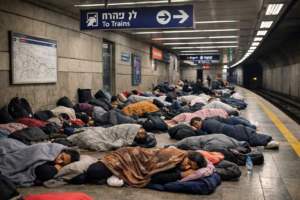
The photograph is haunting in its ordinariness. Dozens of people lie on the hard floor of what appears to be a subway station, wrapped in blankets and jackets, their belongings clutched close like lifelines. Some sleep; others stare vacantly at nothing. Above them, fluorescent lights cast an institutional glow on a scene that speaks of displacement, fear, and the grim reality of modern warfare.
Within hours of its posting on March 2, 2026, this single image had been viewed over three million times. The accompanying caption was explosive: “Indians sleeping in subways after denied access to shelters in bunkers in Israel.”
The implication was devastating—that amidst the escalating conflict between Iran and Israel, with US-Israeli strikes reportedly claiming nearly 800 lives across Iran, Indian nationals had been abandoned, relegated to the cold concrete of public transit while others found safety underground.
But as with so much in the fog of war, the truth proved far more complex than the viral narrative suggested. And in that complexity lies a story not just about one photograph, but about the nature of misinformation, the vulnerability of diaspora communities, and what happens when geopolitical crisis meets the relentless churn of social media.
The Claim That Traveled the World
The post originated from an X account with the handle @softspoken04, featuring the photograph alongside the incendiary claim. Within days, it had been shared thousands of times, sparking outrage across Indian social media. Comments ranged from expressions of solidarity to accusations of institutional racism, from demands for government intervention to anguished questions about why Indian citizens would remain in a war zone.
The timing was critical. Just days earlier, on February 28, the Indian embassy in Tel Aviv had issued an urgent advisory: “In view of the prevailing security situation in the region, all Indian nationals in Israel are advised to exercise utmost caution and remain vigilant at all times.” The advisory specifically urged residents to “stay close to designated shelters” and familiarize themselves with “the nearest protected spaces near their homes and workplaces.”
When news broke that Indians were allegedly being turned away from those very shelters, it struck a nerve. Here was a narrative that confirmed the worst fears of every Indian with loved ones abroad—that in moments of crisis, nationality could become a liability, that the bonds of shared humanity might dissolve when sirens wail and bombs fall.
Who Are India’s People in Israel?
To understand why this story resonated so deeply, one must first understand who these 18,000 Indian citizens in Israel actually are.
They are not, for the most part, the tech entrepreneurs or diplomats one might imagine. According to community data, the majority are caregivers—primarily women from Kerala and other southern states—who have spent years, sometimes decades, caring for elderly Israelis. They arrived through government-to-government agreements, drawn by salaries that could transform their families’ fortunes back home. They learned Hebrew, adapted to a foreign culture, and built lives around the intimate work of tending to the vulnerable.
Then there are the diamond traders, predominantly from Gujarat’s Palanpur community, who have maintained commercial links between Mumbai and Tel Aviv for generations. Students pursuing advanced degrees at Israeli universities. IT professionals drawn to the “Startup Nation.” And approximately 85,000 Jews of Indian origin—the Indian-Jewish community—who hold Israeli citizenship while maintaining cultural and familial ties to the subcontinent.
These are not transient workers who can simply pack bags and leave. These are people with roots, responsibilities, and relationships that bind them to Israel even as conflict erupts. The caregivers, in particular, face an impossible dilemma: flee to safety and abandon elderly charges who depend on them, or stay and accept the risks of war.
When the image of subway sleepers appeared, many Indians immediately thought of these caregivers—middle-aged women from Kerala, working-class men from Punjab, people who might lack the resources or connections to secure proper shelter.
The Embassy Responds: Separating Fact from Fiction
As the viral post gained traction, the Israeli embassy in India moved quickly to respond. Guy Nir, the embassy’s spokesperson, took to X with characteristic directness:
“FAKE NEWS. You can clearly see in the picture people of all ethnicities. Metro stations are designated and official safe spaces in Israel. Many of my Tel-Aviv friends pass their nights there. And as you can see – Indian nationals are welcome, along with all nationals.”
The response was unequivocal, but it raised as many questions as it answered. If the subway was indeed an official shelter, why were people sleeping there at all? And if the claim of denied access was false, what was actually happening to Indian nationals as the conflict intensified?
To understand the reality, one must first understand how Israel approaches civilian protection during wartime—a system born of necessity and refined through decades of conflict.
Israel’s Shelter System: A Nation Built for War
Few countries on earth have invested as heavily in civilian protection as Israel. The reason is simple geography and politics: since its founding in 1948, the nation has faced repeated military conflicts, rocket attacks, and security threats that require every citizen to be prepared for sudden violence.
The result is a multi-layered system of protected spaces that would astonish visitors from less embattled nations. In private homes, especially in newer constructions, “mamad” (short for merhav mugan dirit, or “protected space in a residential building”) are standard features—reinforced rooms with concrete walls, blast-proof windows, and sealed ventilation systems. In apartment buildings without individual shelters, shared “mamak” (merhav mugan komati, or “floor-based protected space”) serve multiple units.
Public buildings—schools, hospitals, community centers—are required to maintain shelters accessible to surrounding neighborhoods. And yes, as Guy Nir noted, underground metro stations are integrated into this network, their depth and concrete construction offering genuine protection against aerial bombardment.
When the Home Front Command issues alerts, citizens are expected to proceed to the nearest protected space within the time available—often just 60 to 90 seconds. In high-risk areas, many choose to sleep in these shelters rather than risk being caught unprepared during the night.
This explains the photograph. Those people on the subway platform were not refugees denied entry somewhere else. They were following official guidance, using a designated safe space exactly as intended. The image that sparked global outrage was, in fact, evidence of the system working as designed.
The Human Reality: What Wartime Actually Looks Like
But understanding the system doesn’t capture the human experience. To grasp what those subway sleepers were actually enduring, one must imagine the reality of living under the threat of aerial attack.
The sirens come without warning—a rising and falling wail that cuts through the night like a knife. By the time you hear them, you have perhaps 90 seconds to reach shelter. If you’re in bed, you scramble for shoes, grab whatever you can carry, and run. If you’re caring for an elderly person who cannot move quickly, those seconds become an eternity of terror.
Once in the shelter, you wait. The sounds that follow—distant booms, sometimes closer detonations—tell you nothing about whether the danger has passed. Children cry. Adults stare at phones, desperate for news. Strangers become temporary families, sharing water and whispered reassurances.
And then, if you’re one of the 18,000 Indian nationals far from home, you face an additional layer of uncertainty. Your family in Kerala or Punjab or Gujarat is watching news coverage that may be inaccurate or alarmist. They’re sending frantic messages. You want to reassure them, but you also need to conserve phone battery and focus on survival.
The caregivers face the cruelest position. Many of their elderly Israeli charges have dementia or mobility issues that make shelter protocols nearly impossible to follow. Do you leave them to save yourself? Do you stay and hope the building holds? These are not hypothetical questions; they are the daily moral calculations of wartime care work.
The Diaspora Dilemma: To Leave or to Stay?
In the days following the outbreak of hostilities, Indian nationals in Israel faced a painful decision. The embassy advisory was clear about vigilance but stopped short of recommending evacuation. This is standard diplomatic practice—governments rarely order mass evacuations unless the situation becomes truly untenable, both because of the logistical challenges and because many citizens will choose to stay regardless.
But for the caregivers, leaving isn’t simple. Their employment contracts bind them to specific clients. Abandoning an elderly person during wartime could have legal consequences, to say nothing of the moral weight of walking away from someone who depends on you. Many have spent years building relationships with the families they serve, becoming de facto family members in households where biological relatives live far away or have drifted apart.
The diamond traders face different calculations. Their businesses require physical presence, inventory management, and client relationships that can’t be maintained from abroad. Leaving means shutting down operations, potentially losing everything they’ve built.
The students—often young, far from home for the first time—must weigh their educational futures against personal safety. Missing weeks or months of coursework could derail academic progress, but staying means accepting risks their parents never anticipated when they sent them abroad.
And the Indian-Jewish citizens, who hold Israeli passports and consider this their home, face the same impossible choices as any Israeli: whether to stay and defend their communities, or seek temporary refuge elsewhere while the country they love comes under attack.
The Misinformation Machine: Why False Narratives Spread
The subway photograph did not go viral by accident. It tapped into deep currents of anxiety, suspicion, and historical grievance that made it irresistible to millions of viewers.
For Indians, there is a painful awareness of how diaspora communities can be abandoned during crises. The 1990 Gulf War evacuation, when India airlifted over 170,000 citizens from Kuwait and Iraq, remains a source of national pride precisely because it addressed a genuine fear: that Indian workers abroad might be left to suffer when conflict erupts. Every subsequent crisis—from Lebanon in 2006 to Ukraine in 2022—has triggered the same anxiety and the same determination to bring citizens home.
For those inclined to believe the worst of Israel, the narrative of discrimination against non-Jewish populations fits comfortably into existing frameworks. The Israeli-Palestinian conflict, treatment of African asylum seekers, and debates over the nation’s identity as a Jewish state all provide context for claims that Indian nationals would be treated as second-class people in a moment of crisis.
And for the broader social media ecosystem, the photograph offered something irresistible: a simple, emotionally charged story that required no context, no nuance, and no understanding of Israel’s civil defense systems. It was perfectly designed for the algorithm—outrageous, visual, and easily shareable.
The fact that the claim was false mattered less than the fact that it felt true to millions of people who had never visited Israel, never experienced a rocket attack, and never considered how they would react if sirens sent them running for shelter in a foreign land.
The Diplomatic Response: Managing Crisis in Real Time
As the misinformation spread, Indian and Israeli officials found themselves in an unusual position: managing not just the actual crisis of war, but the parallel crisis of online falsehoods.
The Indian embassy in Tel Aviv, which had already issued its initial advisory, now faced the additional challenge of reassuring citizens that they were not being abandoned. Behind the scenes, diplomatic staff worked to verify the safety of Indian nationals, establish communication channels, and prepare contingency plans should evacuation become necessary.
The Israeli embassy in New Delhi, meanwhile, confronted a public relations crisis that threatened to damage one of its most important bilateral relationships. India and Israel have grown increasingly close in recent decades, with cooperation spanning defense, technology, agriculture, and intelligence. The idea that Israel would discriminate against Indian nationals during wartime threatened to poison this carefully cultivated partnership.
Guy Nir’s swift response on social media represented a new kind of crisis management—one where embassies must engage directly with the platforms where misinformation spreads, rather than relying on traditional press releases and official statements. His message was clear, factual, and personalized, using his own connections to Tel Aviv (“Many of my Tel-Aviv friends pass their nights there”) to humanize the explanation.
But the challenge extended beyond correcting one false claim. Every hour brought new rumors, new images stripped of context, new narratives designed to provoke outrage. The diplomats’ task was not unlike that of the civilians in shelters: to wait out the storm while maintaining hope that the structure would hold.
The Bigger Picture: India’s West Asia Balancing Act
For the Indian government, the crisis presented a delicate geopolitical challenge. Prime Minister Narendra Modi’s statement that the situation was “a matter of grave concern” and that India “stands for peace and the resolution of disputes through dialogue and diplomacy” reflected the careful balancing act New Delhi must maintain in West Asia.
India has deep and growing relationships with nearly every major player in the region. With Israel, ties have flourished under Modi, who became the first Indian prime minister to visit the country in 2017. Defense cooperation has expanded dramatically, with Israel becoming one of India’s top arms suppliers.
But India also maintains strong ties with Iran, a historic partner with whom it shares cultural and economic connections. The Chabahar port project, which allows India to bypass Pakistan in accessing Central Asia, depends on Iranian cooperation. And India’s substantial Muslim population includes many who view Iran’s Shia leadership with sympathy.
With the Gulf Arab states—the UAE, Saudi Arabia, Qatar—India has economic relationships of enormous importance. Millions of Indians work in these countries, sending home remittances that sustain families and fuel local economies. When Iran launched retaliatory strikes targeting “US-linked facilities” in the UAE, Qatar, and Bahrain, it directly threatened Indian interests in those nations.
The sinking of the Iranian warship Iris Dena near Sri Lanka by a US submarine—killing at least 87 Iranian soldiers—brought the war literally to India’s backyard. The ship had recently participated in Indian naval exercises and docked in Vizag, adding another layer of complexity to India’s position.
In this context, the claim about denied shelter access was more than a social media headache. It threatened to inflame domestic opinion in ways that could constrain the government’s diplomatic flexibility. If Indian citizens were genuinely being endangered by Israeli actions, pressure would mount for a harder line against Jerusalem—potentially damaging a relationship that successive Indian governments have worked to build.
The Human Faces Behind the Headlines
Beyond the geopolitics and misinformation, real people continue to navigate the terror of war.
There is Sunita from Kerala, who has cared for 89-year-old Rivka in Tel Aviv for twelve years. When the sirens sound, she helps her charge into the building’s shelter, where they sit together through the attacks. Rivka’s children live in London and call daily, torn between gratitude for Sunita’s dedication and fear for both women’s safety.
There is Rajesh from Punjab, a diamond polisher who came to Israel fifteen years ago and now manages a workshop in Ramat Gan. His wife and children are in Ludhiana; he speaks to them every evening, assuring them he is safe while calculating whether he can afford to close the business and return home.
There is David, an Indian-Jewish university student whose grandparents emigrated from Mumbai in the 1970s. He serves in the reserves when called, and when not in uniform, he volunteers at a shelter for elderly immigrants who have no family in Israel. He is twenty-three years old.
These are not statistics or diplomatic chess pieces. They are people making impossible choices, living with fear as a constant companion, trying to hold onto normalcy while the world around them descends into chaos.
The subway sleepers in that photograph—whoever they were, whatever their stories—chose to follow safety protocols rather than risk staying in exposed apartments. They found community in a public space, strangers sharing the vulnerability of wartime. They did what humans have always done when confronted with danger: they sought shelter together.
The Duty of Responsible Information
As the conflict continues and new claims emerge daily, the subway photograph offers a cautionary lesson about the nature of information in wartime.
Every image demands context. Every claim deserves verification. Every story has multiple perspectives, and the simplest narrative is rarely the truest one.
This is not to dismiss legitimate concerns about the treatment of diaspora communities during crises. History offers too many examples of abandonment and discrimination to pretend such fears are unfounded. But precisely because those fears are real, we owe it to ourselves and to those affected to demand evidence before embracing outrage.
The 18,000 Indian nationals in Israel deserve better than to have their experiences reduced to viral content. They deserve our attention to their actual circumstances, our support for their genuine needs, and our respect for their resilience in the face of extraordinary challenge.
And they deserve to have their stories told accurately—not as pawns in geopolitical narratives, but as people navigating the universal human experience of fear, hope, and the desperate desire for safety.
Conclusion: Beyond the Photograph
The subway in that photograph still stands. The people who slept there have returned to their daily lives, or perhaps they sleep there again tonight as sirens wail overhead. The war continues, the diplomacy continues, and the misinformation continues.
But the truth, as always, is more complex and more human than any viral post can capture. Indian nationals in Israel are not being denied shelter; they are using the shelter system exactly as designed. They are not abandoned; they are in regular contact with an embassy that monitors their safety. They are not victims of discrimination; they are participants in a shared experience of civil defense that includes Israelis of every background.
They are also afraid, uncertain, and far from home. They worry about families who worry about them. They make calculations about when to stay and when to flee. They do the work of living through war—work that deserves our understanding, not our assumptions.
The next time an image appears on social media with a caption that confirms our worst fears, we might pause before sharing. We might ask who took the photograph, and why. We might wonder about the people in the frame, and what they would want us to know.
And we might remember that in the subway stations of Tel Aviv, Indians and Israelis, Jews and non-Jews, citizens and foreign workers sleep side by side—not as victims of discrimination, but as people doing what people everywhere do when danger approaches: seeking shelter, and hoping for dawn.
As the West Asia crisis continues to evolve, Indian nationals in Israel remain in contact with embassy officials who monitor the situation closely. The Indian government has reiterated its commitment to citizen safety while maintaining its traditional position of supporting peaceful resolution to regional conflicts. For the latest updates on the situation, readers are advised to consult official government sources rather than unverified social media claims.
You must be logged in to post a comment.