
Eurovision’s Crossroads: How a Song Contest Became a Stage for Political Division
The European Broadcasting Union’s decision to allow Israel to compete in the 2026 Eurovision Song Contest in Vienna, following a meeting where it implemented new voting safeguards instead of holding a direct vote on Israel’s participation, has triggered a historic political boycott from Spain, Ireland, Slovenia, and the Netherlands, who cite Israel’s war in Gaza and alleged genocide as incompatible with the contest’s values. This move has deeply fractured the event, revealing a stark continental divide, with nations like Germany, France, and the UK supporting Israel’s inclusion, while also forcing a crisis of identity for a contest built on the slogan “United by Music.”
The boycott, invoking the precedent of Russia’s 2022 expulsion, challenges the EBU’s claim of political neutrality and poses significant financial and cultural questions for Eurovision’s future as it approaches its 70th anniversary.
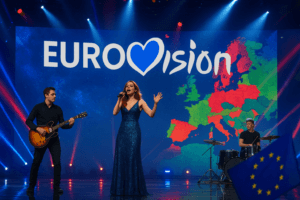
Eurovision’s Crossroads: How a Song Contest Became a Stage for Political Division
The European Broadcasting Union’s (EBU) meeting in Geneva was meant to secure the future of the Eurovision Song Contest. Instead, its decision to allow Israel to participate in the 2026 competition has sparked the largest political boycott in the event’s 70-year history, exposing a fundamental crisis about its identity and purpose.
As broadcasters from Ireland, Spain, the Netherlands, and Slovenia withdraw, and others voice their strong support for Israel’s inclusion, the contest’s cherished slogan “United by Music” is facing its most serious test.
The Unraveling: Why Four Nations Are Stepping Away
The decision by four European broadcasters to boycott the 2026 contest in Vienna is not a singular act of protest, but the culmination of months of escalating tension over Israel’s participation amid the war in Gaza. Each broadcaster cites a blend of ethical principles and procedural grievances.
| Country | Broadcaster | Key Reason for Boycott | Additional Context |
| Spain | RTVE | Gaza situation and Israel’s “use of the contest for political purposes” | A “Big Five” financial contributor; sought a secret ballot on Israel’s participation. |
| Ireland | RTÉ | “Appalling loss of lives in Gaza” and ongoing humanitarian crisis. | Holds the record for most wins (7) alongside Sweden. |
| Netherlands | AVROTROS | Participation is “incompatible with public values,” citing press freedom violations. | A founding member of the contest in 1956. |
| Slovenia | RTVSLO | Acted “on behalf of the 20,000 children who died in Gaza”. | Symbolic of the EU’s eastward enlargement. |
The immediate trigger was the EBU’s General Assembly on December 4, 2025. Several members had pushed for a secret ballot to decide Israel’s exclusion. However, the EBU presented a different path: a vote on a new package of voting safeguards. A “large majority” approved these rules and, in doing so, agreed that no separate vote on Israel’s participation was needed. This procedural maneuver effectively guaranteed Israel’s place in the 2026 contest, prompting the swift announcements of withdrawal.
The EBU’s Compromise: A Technical Fix for a Political Crisis
In November 2025, hoping to pre-empt the looming crisis, the EBU announced a significant voting system overhaul for the 2026 contest. These changes were a direct response to allegations that arose during the 2025 contest in Basel, where Israel’s entry finished second.
Critics accused the Israeli government of running a coordinated campaign to sway the public vote. The new rules aimed to restore “trust, transparency and neutrality” by targeting such perceived manipulation.
Key changes include:
- Halved Public Votes: The maximum number of votes per person was reduced from 20 to 10 to encourage support for multiple entries.
- Juries Return to Semi-Finals: Professional juries will help judge the semi-finals for the first time since 2022, creating a 50/50 balance with public votes.
- Stricter Promotion Rules: Clearer, stronger limits were placed on “disproportionate promotion campaigns” by third parties, including governments.
- Enhanced Technical Safeguards: Improved systems to detect and block fraudulent or coordinated voting activity.
For the EBU and its Director, Martin Green, these were “clear and decisive steps” to protect the contest’s fairness and keep the focus on music. For the boycotting nations, however, these technical adjustments were an inadequate response to a profound moral and political dilemma. They saw the rule changes as a way to avoid the core issue: whether a nation accused of severe human rights violations should be celebrated on a pan-European cultural stage.
A Continent Divided: The Geopolitical Fault Lines
The boycott has revealed stark divisions within Europe, with broadcasters and governments taking firm, opposing stands.
In Support of Israel’s Participation:
- Germany was among the most vocal, with its culture minister stating, “Israel belongs in the Eurovision Song Contest,” and threatening to withdraw if Israel was barred.
- The United Kingdom’s BBC expressed support for the EBU’s collective decision, framing it as a matter of inclusivity and rule enforcement.
- France, Austria, and the Nordic broadcasters (Norway, Sweden, Denmark, Finland, Iceland) also backed the EBU’s approach.
Still Deciding or Expressing Concern:
- Belgium and Iceland have stated they will decide on their participation in the coming days.
For Israel, the decision was a significant victory for its cultural diplomacy. President Isaac Herzog thanked those who “stood up for Israel’s right” to compete, framing participation as a victory over attempts to silence the country. Israeli broadcaster KAN warned that a cultural boycott starting with Israel could harm the contest itself.
A History of Discord: Eurovision’s Political Past
While the current crisis is unprecedented in scale, politics and Eurovision have intersected for decades. Understanding this history is key to seeing the current boycott not as an aberration, but as part of the contest’s fabric.
- The 1969 Tie and Aftermath: A four-way tie for first place in 1969 (involving Spain) led to a rules controversy that caused Finland, Portugal, Norway, and Sweden to boycott the 1970 contest.
- The Cyprus Conflict: Greece boycotted in 1975 and Turkey in 1976 following Turkey’s invasion of Cyprus in 1974.
- The Russia Precedent: The most recent and relevant precedent is Russia’s expulsion in 2022 following its full-scale invasion of Ukraine. The EBU stated that Russia’s inclusion could bring the contest “into disrepute”. This decision is central to the argument of boycotting countries, who question why the same standard is not being applied to Israel.
- Spain’s Ironic Position: History adds a layer of complexity to Spain’s current stance. In the 1960s, Spain itself was the target of boycott calls under Franco’s dictatorship. As one academic noted, Spain’s own use of Eurovision for political rehabilitation has made it “acutely aware of how pop culture can function as a soft power”.
An Uncertain Future for a 70-Year Legacy
The 2026 contest in Vienna, meant to be a grand celebration of Eurovision’s 70th anniversary, is now poised to be its most politically charged edition. The withdrawals will have tangible consequences:
- Financial and Cultural Impact: Losing Spain, a “Big Five” funder, and Ireland, a record-holding powerhouse, diminishes the contest’s financial base and competitive legacy.
- A Fractured “Family”: The sense of a unified European cultural community, however idealized, has been severely damaged. As Eurovision expert Paul Jordan noted, “It’s disunited through politics”.
- The Question of Return: The crisis may not be existential for Eurovision, which has weathered storms before. However, the ties severed will be difficult to repair. The boycotting countries’ return is not guaranteed and would likely require a significant shift in the political landscape or within the EBU itself.
The fundamental question laid bare is this: Can a cultural event that originates in a political institution (the EBU) and involves national broadcasters ever truly be apolitical? The EBU’s strategy has been to manage politics through technical rules and appeals to neutrality. The boycotting nations have rejected that approach, insisting that some political realities are too large to be managed and require taking a stand.
As Vienna prepares to host, the glittering spectacle will unfold under a long shadow. The music will play, but the silence from four national broadcasters will be a loud reminder that, for millions, some values outweigh the chance to sing for the crown.
You must be logged in to post a comment.