
Europe’s Strategic Pivot: Why India Has Become Brussels’ Most Essential Partner in 2026
In 2026, Europe and India are forging a deeper, more pragmatic partnership driven by shared concerns over US unpredictability, the fallout from the Iran war, and mutual interest in de-risking supply chains. A wave of high-level European visits to New Delhi—including Germany’s chancellor, EU chiefs, France’s president, and Finland’s president—reflects a shift away from lecturing toward “values-based realism.” Key developments include an EU-India free trade agreement expected by year-end, a revamped Trade and Technology Council focusing on advanced tech, major defense-industrial deals (Airbus assembly in India, Rafale Marine fighters), and growing alignment on energy security despite lingering differences over Russian oil. The relationship is moving from strategic rhetoric to tangible cooperation in semiconductors, defense, and infrastructure, positioning both sides as essential counterweights to an increasingly volatile global order.
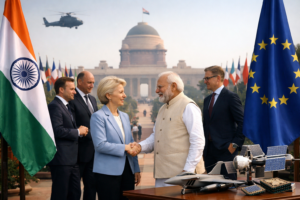
Europe’s Strategic Pivot: Why India Has Become Brussels’ Most Essential Partner in 2026
As Washington wavers and global crises multiply, European leaders are quietly rewriting the rules of engagement with New Delhi—and the stakes couldn’t be higher.
For years, the Europe-India relationship was a study in missed connections: a strategic partnership in name only, hampered by divergent priorities, interminable trade negotiations, and fundamental disagreements over Russia. Then something shifted.
If the 11th Raisina Dialogue, India’s premier foreign policy conference held annually in New Delhi, offered any single takeaway, it is this: Europe has finally stopped treating India as an afterthought. In its place is something that resembles genuine strategic courtship.
The numbers alone tell a compelling story. Five European heads of state or equivalent leaders have touched down in New Delhi since January: German Chancellor Friedrich Merz, European Commission President Ursula von der Leyen and Council President Antonio Costa (as Republic Day guests), French President Emmanuel Macron, Spanish Prime Minister Pedro Sanchez, and Finnish President Alexander Stubb. This doesn’t count the dozen ministers who descended on Delhi for India’s AI summit in February.
What makes this parade of European leadership remarkable isn’t just the frequency—it’s the shift in tone.
The End of European Lecturing
For those who have tracked this relationship over the past decade, the change is palpable. European delegates at Raisina have often found themselves on the defensive, their policies scrutinized from the main stage while Russian speakers received sympathetic audiences. The criticism cut both ways: European officials privately grumbled about India’s continued oil purchases from Russia; Indian policymakers bristled at what they perceived as European hypocrisy.
This year, the atmosphere was different. Finland’s Stubb delivered what many attendees described as a masterclass in diplomatic recalibration. His opening keynote introduced the concept of “values-based realism”—a phrase that managed to acknowledge European principles while demonstrating genuine understanding of India’s strategic constraints. His nod to strategic autonomy, confidence in India’s global role, and pointed critique of Europe’s propensity to lecture resonated deeply with the Indian audience.
Stubb’s approach mirrored what von der Leyen and Macron had articulated in their own visits: India is no longer being courted as a potential partner but recognized as an essential one—a “trusted” actor in increasingly turbulent times.
The De-risking Calculus
Behind the diplomatic pleasantries lies a harder-headed calculation. A senior Indian official, speaking in a private briefing at Raisina, offered a stark framing: while 2025 was a year of shock, 2026 would be defined by de-risking and diversification.
Europe’s place in this strategy is no accident. The Indian Ministry of External Affairs’ website, which tracks incoming visits, reads like a European itinerary. But the real story isn’t just about Europe’s courtship of India—it’s about the convergence of two powers simultaneously recalibrating their relationships with the United States.
Tensions between New Delhi and Washington, while easing after a year-long freeze, remain palpable. The long-delayed trade deal expected by the end of March offers some stability, but Deputy Secretary of State Christopher Landau’s Raisina comment—that Washington “is not going to make the same mistakes with India that [it] made with China twenty years ago”—sent a chill through the conference halls. It was a reminder that even as the trade deal moves forward, the underlying relationship requires constant management.
The recent sinking by a US submarine of an Iranian ship in the Indian Ocean—following a naval exercise hosted by India—underscored the fragility of the bilateral relationship. So did continued American statements on India’s Russian oil purchases. As one Indian policymaker put it in a conversation off the record: “The United States remains indispensable, but indispensable is not the same as reliable.”
The Iran War’s Unintended Consequences
If Washington’s volatility has pushed Europe and India together, the ongoing Iran war has welded the partnership. The conflict has exposed vulnerabilities on both sides: European leaders were neither warned of the US-Israeli strike nor consulted on coordinating responses afterward. For India, the stakes are existential. Safeguarding against energy costs and shipping risks, and ensuring the security of its 9 million-strong diaspora in the Middle East, have become pressing priorities.
Indian Foreign Minister S. Jaishankar’s presence at the EU foreign ministers’ council meeting in Brussels this week was scheduled in advance, ostensibly focused on implementing the EU-India summit agenda from earlier this year. But in practice, Iran and energy security dominated conversations. Jaishankar’s statement that “in a multipolar and uncertain world, the India-EU partnership will act as a factor of stability and resilience” carried weight precisely because it was delivered against a backdrop of transatlantic strain.
Beyond the Free Trade Agreement
The announcement of the EU-India Free Trade Agreement earlier this year surprised even longtime observers—many of whom had written off the possibility entirely. But the FTA, significant as it is, represents only the opening act.
EU officials tell me that legal scrubbing of the text should be completed by June, with the actual agreement likely signed before Diwali in November. The real challenge will follow: ratification by the European Parliament. There are reasons for optimism—this FTA excludes sensitive sectors like agriculture and enjoys member-state consensus, unlike the contentious Mercosur agreement—but party politics in Europe could still derail the timeline. Meanwhile, the Investment Protection Agreement continues to be negotiated with India’s Ministry of Finance, adding another layer of complexity.
What’s more interesting than the FTA itself is what comes after. Officials at Raisina described plans for what they called “TTC 2.0″—a reformed version of the chronically underperforming EU-India Trade and Technology Council. The new iteration will focus more intensively on advanced technologies: semiconductors, biotech, quantum. Perhaps more significantly, it will likely expand to include business and private sector stakeholders, moving beyond the government-to-government framework that has limited the TTC’s effectiveness.
Technology as the New Frontier
Technology has emerged as the connective tissue of the Europe-India relationship. During Stubb’s visit, trade, technology, and talent flows were identified as the three pillars of the Finland-India relationship—a framework that reflects deeper structural shifts. Following the ban on Huawei, Nokia equipment now powers much of India’s 5G infrastructure, a fact that hasn’t escaped European strategic planners.
France and India have declared 2026 the year of innovation, and Delhi is exploring a technology partnership format with Paris modeled on the iCET/TRUST framework it has with the United States. The challenge, as one Indian official noted, is that Europe struggles to identify the relevant actors, appropriate formats, and priority sectors for these partnerships. “India wants to elevate bilateral technology cooperation with European partners to the level of what it has with the US,” the official explained. “But Europe hasn’t figured out who to talk to or how to structure these conversations.”
France, as always, is ahead of its European peers. During Macron’s visit, Paris and New Delhi upgraded their already strong ties to a “Special Global Strategic Partnership”—language that reflects the “special and unique” nature of the relationship. The addition of an annual foreign-minister-level dialogue to the bilateral exchange architecture formalizes what has been true for years: France operates on a different plane in India than the rest of Europe. It’s worth remembering that France was the first Western country India signed a strategic partnership with back in 1998—a fact India’s Ambassador to Paris highlighted in Delhi in February, reminding everyone of the depth of that particular relationship.
Defense-industrial Breakthroughs
The defense sector offers perhaps the most concrete evidence of the relationship’s evolution. Macron’s visit saw the inauguration of Airbus’ H125 helicopter final assembly line plant in Karnataka—a project considered a watershed for India’s Make in India program. Unlike previous helicopter production in the country, which involved public-sector companies, this line marks a significant private-sector entry into aerospace manufacturing.
India also signed a contract to acquire 26 Dassault Aviation Rafale M carrier-based fighters, becoming the first international buyer for the type’s “Marine” variant. These are not symbolic purchases; they represent genuine industrial integration between Indian and European defense sectors.
More announcements are expected this year. Defense-industrial cooperation has become a priority for both sides, driven by shared concerns about supply chain security and the recognition that neither can rely exclusively on traditional suppliers.
The Russian Oil Question
No discussion of Europe-India relations is complete without addressing the elephant in the room: Russia. Moscow has been a persistent source of friction, with European officials expressing frustration over India’s continued energy purchases while India has pointedly noted Europe’s own selective application of sanctions.
The Iran war has complicated this dynamic. With the Strait of Hormuz effectively closed, India—dependent on imports for 80 percent of its energy needs—has returned to Russian oil as a practical necessity. The United States has “granted” India a 30-day waiver, a formulation that Indian officials find grating but accept as a temporary accommodation.
What’s notable is how European governments have responded. Rather than public criticism, there has been a tacit acknowledgment of India’s constraints. As one European diplomat put it to me in Delhi: “We understand the energy calculus. The question is whether India can use its relationship with Russia to influence behavior in ways we cannot.”
Whether that understanding survives pressure from Washington or a further escalation of the Ukraine war remains to be seen. But for now, Russia has ceased to be the relationship-killer it once was.
What Comes Next
The next six months will be decisive. The FTA’s legal scrubbing and eventual signing will test whether the political momentum can survive the technical scrutiny. The reformed TTC will reveal whether Europe can match its strategic rhetoric with institutional capacity. And the ongoing Iran war will demonstrate whether the Europe-India partnership can function as a genuine stabilizing force.
Perhaps most significantly, the relationship will face its first real test of durability. The current alignment between Europe and India has been driven largely by shared concern about American unpredictability. But what happens when the United States stabilizes? Will European governments revert to prioritizing transatlantic ties? Will India return to its traditional hedging strategy?
The answer may lie in the nature of the partnerships being built. Unlike previous attempts at engagement, current cooperation focuses on specific, tangible sectors: semiconductors, defense manufacturing, 5G infrastructure, energy security. These aren’t relationships of convenience; they’re relationships of dependency.
As one Indian policymaker noted in a conversation that stretched late into the Delhi night: “The US will always be important. But we’ve learned that putting all our eggs in one basket isn’t a strategy. Europe understands this because they’ve learned the same lesson.”
Whether that mutual understanding translates into lasting partnership is the question that will define the next chapter of Europe-India relations. For now, at least, Europe seems to have found its moment in the Delhi sun.
You must be logged in to post a comment.