
European Parliament’s Silence on West Bank Expansion: A Watershed Moment in the Palestinian Conflict
The European Parliament’s rejection of a debate on Israel’s expansion in the West Bank, blocked by a center-right and far-right coalition, coincided with a decisive Israeli security cabinet decision to repeal laws barring land sales to settlers, unseal ownership records, and—most significantly—extend its enforcement authority into areas officially under Palestinian civil control. This move, widely condemned by the EU, UK, and Arab states as a violation of international law and a step toward de facto annexation, effectively dismantles the Oslo Accords’ framework and follows the International Court of Justice’s 2024 ruling against the occupation. The international community’s strong verbal condemnations, juxtaposed with a lack of actionable political consequences like sanctions, alongside the European Parliament’s procedural inaction, highlights a profound diplomatic paralysis that risks cementing a one-state reality and closing the window for a negotiated two-state solution.
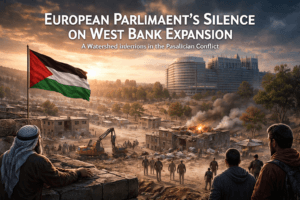
European Parliament’s Silence on West Bank Expansion: A Watershed Moment in the Palestinian Conflict
In a significant procedural move, the European Parliament has declined to debate Israel’s recent expansion of control in the occupied West Bank, a decision that has ignited controversy within its chambers. This political development coincides with a sweeping Israeli security cabinet decision that critics and legal experts argue represents a decisive step toward the de facto annexation of Palestinian territory. This confluence of events underscores a profound crisis in international diplomacy and the enforcement of international law.
The request for an urgent debate was put forward by the Left group in the European Parliament, which sharply criticized the institution for its inaction. “Once again, the Parliament decided to turn a blind eye to violence in Palestine,” the group stated. The motion was reportedly blocked by a coalition of center-right and far-right political groups. This decision occurred as lawmakers gathered in Strasbourg for a plenary session, shifting global attention away from a dramatic escalation on the ground.
The Israeli Security Cabinet’s Decision: A Three-Pronged Strategy
The parliamentary debate rejection directly responds to measures approved by Israel’s security cabinet on February 8, 2026. Analysts from the Israeli peace organization Peace Now describe these measures as a coordinated “series of decisions to take control of land and strip powers from the Palestinian Authority”. The strategy unfolds across three key fronts:
- Transforming Land Ownership: The cabinet repealed a long-standing Jordanian-era law that prohibited the sale of West Bank land to non-Arabs, effectively allowing Israeli settlers to purchase land directly from Palestinians. Simultaneously, it ordered the unsealing of classified land registry records and abolished a requirement for government-issued transaction permits, removing critical oversight designed to prevent fraud and forgery in a high-conflict environment.
- Expanding Administrative Control: Perhaps the most aggressive shift is the authorization for Israeli civil administration bodies to conduct enforcement operations—including demolitions—in Areas A and B. These areas, constituting roughly 40% of the West Bank, were designated under the 1995 Oslo II Accords to be under the civil and security control of the Palestinian Authority (PA). Israel will now exercise oversight in these zones under the broad pretexts of protecting antiquities, the environment, and water resources.
- Altering the Status of Holy Sites: The cabinet transferred authority over planning and building permits in Hebron’s sensitive settlement bloc, including the area around the Cave of the Patriarchs (Ibrahimi Mosque), from the Palestinian municipality to Israel’s Civil Administration. A similar move was made to place Rachel’s Tomb in Bethlehem under direct Israeli administration. These sites are sacred to Jews, Muslims, and Christians, making this shift highly inflammatory.
Israeli Finance Minister Bezalel Smotrich, a settler leader who championed the measures, framed their objective unequivocally: “We will continue to kill the idea of a Palestinian state”.
Breaching International Law and Agreements
These actions place Israel on a direct collision course with established international legal frameworks. The International Court of Justice (ICJ) declared in July 2024 that Israel’s occupation of Palestinian territory is illegal and called for its termination. A subsequent UN General Assembly resolution demanded Israel end its unlawful presence in the Occupied Palestinian Territory.
Furthermore, the new measures systematically dismantle the architecture of the Oslo Accords. By operating administratively in Areas A and B, Israel is unilaterally nullifying the interim agreements that granted the Palestinian Authority its limited self-governance in these zones. The transfer of authority in Hebron also violates the specific 1997 Hebron Protocol.
Peace Now warns that this is not merely about deepening control in Area C (already under full Israeli control) but represents “dangerous and irresponsible sovereignty measures also in Areas A and B”.
The Immediate Human Impact on the Ground
Legal decisions translated rapidly into concrete actions. Following the cabinet’s announcement, reports from the West Bank indicated an immediate surge in violence and intimidation:
- Settlers raided the Al-Rashaydeh Mosque east of Bethlehem, stealing contents and causing damage.
- An 80-year-old disabled Palestinian man was brutally beaten by settlers in Bani Naim.
- Demolition notices were distributed in Palestinian villages, with demolitions carried out in Bedouin communities in the Jordan Valley.
These incidents were characterized by observers as the “true translation” of the government’s decisions, interpreted by settlers as a “green light” for impunity. The moves also exacerbate a pre-existing crisis; the UN recorded that a record number of over 37,000 Palestinians were displaced in 2025 alone due to settlement expansion and violence.
A Global Backlash of Words, But Insufficient Action
The international response has been one of near-universal condemnation, yet it highlights a stark gap between diplomatic rhetoric and effective political pressure.
| Country/Entity | Stance on Israeli Measures | Key Statement |
| European Union | Condemned, called “step in wrong direction” | Considers measures a “clear violation” of international law; sanctions “still on the table”. |
| United Kingdom | Strongly condemned | “Any unilateral attempt to alter the geographic or demographic make-up of Palestine is wholly unacceptable”. |
| Arab & Muslim States | Condemned “in strongest terms” | Joint statement called it “accelerating attempts at its illegal annexation”. |
| United States | Opposed to annexation | A White House official reiterated Trump’s opposition, favoring a “stable West Bank”. |
| Australia | Objected | Stated the decision “will undermine stability and security”. |
Despite this chorus of disapproval, the European Parliament’s refusal to even debate the issue symbolizes a broader international paralysis. Former EU advisor James Moran argued that condemnations are no longer sufficient: “It is time for sanctions,” suggesting the EU should consider suspending parts of its trade agreement with Israel.
Conclusion: The Closing Window for a Two-State Solution
The events of February 2026 represent a potential point of no return. Israel’s government is implementing a detailed bureaucratic and legal strategy to cement single-state control over the entire West Bank, effectively rendering the Palestinian Authority powerless. The international community, while vocally opposed, appears unable or unwilling to mount a decisive response beyond statements.
The European Parliament’s choice to “turn a blind eye” through procedural rejection is a microcosm of this larger failure. As legal expert Dalal Iriqat noted, the world is witnessing “the institutional and legal annexation of the West Bank”. Without a swift and substantive shift from diplomatic condemnation to tangible consequences—such as the sanctions many are now calling for—the foundation for any future Palestinian state may be irreversibly dismantled, closing the last remaining window for a negotiated two-state solution and risking a further explosion of violence.
You must be logged in to post a comment.