
EU Trade Shift: How India Faces a Double Blow of Tariffs and Carbon Costs in 2026
The European Union’s suspension of Generalized Scheme of Preferences (GSP) benefits for India, effective January 2026, withdraws critical tariff concessions on about 87% of Indian exports by value—including key sectors like textiles, machinery, and chemicals—forcing them to pay higher standard EU duties and coinciding with the new costs of the EU’s Carbon Border Adjustment Mechanism (CBAM), which together create a significant “double burden” that undermines India’s price competitiveness against rivals like Bangladesh and Vietnam; while this move is a rules-based “graduation” triggered by India’s own export success, and occurs alongside optimistic negotiations for a broader Free Trade Agreement (FTA), Indian exporters face a challenging interim period of at least a year or more of higher trade barriers before any potential FTA relief materializes.
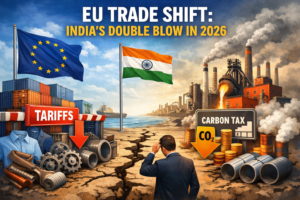
EU Trade Shift: How India Faces a Double Blow of Tariffs and Carbon Costs in 2026
A significant shift in Europe’s trade policy marks the start of 2026, creating immediate challenges for Indian exporters. The European Union has suspended critical tariff benefits for a vast majority of Indian goods, a move that coincides with the launch of its new carbon tax, placing Indian industries at a sudden competitive disadvantage.
This development is not a sudden punishment but the result of a rules-based “graduation” process within the EU’s Generalised Scheme of Preferences (GSP). The scheme is designed to support developing economies, but its benefits are withdrawn for specific product groups once a country’s exports in those categories cross a certain threshold for three consecutive years. India has now reached that point for most of its industrial exports.
The timing is particularly critical as it introduces a dual financial burden for Indian businesses: the return of regular import tariffs and the new costs of the EU’s Carbon Border Adjustment Mechanism (CBAM), all while the promise of a comprehensive Free Trade Agreement (FTA) remains on the horizon.
The Immediate Impact: What Changed on January 1, 2026?
As of the new year, preferential access to the EU market has been revoked for approximately 87% of the value of Indian exports to the bloc. This means products that once enjoyed a tariff reduction now face the EU’s standard “Most Favoured Nation” (MFN) rates.
- The Scale of the Shift: The affected sectors are the backbone of India’s industrial exports to Europe. They include minerals, chemicals, plastics, textiles and garments, iron and steel, machinery, electrical goods, and transport equipment. The Federation of Indian Export Organisations (FIEO) states this move eliminates an average tariff advantage of 20% that Indian products previously held.
- A Concrete Example: In the highly competitive apparel sector, a garment that attracted a 12% MFN tariff paid only 9.6% under the GSP. From January 2026, Indian exporters must pay the full 12%, directly squeezing their profit margins and making them less competitive against rivals from countries like Bangladesh and Vietnam, which retain duty-free access.
Only a narrow band of exports, primarily agricultural items, leather goods, and handicrafts—accounting for less than 13% of India’s exports to the EU—continue to receive GSP benefits.
Beyond Tariffs: The Added Layer of Carbon Costs
Compounding the tariff hike is the full implementation of the EU’s Carbon Border Adjustment Mechanism (CBAM), which also entered its definitive “tax phase” on January 1, 2026. This policy is a cornerstone of the European Green Deal, designed to price the carbon emissions embedded in imported goods like steel, aluminium, cement, and fertilisers.
For India, a major supplier of iron and steel to the EU, this presents a distinct challenge. The sector accounts for about 90% of India’s CBAM-covered exports to Europe. The mechanism requires EU importers to purchase certificates corresponding to the carbon emissions generated during the production of these goods in India. If the carbon price in India is lower than the EU’s, the cost difference becomes payable at the border.
- A Dual Burden for Key Sectors: Indian steel and aluminium exporters are thus hit twice: they lose their GSP tariff advantage and face new compliance costs and potential levies under CBAM. This “double hit” increases production costs and administrative complexity.
- An Equity Debate: India has raised concerns about CBAM’s fairness, arguing it places a disproportionate burden on developing nations. The mechanism imposes carbon costs without accounting for historical emissions or different levels of economic development, potentially channeling resources from developing to developed economies.
Sectors Hardest Hit by the EU’s 2026 Policy Changes
| Policy Change | Primary Sectors Impacted | Key Consequence for Indian Exporters |
| GSP Benefit Suspension | Textiles & Garments, Machinery, Electrical Goods, Plastics, Chemicals | Loss of ~20% average tariff advantage; must now pay full MFN rates. |
| Carbon Border Adjustment Mechanism (CBAM) | Iron & Steel, Aluminium, Cement, Fertilisers | New costs for embedded carbon emissions; increased compliance and reporting burdens. |
| Combined “Double Hit” | Iron & Steel, Aluminium | Face both higher tariffs and new carbon costs, severely pressuring competitiveness. |
The Strategic Landscape: FTA Hopes and Global Realignments
This tightening of trade terms occurs paradoxically alongside significant progress in India-EU relations. High-level visits and negotiations are underway, with leaders from both sides expressing optimism about concluding the long-pending **”mother of all deals”**—a comprehensive Free Trade Agreement.
However, experts caution that even if an FTA is announced imminently, its ratification and implementation will take at least a year or more. This leaves Indian exporters navigating a difficult interim period of higher costs without the relief the FTA is intended to provide.
Furthermore, the EU deal is seen as a crucial, but partial, strategic response to broader global tensions. With the United States—India’s largest export market—having imposed significant tariffs, the EU agreement provides an “alternative anchor in the West.” Yet, the numbers reveal a gap: India’s trade surplus with the U.S. was $45.8 billion in 2024, nearly double its $25.8 billion surplus with the EU. An EU FTA is therefore a vital shock absorber, but not a complete substitute for stable trade relations with the U.S..
Navigating the New Reality: Paths Forward for India
Faced with this dual challenge, Indian policymakers and industry are exploring several adaptation and response strategies:
- Accelerating Domestic Carbon Pricing: One of the most effective ways to mitigate CBAM costs is for Indian industries to have their domestic carbon prices recognised by the EU. Experts recommend advancing India’s own Carbon Credit Trading Scheme (CCTS). This would incentivise domestic decarbonisation and potentially reduce the financial burden at the EU border.
- Strategic Sectoral Adaptation: Industries must invest in cleaner production technologies. This includes shifting to renewable energy, improving energy efficiency, and exploring green hydrogen. Larger firms may lead this transition, but targeted policy support is crucial for MSMEs to adapt.
- Leveraging Other Trade Agreements: To diversify risk, India is actively strengthening ties with other partners. Recent and ongoing deals with the UK, UAE, Oman, and New Zealand are part of a strategy to build resilient trade networks less dependent on any single market.
- Negotiating for Equity in Green Trade: In ongoing FTA talks, India is pressing for the EU to acknowledge its domestic climate policies and consider equity principles in environmental measures like CBAM. The goal is to ensure the green transition is fair and does not unfairly penalise developing economies.
The EU’s suspension of GSP benefits is a clear signal that India’s export success has moved it into a new category within the global trading system. The era of unilateral preferences is giving way to a more complex era of reciprocal agreements and green conditionality. While the imminent India-EU FTA holds the promise of a more stable and ambitious partnership, the journey there in 2026 will test the resilience and adaptability of Indian exporters like never before. Their ability to navigate this period of higher tariffs and carbon costs will not only determine short-term market share but also shape India’s long-term role in a global economy increasingly defined by both trade and climate imperatives.
You must be logged in to post a comment.