
Escalation in the Levant: Decoding Israel’s Renewed Strikes in Lebanon and a Region on Edge
Escalation in the Levant: Decoding Israel’s Renewed Strikes in Lebanon and a Region on Edge
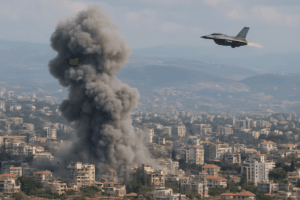
In the early hours of December 8, 2025, Israeli warplanes struck several targets across southern Lebanon. The Israel Defense Forces (IDF) stated the operations hit Hezbollah infrastructure, including a training compound for the group’s elite Radwan Force, which it accused of preparing attacks against Israel. This latest flare-up is not an isolated event but a continuation of a tense, violent pattern that has gripped the Israel-Lebanon border for over two years, threatening to unravel a fragile ceasefire and plunge the region into a broader war.
The Immediate Catalyst and Strategic Context
The late 2025 strikes fit into a deliberate campaign. Following a US-brokered ceasefire in November 2024 that ended a year of intense conflict, Israeli forces have maintained consistent military pressure. According to one Israeli security research center, Israel carried out 600 strikes in Lebanon between that ceasefire and late 2025, nearly half concentrated just south of the Litani River—an area where Hezbollah agreed to withdraw under the truce.
Israel justifies these actions as preemptive and necessary. Military officials argue they target Hezbollah’s efforts to rebuild military capabilities, including weapons smuggling, tunnel reconstruction, and the recruitment of operatives, which they claim violate the ceasefire terms. A core, tangible objective is to prevent a repeat of the cross-border infiltrations that characterized the 2024 war by disrupting the Radwan Force’s plans.
The following table contrasts the operational tempo before and after the 2024 ceasefire with the strategic context of the recent strikes:
| Aspect | Period (Oct 2023 – Nov 2024) | Period (Post-Ceasefire, into late 2025) | Strategic Context for Dec 2025 Strikes |
| Reported Attacks | Over 13,600 cross-border attacks exchanged. | Hundreds of Israeli strikes post-truce. | Part of a sustained campaign to enforce ceasefire terms. |
| Primary Israeli Goal | Degrade Hezbollah capabilities, push fighters from border. | Prevent military reconstitution, uphold security zone. | Target specific reconstruction efforts (e.g., training compounds). |
| Key Violation/Issue | Full-scale war, displacing over 1 million Lebanese. | Alleged Hezbollah rearmament; Israeli occupation of hilltops. | Focus on Hezbollah’s “terror infrastructure” and training activities. |
| Humanitarian Impact | ~4,000 Lebanese and 120 Israelis killed. | Continued civilian casualties, widespread displacement. | Reinforces a de facto buffer zone, hindering return. |
Lebanon’s Institutional Crisis: A State Unable to Act
A critical backdrop to this conflict is the profound weakness of the Lebanese state. For years, Lebanon has grappled with economic collapse, political paralysis, and the erosion of state authority. This vacuum has been filled by Hezbollah, which operates as a state-within-a-state, maintaining a formidable military wing independent of the Lebanese Armed Forces (LAF).
The state’s focus has often been misdirected. Analysts argue that by framing Syrian refugees as the primary security threat, the government has diverted its security apparatus inward toward policing vulnerable populations instead of strengthening national defense. This has left the country exposed when confronting external threats like Israeli incursions.
Consequently, the LAF finds itself in a nearly impossible position. It lacks the political mandate and military capacity to forcibly disarm Hezbollah—a move President Joseph Aoun has warned could trigger a civil war. While the army has begun deploying south of the Litani River as per the ceasefire, it has often been reluctant to inspect private properties for weapons, wary of being seen as doing Israel’s bidding or sparking internal conflict. This institutional incapacity is a root cause of the cycle of violation and response.
The Human and Physical Toll on Southern Lebanon
The cost of this ongoing conflict is etched into the landscape and lives of southern Lebanon. Entire villages like Aita al-Shaab, Kfar Kila, and Yaroun bear the scars of destruction. Amnesty International documents a trail of deliberate destruction by Israeli forces using bulldozers and explosives, damaging or destroying over 10,000 structures in some border municipalities between late 2024 and early 2025.
For residents, the conflict is a relentless ordeal. The constant hum of Israeli drones, the fear of sudden airstrikes—like the one that hit a car in the village of Froun—and the psychological strain of displacement define daily life. “We’ve got every reason to be afraid,” one resident of the border village of Yaroun told the BBC. “There’s no-one here. You’ll leave in a bit, and we’ll be left alone”.
Publicly, Hezbollah’s narrative of resistance remains, with banners of “martyrs” hanging in its strongholds. Privately, a shift may be emerging. Exhaustion is palpable. In Beit Lif, after an Israeli warning of imminent attack, one local told reporters that Hezbollah needs to “either respond to Israel or accept defeat, disarms and let us move on with our lives. This can’t continue”.
The Iranian Nexus: Hezbollah as a Strategic Proxy
To fully understand the dynamics, one must look to Tehran. The Iran-Hezbollah relationship is a cornerstone of Middle Eastern geopolitics. Iran provides Hezbollah with an estimated $700 million annually, along with training and weapons, transforming it from a local militia into a regional powerhouse with an arsenal of over 100,000 rockets.
This is not merely a transactional alliance but an ideological partnership. Hezbollah’s founding manifesto pledged allegiance to Iran’s revolutionary leader, and the group is a key pillar in Iran’s “Axis of Resistance,” designed to project power and pressure adversaries like Israel and the United States while allowing Iran to avoid direct confrontation.
However, the relationship is nuanced. Experts describe Iran’s command style as a blend of authoritative, delegative, and cooperative control. While Tehran may direct Hezbollah’s involvement in regional conflicts like Syria, it grants the group significant autonomy in Lebanese domestic politics and in deciding the scope of its engagements with Israel. This autonomy means Hezbollah’s calculations—balancing its role as Iran’s proxy with its identity as a Lebanese actor—directly influence the risk of escalation.
Regional Implications and the Path Ahead
The situation remains a tinderbox. Hezbollah has warned that “everything has a limit”, while Israeli officials have signaled readiness for further escalation. The conflict risks drawing in Iran and its wider network of proxies, a prospect Iranian officials have acknowledged even as they express a preference to avoid all-out war.
International diplomacy is strained. The United States supports Israel’s right to defend itself while pushing for diplomatic solutions. However, as noted by Western diplomats, there is growing frustration with the “Lebanese way” of slow-rolling Hezbollah’s disarmament.
A sustainable path forward appears distant. It would require a reinforcement of Lebanese state sovereignty in the south, credible international monitoring, and a political settlement that addresses Israeli security concerns without perpetuating Lebanon’s collapse. Without these, the cyclical logic of strike and counter-strike, violation and retaliation, threatens to continue—a grim stalemate where civilians on both sides of the border remain the primary casualties, waiting for a peace that remains elusive.
You must be logged in to post a comment.